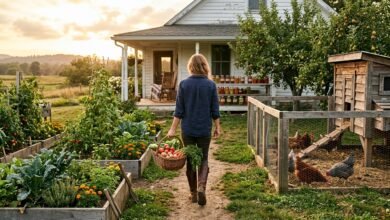

You don’t need a hundred acres to live a more self-sufficient life. Homesteading on one acre is enough to grow most of your vegetables, keep a small flock of laying hens, plant fruit trees, raise meat rabbits or a couple of dwarf goats, and catch your own rainwater, all while still having space for the house, driveway and a bit of lawn. The key is planning. This guide shows how to lay out a one-acre homestead, what you can realistically produce, and how to build it up step by step without burning out.
How Big Is One Acre?
One acre is 43,560 square feet (about 4,047 m²), roughly 208 × 208 feet, or about three-quarters of an American football field. After the house, driveway, sheds and paths, most one-acre homesteads have around half to three-quarters of an acre left for food production. That’s a lot of growing space if you use it well.
What Can You Realistically Produce on One Acre?
With good planning and a few years of soil building, a one-acre homestead can typically provide:
- Most of a family’s vegetables in season, plus extra for canning, freezing and storage
- Eggs year-round from 6–12 hens
- Fruit from 10–20 dwarf or semi-dwarf trees, plus berries
- Meat from rabbits, meat chickens, or ducks
- Milk from a pair of dwarf dairy goats (where zoning allows)
- Honey from 1–3 beehives
- Herbs, compost, firewood kindling and rainwater
What one acre usually can’t do is grow all your grain, or feed large livestock like cattle or horses without buying in most of their hay and feed.
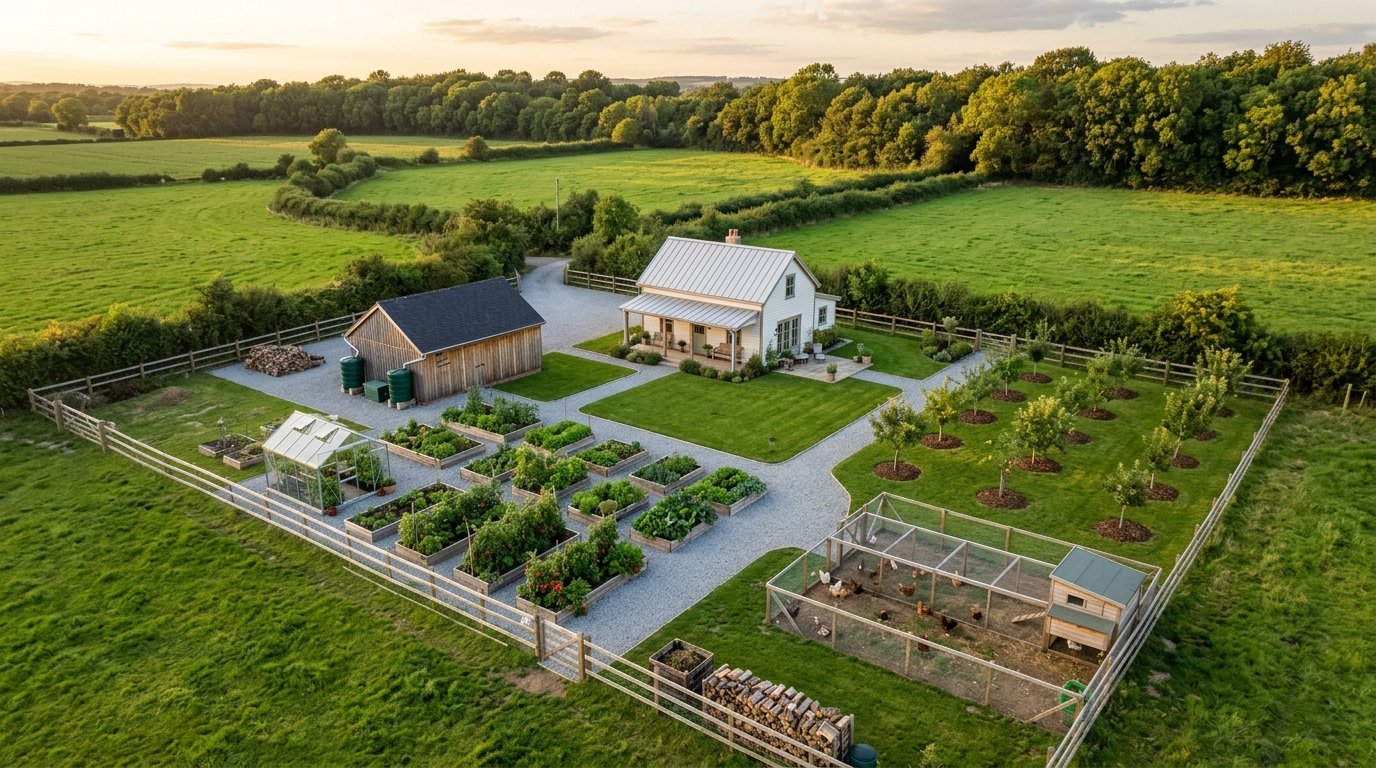
Sample One-Acre Homestead Layout
Here’s a practical allocation you can adapt to your own land:
| Zone | Approx. area | What goes there |
|---|---|---|
| House, driveway, yard | ~10,000 sq ft (0.23 ac) | Home, parking, small lawn, patio |
| Kitchen garden | ~5,000 sq ft (0.11 ac) | Raised beds or rows: vegetables, herbs, salad |
| Main crop garden | ~5,000 sq ft (0.11 ac) | Potatoes, squash, corn, beans, onions for storage |
| Orchard and berries | ~8,000 sq ft (0.18 ac) | Dwarf/semi-dwarf fruit trees, berry bushes, beehives |
| Livestock area | ~8,000 sq ft (0.18 ac) | Chicken coop and run, rabbit hutches or goat shelter and paddock |
| Work zone | ~2,500 sq ft (0.06 ac) | Compost bays, tool shed, greenhouse, water tanks |
| Paths and buffer | ~5,000 sq ft (0.11 ac) | Access paths, windbreak hedging, wildlife strip |
Use Permaculture Zones
Place things by how often you visit them:
- Zone 1 (closest to the house): herbs, salad greens, kitchen garden, compost. You visit these daily.
- Zone 2: chickens, main vegetable beds, greenhouse. Daily or near-daily.
- Zone 3: orchard, main crops, goats or larger animals, bees. A few times a week.
- Zone 4: windbreaks, woodlot or wild area. Occasional visits.
This one principle saves hours every week. Chickens next to the garden means scraps go one way and manure goes the other.
The Garden: Your Homestead’s Engine
The vegetable garden produces the most food per square foot. Focus on:
- High-value crops you eat often: tomatoes, peppers, salad greens, herbs, beans, zucchini.
- Storage crops: potatoes, winter squash, onions, garlic, carrots and dry beans carry you through winter. Start with our complete guide to growing potatoes.
- Succession planting: sow small amounts every 2–3 weeks so you’re not buried in one crop.
- Season extension: a greenhouse, polytunnel or low tunnels can add months to your growing season.
Most new homesteads have tired or compacted soil. Your first priority is building it up. See our guide to improving clay soil with compost.
Best Animals for a One-Acre Homestead
| Animal | Space needed | What you get | Beginner friendly? |
|---|---|---|---|
| Laying hens | Small coop + run | Eggs, manure, pest control | Yes, best first animal |
| Meat rabbits | Hutches or colony pen | Lean meat, excellent manure | Yes |
| Ducks | Coop + run + water | Eggs, slug control | Yes (messy) |
| Honeybees | A few square feet per hive | Honey, wax, pollination | Moderate (learn first) |
| Dwarf goats (e.g., Nigerian Dwarf) | Shelter + ~¼ acre paddock for 2–3 | Milk, brush clearing | Moderate |
| Pigs (1–2 feeders) | Pen or rotated paddock | Pork, land clearing | Moderate, seasonal |
Chickens are the natural starting point. Our beginner’s guide to raising chickens covers costs, breeds and coop setup. Always check zoning before getting goats, pigs or roosters; many residential and semi-rural areas restrict them.
Water: Plan It From Day One
Water is often the limiting factor on a small homestead. Rainwater harvesting is one of the best investments you can make:
- Each inch of rain on 1,000 sq ft of roof gives you about 620 US gallons (around 2,350 liters).
- Connect gutters on the house, barn and sheds to IBC totes or tanks.
- Use drip irrigation and mulch in the garden. Together they can cut garden water use dramatically compared with sprinklers.
- Check local rules; a few areas restrict rainwater collection.
Build It in Phases (Don’t Do Everything in Year One)
Burnout is the number one reason homesteads fail. A realistic timeline:
- Year 1: Observe your land (sun, water flow, wind), start compost, build a kitchen garden, get laying hens, plant fruit trees (they take years to produce, so plant early).
- Year 2: Expand the garden, add storage crops, install rainwater collection, start food preservation (canning, dehydrating, freezing).
- Year 3: Add a second livestock species (rabbits, bees or goats), put up a greenhouse, start selling surplus eggs or produce.
- Year 4+: Refine systems, add perennials (asparagus, rhubarb, berries), and look at small income streams.
Can a One-Acre Homestead Make Money?
Yes, on a small scale. Common income streams include eggs, cut flowers, microgreens, seedlings, honey, goat milk soap, rabbits and farm-stand produce. Most one-acre homesteads aim to offset costs rather than replace a full income. For ideas, see our breakdown of the most profitable farm animals for small farms.
Essential Equipment for One Acre
You don’t need a big tractor for one acre. A quality wheelbarrow, broadfork, hoes, a walk-behind tiller or a sub-compact tractor, a good mower, and fencing tools will cover most jobs. If you’re weighing up a tractor, read our small farm tractor buying guide.
FAQ: Homesteading on an Acre
Is one acre enough to be self-sufficient?
One acre can supply most of a family’s vegetables, eggs, fruit and some meat. Full self-sufficiency, including grain and all animal feed, usually needs more land.
How many chickens can I keep on one acre?
Space-wise, an acre can easily hold dozens of chickens. In practice, local zoning limits and how many eggs you can use or sell usually decide the number.
Can I keep goats on one acre?
Two or three dwarf goats can do well on a well-fenced portion of an acre if you supplement with hay. Goats need a companion, so never keep just one.
What should I do first on a new homestead?
Start a compost system, plant fruit trees, and set up a small kitchen garden near the house. Then add chickens.
Homesteading on an acre is about working with what you have, starting small, and building steadily. Get the soil, water and layout right, and every year will be more productive than the last.