
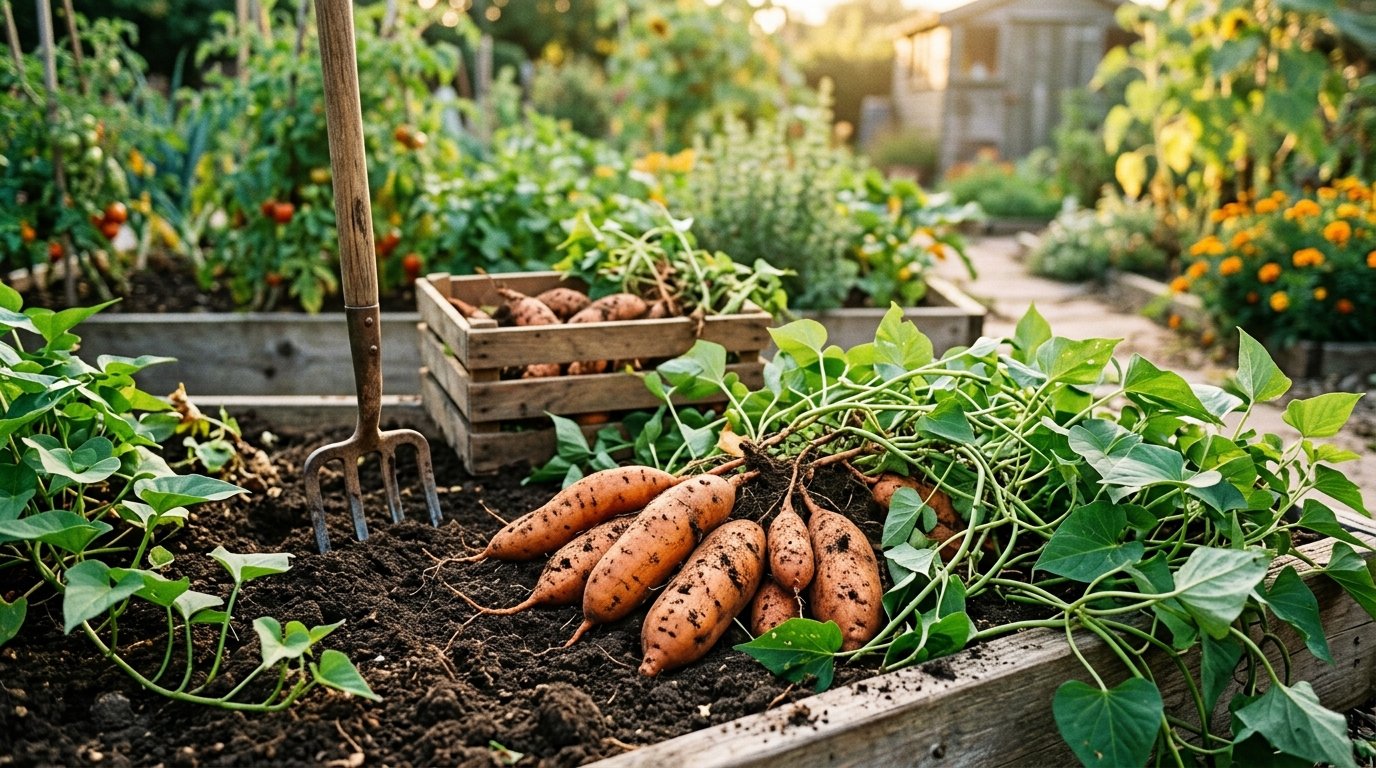

Sweet potatoes are one of the most productive and forgiving crops you can grow in warm weather. They shrug off heat, need little fertilizer, and a handful of plants can fill a basket with sweet, nutrient-rich roots that store for months. Unlike regular potatoes, they aren’t grown from seed tubers. They’re grown from rooted shoots called slips. This guide covers how to grow sweet potatoes from start to finish: making or buying slips, planting, care, harvesting and the curing step most beginners miss.
Quick Facts: Growing Sweet Potatoes
| Grown from | Slips (rooted sprouts), not seeds or seed potatoes |
| Planting time | 2–4 weeks after your last frost, when soil is at least 65°F (18°C) |
| Days to harvest | About 90–120 days, depending on variety |
| Sun | Full sun, 6–8+ hours |
| Soil | Loose, well-drained, sandy or loamy; pH about 5.5–6.5 |
| Spacing | 12–18 in (30–45 cm) apart, rows 3–4 ft (90–120 cm) apart |
| Water | About 1 in (2.5 cm) per week; less in the final 3–4 weeks |
Sweet Potatoes vs Regular Potatoes
Despite the name, sweet potatoes (Ipomoea batatas) are in the morning glory family, not related to regular potatoes. That’s why they grow so differently:
- They love heat and are killed by frost. Regular potatoes prefer cool weather.
- They grow from slips instead of seed potatoes.
- Their vines spread widely across the ground.
- The leaves are edible (cooked like spinach), while regular potato leaves are toxic.
For cool-season spuds, see our guide on how to grow potatoes.
Best Sweet Potato Varieties
| Variety | Days (approx.) | Notes |
|---|---|---|
| Beauregard | 90–100 | The most popular all-rounder: orange flesh, high yields, reliable |
| Georgia Jet | 80–90 | Fast maturing, a good choice for shorter summers |
| Covington | 100–120 | Uniform roots, stores very well |
| Vardaman | 100–110 | Compact, bush-type vines, good for small gardens |
| O’Henry / White types | 90–110 | Cream flesh, drier and less sweet |
| Purple varieties | 100–120 | Striking purple flesh, rich in antioxidants |
Short-season or cool climates (northern US, Canada, the UK, southern Australia): choose fast varieties like Georgia Jet or Beauregard, and use black plastic mulch, a polytunnel or a greenhouse to add warmth.
How to Grow Sweet Potato Slips
You can buy certified disease-free slips from nurseries and seed companies, which is the most reliable option, or grow your own about 6–8 weeks before planting.
Method 1: Water Jar
- Choose an organic sweet potato (conventional ones may be treated to stop sprouting).
- Push 3–4 toothpicks around the middle and suspend it in a jar with the bottom third in water.
- Place in a warm, bright spot (75–80°F / 24–27°C is ideal). Change the water every few days.
- Within 2–4 weeks, leafy shoots appear. When they’re 6–8 in (15–20 cm) long, twist them off.
- Put the shoots in water until roots form (about a week). They’re now slips ready to plant.
Method 2: Soil Bed (Faster, More Slips)
Lay whole sweet potatoes on their side in a tray of moist potting mix, cover halfway, and keep warm. Pull or cut slips when they’re 6–10 in long with a few leaves. Slips cut above the soil line carry fewer soil-borne diseases.
Preparing the Soil
Sweet potatoes want loose soil so roots can swell easily. In heavy ground, you get small, twisted roots.
- Loosen the soil 10–12 in (25–30 cm) deep.
- Build raised ridges or mounds about 8–12 in (20–30 cm) high. They warm faster and drain better.
- Add well-rotted compost, but go light on nitrogen. Too much nitrogen means huge vines and few roots.
- If you have heavy soil, improve it first with our guide on compost for clay soil, or grow in raised beds or large containers.
- Cover ridges with black plastic 1–2 weeks before planting to warm the soil in cooler regions.
How to Plant Sweet Potato Slips
- Wait until soil is at least 65°F (18°C) and nights stay above 55°F (13°C).
- Plant slips 12–18 in (30–45 cm) apart along the ridge, burying them up to the top leaves, about 3–4 in (8–10 cm) deep.
- Water thoroughly after planting.
- Keep the soil evenly moist for the first 1–2 weeks while slips establish. Wilting on day one is normal; they usually perk up within a few days.
Caring for Sweet Potatoes
- Weeding: keep beds weed-free for the first month. After that, the vines shade out most weeds.
- Watering: about 1 in (2.5 cm) per week. Reduce watering in the last 3–4 weeks before harvest to prevent splitting.
- Don’t prune the vines heavily; leaves feed the roots. You can pinch a few tips for cooking greens.
- Lift runners occasionally if they root along the stems, so energy stays in the main roots.
- Fertilizer: usually unnecessary in decent soil. If needed, use a low-nitrogen, higher-potassium feed.
Common Problems
| Problem | Cause | Fix |
|---|---|---|
| Lots of vines, tiny roots | Too much nitrogen, heavy soil, too little heat | Cut nitrogen, loosen soil, use black plastic |
| Cracked roots | Irregular watering, especially late | Water evenly, reduce near harvest |
| Holes and tunnels | Wireworms, sweet potato weevil | Rotate crops, use clean slips, harvest promptly |
| Leaves eaten overnight | Deer and rabbits love the foliage | Fencing or row cover |
| Long, stringy roots | Compacted soil | Build loose ridges or raised beds |
When and How to Harvest Sweet Potatoes
Harvest when the variety reaches maturity (usually 90–120 days) and before the first frost. Cold soil below about 50°F (10°C) can damage roots, and frost-blackened vines can cause rot, so dig promptly if frost is forecast.
- Dig a test plant first to check size.
- Cut back vines, then dig carefully with a garden fork, starting 12–18 in away from the crown. Sweet potato skins are thin and bruise easily.
- Lift the roots gently and let them dry on the soil surface for a few hours if the weather is dry.
- Don’t wash them.
Curing: The Secret to Sweet Flavor
Freshly dug sweet potatoes aren’t very sweet. Curing heals skin damage and converts starches to sugars.
- Cure for 7–10 days at about 80–85°F (27–29°C) with high humidity (85–90%). A warm room with a humidifier, or a closed box with a damp towel in a warm spot, works well.
- Then rest them for 3–6 weeks in storage before eating for the best flavor.
- Store at 55–60°F (13–16°C) in a dark, ventilated place. Never refrigerate raw sweet potatoes; cold causes hard centers and off flavors.
Properly cured, sweet potatoes can store for 6 months or more.
Growing Sweet Potatoes in Containers
Use a large grow bag or pot, at least 15–20 gallons (60–75 liters), filled with loose potting mix and compost. Plant 2–3 slips per container, keep it in the warmest, sunniest spot you have, and water consistently. Containers warm up faster than the ground, which makes them a great option in cooler climates.
FAQ: How to Grow Sweet Potatoes
How long does it take to grow sweet potatoes?
Most varieties take 90–120 days from planting slips to harvest.
Can I grow sweet potatoes from a store-bought sweet potato?
Yes, especially organic ones. But certified slips from a nursery are disease-free and more reliable.
How many sweet potatoes does one plant produce?
In good conditions, a plant commonly yields several roots, often 2–5 lb (1–2 kg) per plant.
Can sweet potatoes grow in cold climates?
Yes, with fast varieties, warm raised beds, black plastic mulch, or a polytunnel or greenhouse.
Are sweet potato leaves edible?
Yes. Young leaves and tips can be cooked like spinach.
Building a bigger food garden? See how sweet potatoes fit into a full plan in our guide to homesteading on an acre.