

Last updated: October 2026
This guide contains affiliate links. As an Amazon Associate, FarmingAround earns from qualifying purchases, at no extra cost to you.
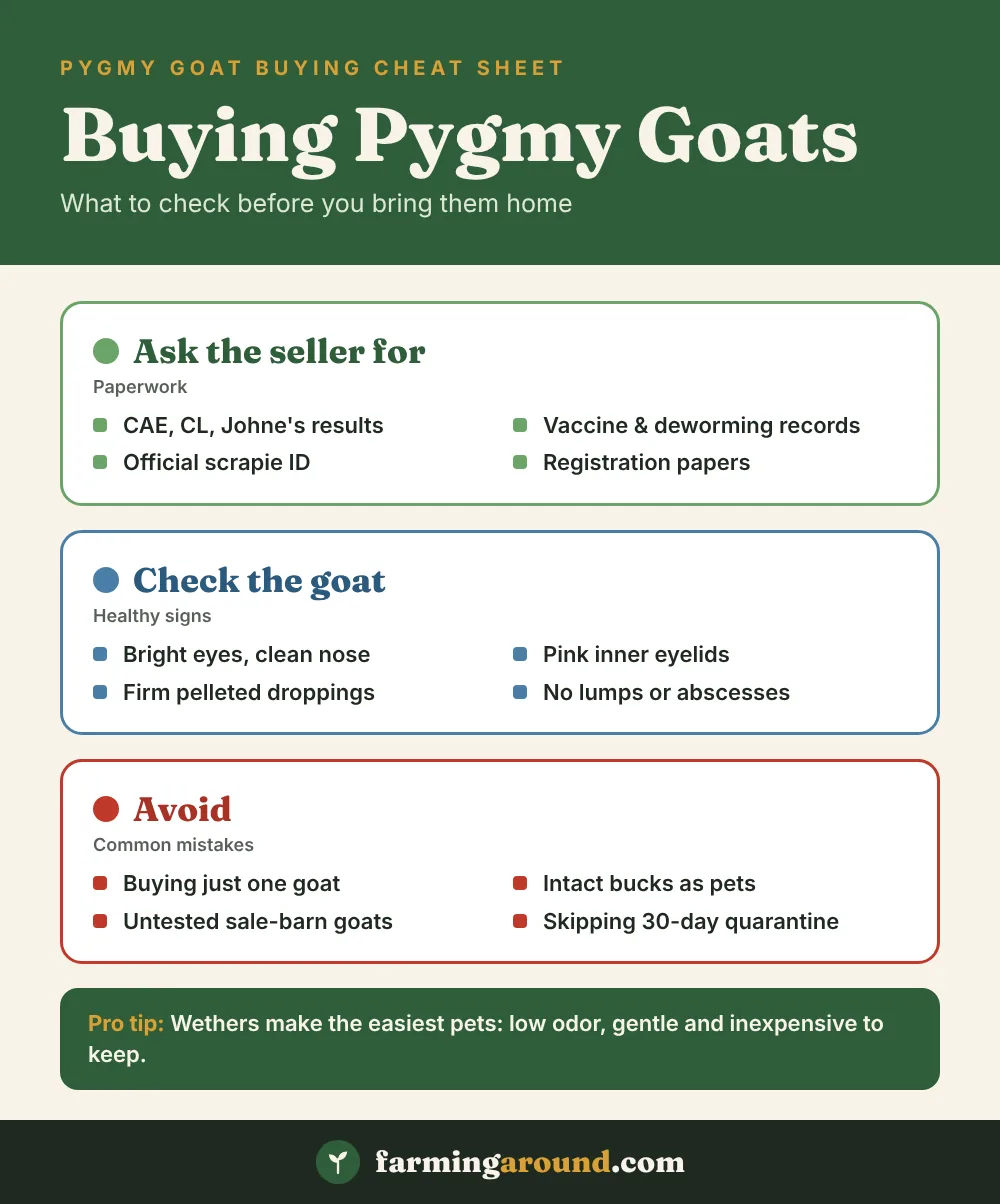
If you’re looking at pygmy goats for sale, buy at least two from a breeder who can show you negative tests for CAE, CL and Johne’s disease, official scrapie ID and, ideally, registration papers. Pygmies are small (16–23 in / 41–58 cm tall), stocky, friendly goats that live 10–15 years, so you’re making a long commitment. Wethers (castrated males) are the easiest pets; choose does if you want kids.
This buying guide covers the Pygmy breed profile, how to tell a Pygmy from a Nigerian Dwarf, where to buy, what to check before you hand over money, and the care your new goats will need once they’re home.
Key takeaways
- Never buy just one: goats are herd animals and a lone Pygmy will be stressed and noisy.
- Ask for test results: CAE, CL and Johne’s have no cure, so start with a clean herd.
- Wethers make the best pets: intact bucks smell strongly and can get pushy in rut.
- Quarantine new arrivals for about 30 days before mixing them with other goats.
In this guide
Pygmy Goat Quick Facts
| Trait | Pygmy goat |
|---|---|
| Type | Miniature goat kept mainly as a pet, for brush clearing and small-scale meat |
| Height | About 16–23 in (41–58 cm); NPGA does 16–22⅜ in (41–57 cm) |
| Weight | Does about 53–75 lb (24–34 kg); bucks about 60–86 lb (27–39 kg) |
| Build | Short legs, deep wide barrel, compact and well muscled |
| Colors (NPGA) | Caramel with markings, agouti (gray, brown or black), black |
| Lifespan | Generally 10–15 years |
| Breeding | Year-round; 1–4 kids, twins common |
| Temperament | Friendly, playful, alert |
| Registries | National Pygmy Goat Association (NPGA), American Goat Society (AGS) |
History of the Breed
Like the Nigerian Dwarf, the Pygmy goat descends from the West African Dwarf goats of West and Central Africa, where small, hardy goats have long been kept for meat, milk and skins. European zoos exhibited these goats in the 19th and early 20th centuries, and between about the 1930s and 1960s small goats of this type were shipped to the United States for zoos and research.
Some ended up with private breeders. By the 1970s, American breeders had sorted them into two types: a fine-boned dairy type that became the Nigerian Dwarf, and a broad, compact type that became the American Pygmy. A breed society and herdbook for Pygmies followed in the mid-1970s, and the National Pygmy Goat Association still maintains the US breed standard.
Size, Colors and Appearance
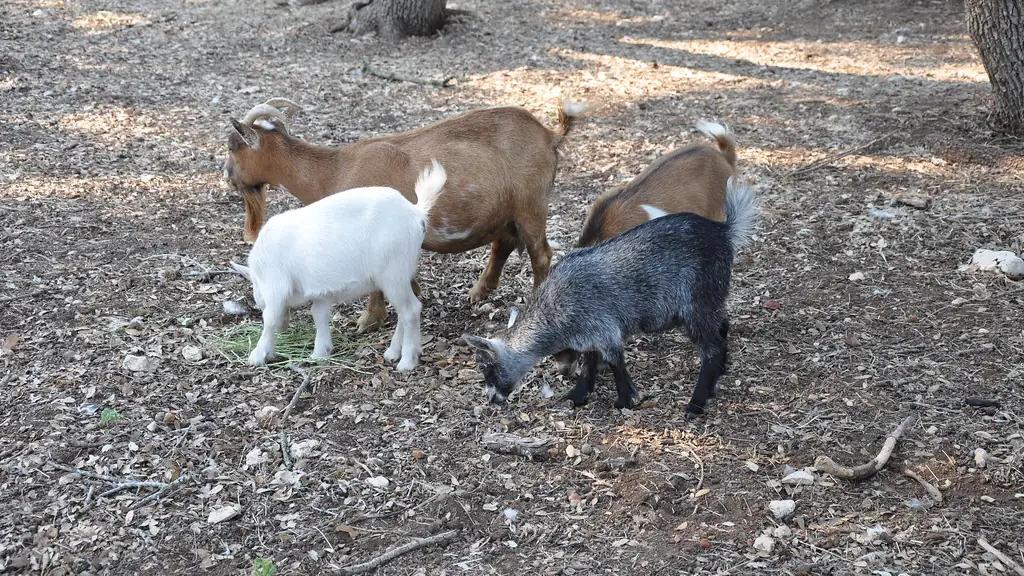
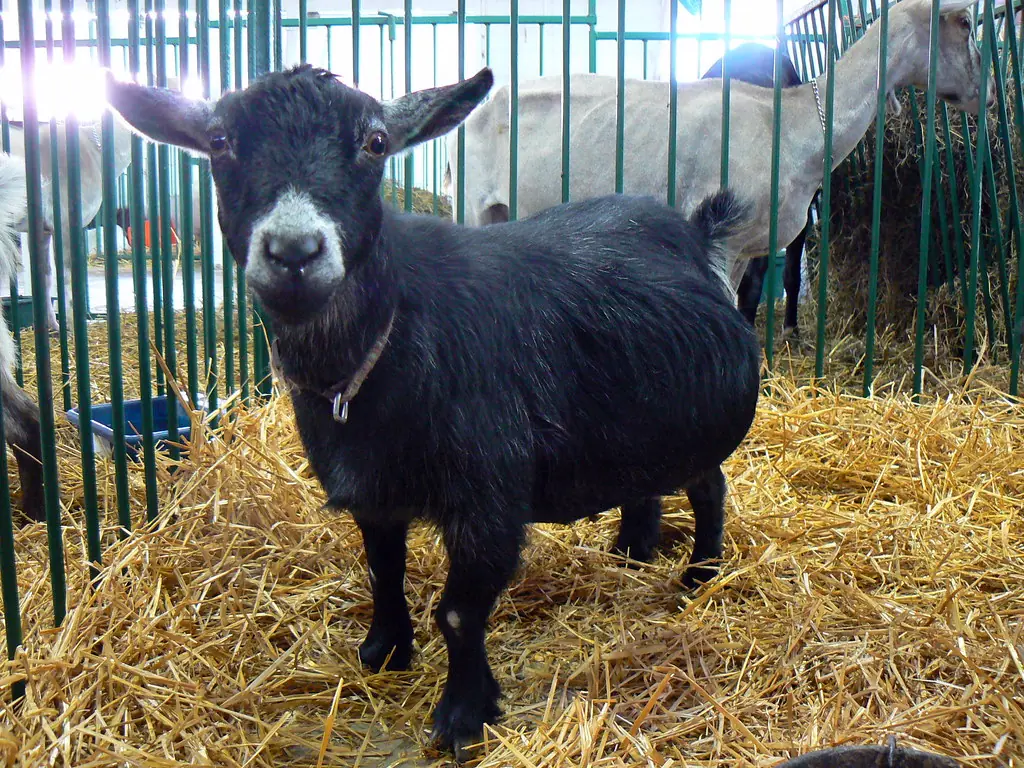
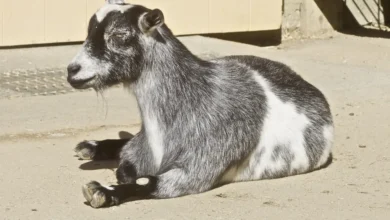
Pygmies are “cobby”: short-legged, deep-bodied and well muscled, with a short head, a slightly dished face and upright ears. Bucks grow a long, flowing beard and mane; does have a sparse beard or none. Both sexes are naturally horned, though many breeders disbud kids.
- Height: the NPGA standard calls for does over 12 months to measure 16–22⅜ in (41–57 cm) at the withers. Bucks and wethers can be a little taller, up to around 23 in (58 cm).
- Weight: does about 53–75 lb (24–34 kg), bucks about 60–86 lb (27–39 kg).
- Colors: the NPGA recognizes caramel (with black or brown markings), agouti (black, gray or brown, often with a frosted muzzle and darker legs), and black (with or without white markings). Registered Pygmies should show the breed’s markings, such as darker socks and a dorsal stripe in caramels.
Temperament
Pygmies are docile, curious and playful. They enjoy climbing and head-butting games with each other, and most become very friendly with people they see every day. That makes them popular with families, petting zoos and 4-H clubs.
Their playfulness means they need things to do: stumps, platforms, ramps and browse to strip. Bored goats find their own entertainment, usually at the expense of fences, gates and garden plants.
Watch: Pygmy Goat Basics
This first episode from Pygmy Harbor Farm walks through what to know about keeping Pygmy goats.

Pygmy vs Nigerian Dwarf
Sellers sometimes advertise any small goat as a “pygmy,” so know the difference before you shop:
| Feature | Pygmy | Nigerian Dwarf |
|---|---|---|
| Purpose | Pet, brush clearing, meat | Dairy |
| Build | Stocky, short-legged, wide barrel | Slim, angular, longer legs |
| Colors | Set colors and markings (caramel, agouti, black) | Any color or pattern |
| Milk | Small amounts | Rich milk, often 6–10% butterfat |
| Main US registries | NPGA, AGS | ADGA, AGS |
If milk is your goal, a Nigerian Dwarf is the better pick. For a hardy, compact companion goat, the Pygmy is hard to beat. Our overview of types of goats compares both with full-size breeds.
Where to Find Pygmy Goats for Sale
- Registered breeders: the NPGA and AGS both have breeder listings. Registered stock costs more, but you get known parentage and, usually, better health records.
- Goat shows and 4-H fairs: a good place to see quality animals and meet breeders face to face.
- Local farms and goat clubs: often have wethers and retired does at friendly prices.
- Online classifieds and auctions: use with care. Sale-barn goats come with unknown health histories and are a common way to bring disease home.
Prices vary widely by region, sex, registration and bloodline. Wethers are usually the least expensive, and registered breeding does the most. Whatever the purchase price, budget for hay, minerals, fencing, shelter and vet care, which add up to far more over a goat’s life.
Buying Checklist: What to Check Before You Pay
Questions to ask the seller
- Has the herd been tested for CAE (caprine arthritis encephalitis), CL (caseous lymphadenitis) and Johne’s disease, and can I see the results?
- What vaccines (such as CD&T) and dewormers has this goat had, and when?
- Is the goat registered or eligible for registration? Can I see the papers?
- Has it been disbudded? For bucks sold as pets, has it been castrated, and how?
- What is it eating now? Plan to bring some of the same hay to switch feed gradually.
What to look for in the goat
- Bright, alert eyes and a clean nose; no coughing.
- Pink inner eyelids rather than pale (pale can signal a heavy worm load).
- Firm, pelleted droppings and a clean rear end.
- No lumps or abscesses around the jaw, neck, shoulders or flanks (a possible sign of CL).
- Sound, well-trimmed hooves and an even, comfortable walk; no swollen knees.
- Good body condition: you should feel the spine and ribs under a light covering, not see them.
Check the paperwork. In the US, goats generally need official scrapie ID (an ear tag, tattoo or microchip) when they change owners or leave the farm they were born on. Castrated goats under 18 months have some exemptions, and some states set stricter rules, so check with your State Veterinarian’s office.
Care After You Buy
Housing: a dry, draft-free shelter with bedding and a secure yard. Use woven wire or livestock panels at least 4 ft (1.2 m) tall; Pygmies climb and squeeze through gaps.
Feeding: good-quality hay, pasture and browse should be the bulk of the diet, plus clean water and free-choice loose goat mineral. Feed hay in raised feeders rather than on the ground to cut down on worms. Treats should be a small part of the diet; see our guide to what goats can eat for safe options and toxic plants.
Pro tip: Pet wethers rarely need grain. Keeping them on hay and browse keeps them trim and lowers the risk of urinary stones, a painful and potentially fatal blockage in male goats.
Health routine: trim hooves every 4–8 weeks, vaccinate with CD&T on your vet’s schedule, and deworm based on eyelid checks (FAMACHA) and fecal egg counts rather than by the calendar. Find a vet who treats goats before you need one.
Breeding: Pygmies breed year-round and can reach puberty at 4–5 months, so separate buck kids early. Wait until does are 12–18 months old before breeding.
Pygmy goats fit well on small acreage; see homesteading on an acre for planning ideas, or read about another small American breed in why fainting goats faint.
Pros and Cons of Pygmy Goats
| Pros | Cons |
|---|---|
| Small, hardy and adaptable | Escape artists that test every fence |
| Friendly and entertaining | Must be kept in pairs or groups |
| Good brush and weed clearers | Will strip garden plants and young trees |
| Need less space and feed than big goats | Long-lived: a 10–15 year commitment |
| Breed year-round | Little milk compared with dairy breeds |
Helpful gear for this guide
Handy picks that match the advice above.
Links go to Amazon. Prices and availability change, so check reviews and fit for your setup before buying.
At a Glance: Buying Pygmy Goats
FAQ
How much do pygmy goats cost?
Prices vary a lot by region, sex and registration. Pet-quality wethers are usually cheapest; registered breeding does cost the most. Ongoing costs for feed, fencing and vet care matter more than the purchase price.
Can you keep just one pygmy goat?
No. Goats are herd animals and a single goat becomes lonely and stressed. Buy at least two; two wethers or a doe and a wether are easy pairings.
How big do pygmy goats get?
Most adults stand about 16–23 in (41–58 cm) at the withers and weigh roughly 53–86 lb (24–39 kg), with bucks the largest.
Are pygmy goats good with children?
Yes, they’re usually gentle and playful. Supervise young children, and choose disbudded wethers or does rather than bucks.
Do pygmy goats smell?
Does and wethers have very little odor. Intact bucks smell strongly, especially in rut, which is one reason wethers make better pets.
How long do pygmy goats live?
Generally 10–15 years with good care.
Sources
- Oregon State University Extension: Pygmy Goat 4-H Resource
- Goat Journal: Breed Profile, Pygmy Goats
- USDA APHIS: Scrapie Program Identification Requirements
This guide is general information. For health, vaccination and feeding decisions, consult a livestock vet or your local extension office.

2 Comments