

Last updated: October 2026
This guide contains affiliate links. As an Amazon Associate, FarmingAround earns from qualifying purchases, at no extra cost to you.
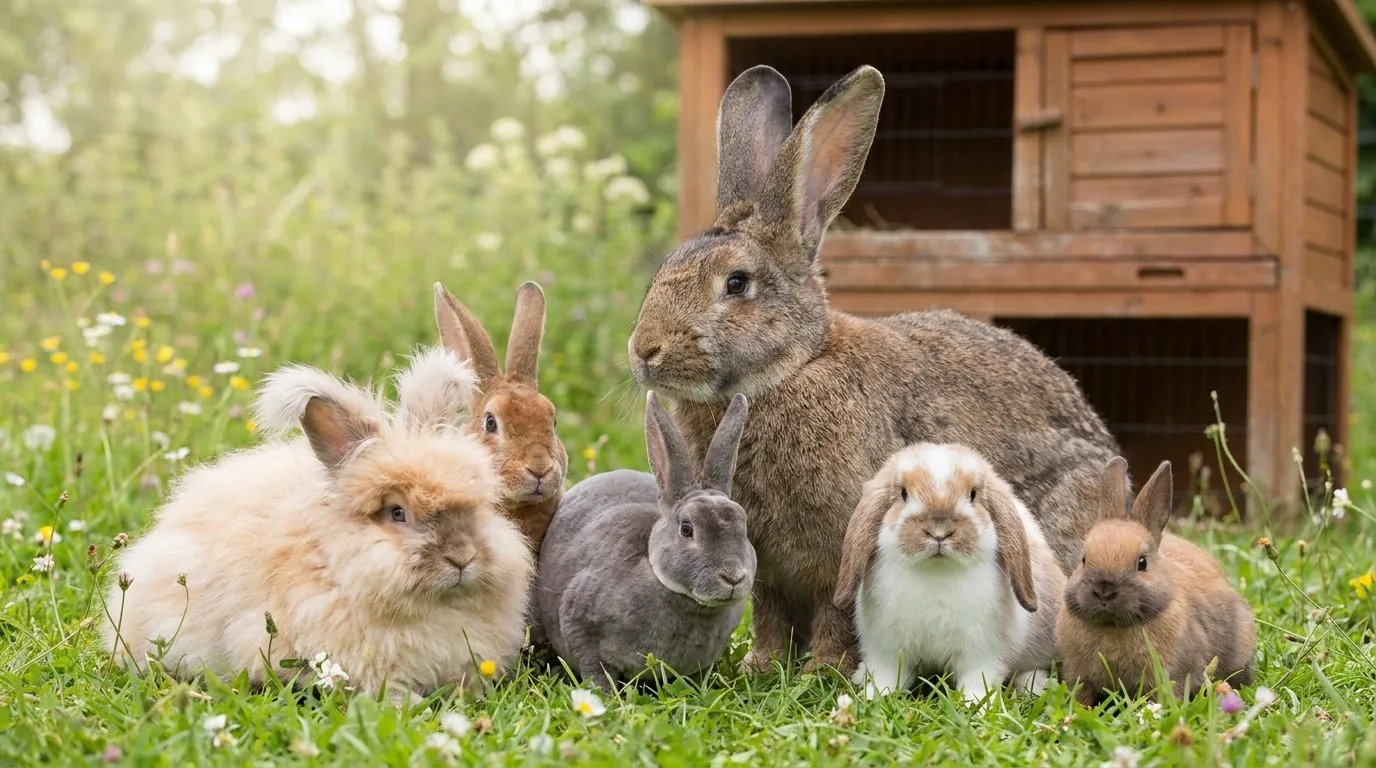
The best rabbit breeds for a farm or homestead are the New Zealand and Californian for meat, the Rex for fur, the English Angora for wool, and the Holland Lop, Mini Rex or Dutch for a friendly family pet. The American Rabbit Breeders Association (ARBA) recognizes 53 rabbit breeds, ranging from the Netherland Dwarf at no more than 2.5 lb (1.1 kg) to the Flemish Giant, which has no maximum weight at all.
This guide compares the most useful breeds side by side, then covers where they came from, how they look and behave, what they produce, how to house them in different climates, and how to pick the right one for your goals.
Key takeaways
- Meat: New Zealand and Californian are the standard choices; Silver Fox and American Chinchilla are good heritage options.
- Fur and wool: the Rex leads for fur, and Angoras are kept for wool but need regular grooming.
- Pets: Holland Lop, Mini Rex and Dutch are friendly, family-sized breeds; handling matters as much as breed.
- Care: unlimited grass hay, shade and airflow (heat above 80°F / 27°C is the big risk), and plan for an 8–12 year lifespan.
In this guide
Rabbit Breeds at a Glance
Weights below are the maximum senior weights in the ARBA standard unless noted. Individual rabbits vary, and show standards differ slightly in the UK (British Rabbit Council) and Australia.
| Breed | Origin | Size (ARBA max) | Main purpose | Temperament |
|---|---|---|---|---|
| New Zealand | United States (recognized 1916) | 12 lb (5.4 kg) | Meat, fur | Calm, easy to handle |
| Californian | Southern California, 1920s | 10.5 lb (4.8 kg) | Meat, fur | Calm, docile |
| Silver Fox | United States | 12 lb (5.4 kg) | Meat, fur, show | Gentle |
| American Chinchilla | Developed from stock shown in the US in 1919 | 12 lb (5.4 kg) | Meat, fur, show | Docile |
| Flemish Giant | Flanders, Belgium | No maximum; often over 20 lb (9 kg) | Pet, show, crossbreeding | Very gentle, laid-back |
| Rex | France (shown 1924) | 10.5 lb (4.8 kg) | Fur, meat, pet | Friendly, even-tempered |
| English Angora | Angora line (Europe) | 7.5 lb (3.4 kg) | Wool | Sweet, tolerant of handling |
| Mini Rex | Texas, 1984 | 4.5 lb (2 kg) | Pet, show | Friendly, curious |
| Holland Lop | The Netherlands | 4 lb (1.8 kg) | Pet, show | Playful, affectionate |
| Dutch | England, 1830s | 5.5 lb (2.5 kg) | Pet, show | Easygoing, good with families |
| Lionhead | Europe; ARBA-recognized 2014 | 3.75 lb (1.7 kg) | Pet, show | Lively, affectionate |
| Netherland Dwarf | The Netherlands | 2.5 lb (1.1 kg) | Pet, show | Energetic, can be skittish |
Domestic rabbits generally live 8–12 years, according to the UK animal charity Blue Cross, and larger breeds are thought to live shorter lives than small ones. That is a long commitment for a pet, so plan for it.
A Short History of Domestic Rabbit Breeds
All domestic rabbits descend from the European rabbit. Most modern breeds were shaped in the 1800s and early 1900s, when rabbit keeping boomed in Europe and North America for meat, fur and exhibition.
- The Flemish Giant is one of the oldest, believed to have been bred in Flanders as early as the 16th century. It reached America in the early 1890s and was used to add size to meat rabbits.
- The Dutch was developed in England in the 1830s and remains one of the most recognizable breeds, thanks to its white blaze and “saddle” markings.
- The New Zealand, despite its name, was developed in the United States and recognized in 1916. The white variety became the backbone of commercial meat and fur production.
- The Californian was bred in Southern California in the 1920s by George West, and it is still one of the most widely kept commercial breeds.
- The Rex was first shown in Paris in 1924 and brought to the US that same year. Its velvety coat comes from a genetic mutation that makes the guard hairs the same length as the undercoat.
- Newer pet breeds such as the Holland Lop (recognized by ARBA in 1979), Mini Rex (1988) and Lionhead (2014) were developed as smaller, friendlier companions.
Appearance: Body Types, Ears and Coats
Breeds differ in three main ways you can see at a glance.
Body type
Commercial meat breeds such as the New Zealand and Californian have a deep, well-muscled “commercial” body. Dwarf breeds such as the Netherland Dwarf and Holland Lop are compact with short ears and a round head. Giants such as the Flemish are long and heavy-boned.
Ears
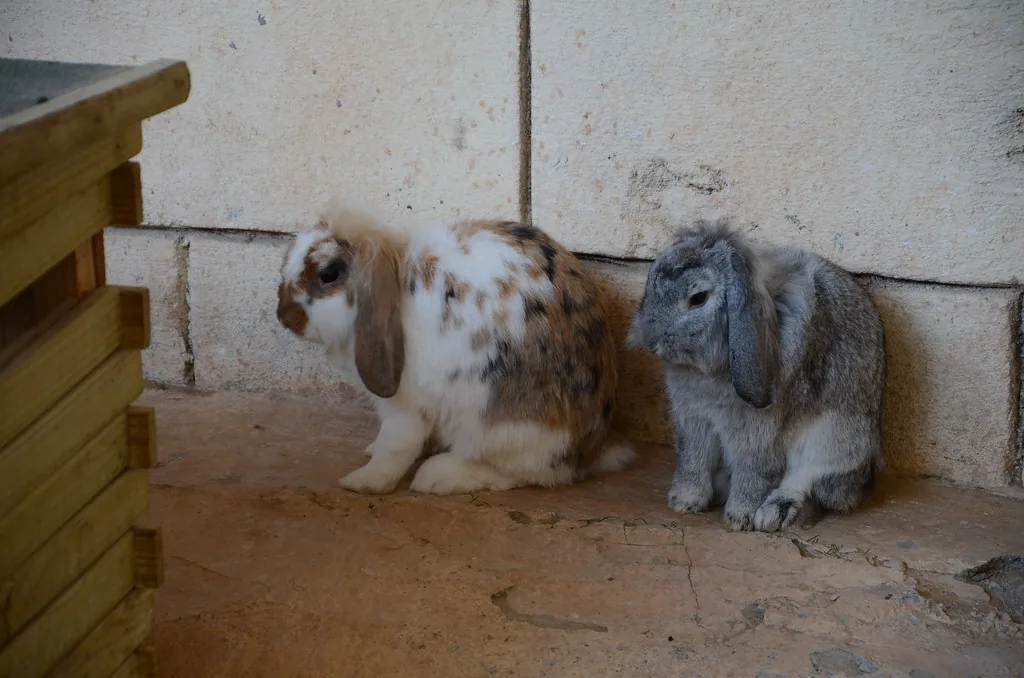
Most breeds have upright ears. Lop breeds, including the Holland Lop, carry their ears hanging down beside the head. The Holland Lop was bred as a smaller version of the much larger French Lop.
Coat
- Normal fur: New Zealand, Californian, Dutch, Flemish Giant.
- Rex fur: short, dense and plush, as on the Rex and Mini Rex.
- Silvered fur: the Silver Fox has silver-tipped and white hairs through the coat.
- Wool: Angora breeds grow long, fine wool that is harvested for spinning.
- Mane: the Lionhead has a ring of longer wool around the head and neck.
Temperament
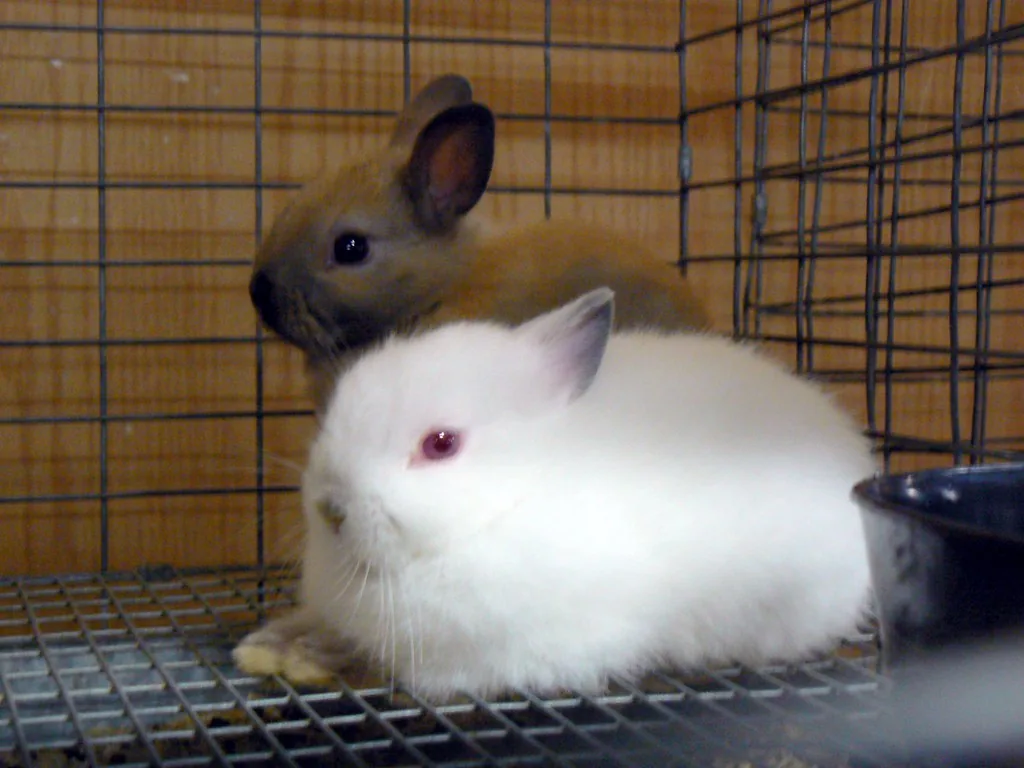
Temperament depends as much on handling as on breed. A rabbit that is picked up gently and often from a young age will usually be calmer than one left alone in a hutch. That said, some general patterns hold:
- Calmest: Flemish Giant (nicknamed the “Gentle Giant”), New Zealand, Californian and Dutch.
- Most playful: Holland Lop, Mini Rex and Lionhead.
- More skittish: small dwarf breeds such as the Netherland Dwarf can be quick and nervous, which makes them less suitable for young children.
Rabbits are prey animals. Most dislike being carried, and a frightened rabbit can kick hard enough to injure its own spine. Always support the hindquarters when lifting any breed.
Pro tip: Ask to meet the parents when you buy from a breeder. Calm, well-handled adults are a good sign, and a breeder who handles young rabbits often will usually sell calmer ones.
Production: Meat, Fur and Wool
Meat rabbits
The New Zealand and Californian are the standard choices for meat because they grow fast, have good meat-to-bone ratios and are usually easy to source. Many breeders cross the two. Heritage breeds such as the Silver Fox and American Chinchilla are also good meat rabbits, and the American Chinchilla is on The Livestock Conservancy’s Watch list, so raising it helps keep a rare breed going.
USDA’s Food Safety and Inspection Service defines a fryer, the most common meat rabbit, as one under 12 weeks old weighing 1½–3½ lb (0.7–1.6 kg). A roaster is a mature rabbit, usually over 8 months old and more than 4 lb (1.8 kg).
Rabbits breed readily. The Merck Veterinary Manual gives a gestation of about 31–33 days, weaning at about 4–5 weeks, and sexual maturity at 4–4.5 months for medium breeds, 3.5–4 months for small breeds and 6–9 months for giants. If you are comparing livestock options, our guide to the most profitable farm animals puts rabbits alongside poultry, goats and others.
Fur rabbits
The Rex is the leading fur breed because of its short, dense, velvet-like coat. Satin, Silver Fox and the Chinchilla breeds are also kept for pelts, often alongside meat production.
Wool rabbits
Angora breeds produce wool that is plucked or sheared and spun into yarn. ARBA recognizes four Angoras: English, French, Giant and Satin. The English Angora is the smallest and has the most wool around the face and ears, so it needs the most grooming. Angoras need regular grooming and wool harvesting, or their coats mat and they can swallow enough wool to cause digestive trouble.
Manure: a bonus for the garden
Every breed produces small, dry pellets that are one of the easiest manures to handle. Rabbit manure can go into the compost pile and is a good way to add organic matter to heavy ground; see our guide to compost for clay soil, or learn how to build a compost pile to make the most of it.
Care and Housing
Space
The Merck Veterinary Manual gives these minimum cage sizes for one rabbit. They are floor minimums only; rabbits also need daily time in a larger run or exercise area to hop, stretch and stand up on their hind legs.
| Breed size | Example breeds | Minimum cage floor |
|---|---|---|
| Small | Netherland Dwarf, Holland Lop, Mini Rex | 18 × 24 in (46 × 61 cm) |
| Medium to large | Dutch, Rex, New Zealand, Californian | 24 × 30 in (61 × 76 cm) |
| Giant | Flemish Giant | 30 × 36 in (76 × 91 cm), 16–18 in (41–46 cm) tall |
Climate
Heat is the bigger danger. Merck notes that long exposure to temperatures above 80°F (27°C) can make rabbits sick, and that domestic rabbits do poorly in temperatures below 50°F (10°C). In practice, well-sheltered outdoor rabbits handle cold far better than heat.
Plan for heat before summer. Hot, humid conditions in enclosed hutches can kill rabbits. Move hutches into deep shade with good airflow before the first heat wave, not during it.
- Hot regions (southern US, much of Australia and South Africa): give deep shade, good airflow and frozen water bottles to lie against. Short-coated breeds cope better than Angoras or Lionheads.
- Cold regions (northern US, Canada, UK winters): keep hutches dry and out of the wind, add extra bedding, and check that water has not frozen.
Feeding
Unlimited fresh grass hay, such as timothy or orchard grass, should make up most of every rabbit’s diet, with a measured amount of plain pellets, fresh leafy greens and constant clean water. Hay keeps their continuously growing teeth worn down and their gut moving. Make diet changes slowly, over a week or more.
For a full list of safe greens, treats and foods to avoid, see our guide to what rabbits eat.
Health
Vaccinate where vaccines are available: ask your vet about rabbit hemorrhagic disease (RHDV2 in the US; RHD and myxomatosis in the UK). Handle each rabbit weekly to check teeth, nails, eyes and the fur under the tail. A rabbit that stops eating or stops passing droppings for even a few hours needs a vet quickly.
Pros and Cons of Keeping Rabbits
| Pros | Cons |
|---|---|
| Quiet, so they suit small lots and many suburban areas | Sensitive to heat; losses are common in hot spells without shade |
| Need little space compared with most livestock | Breed so readily that a pair can quickly become too many |
| Excellent garden manure | Long-lived as pets, so a big time commitment |
| Fast-growing meat on a small footprint | Not all areas have a rabbit-savvy vet |
| Options for meat, fur, wool and companionship | Angoras need frequent grooming |
Which Rabbit Breed Suits You?
- Homestead meat: New Zealand, Californian or a cross of the two. Choose a heritage breed like the Silver Fox or American Chinchilla if you also want to support conservation.
- Fiber artists: an Angora, as long as you enjoy regular grooming.
- Families with children: Dutch, Mini Rex or Holland Lop. Giants such as the Flemish are gentle but heavy for children to lift.
- Small indoor spaces: Holland Lop, Mini Rex or Lionhead.
- Showing: any ARBA or BRC recognized breed; join the breed club and buy from a breeder with pedigreed stock.
Watch: Finding Good Meat Rabbits
Living Traditions Homestead shares where to find meat rabbits and what to look out for when buying.
Rabbits fit neatly into small-acreage plans alongside poultry and gardens. If you are laying out a property, our guide to homesteading on an acre shows how the pieces fit, and what is homesteading covers the bigger picture.
Helpful gear for this guide
Handy picks that match the advice above.
Links go to Amazon. Prices and availability change, so check reviews and fit for your setup before buying.
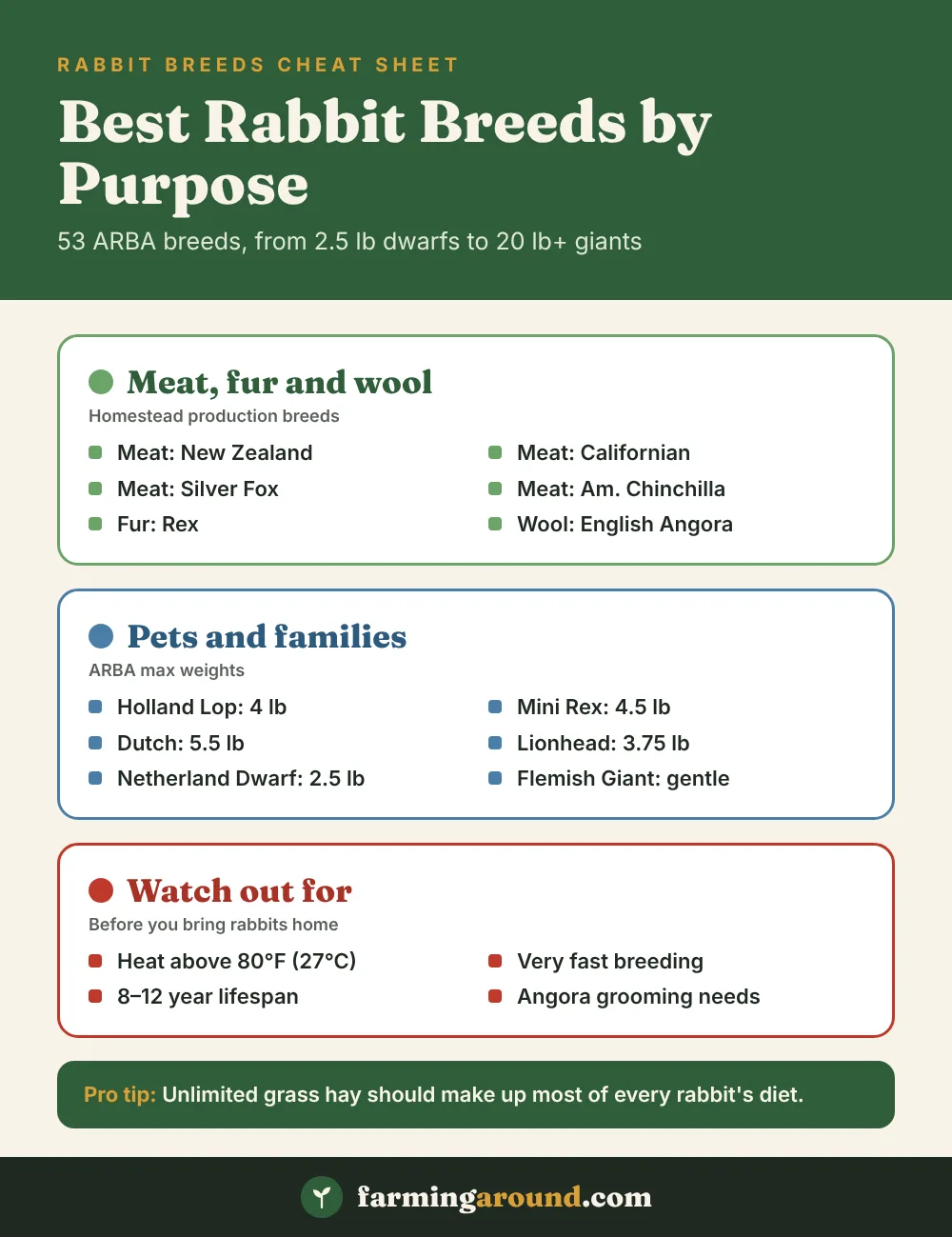
Quick Reference: Rabbit Breeds by Purpose
FAQ
How many rabbit breeds are there?
ARBA currently recognizes 53 rabbit breeds in the US. The British Rabbit Council recognizes a different, longer list, and many other breeds exist worldwide that neither body recognizes.
What is the best rabbit breed for meat?
The New Zealand and Californian are the most widely used meat breeds because they grow quickly and dress out well. Many homesteaders cross the two. Silver Fox and American Chinchilla are good heritage alternatives.
What is the friendliest rabbit breed?
The Flemish Giant, Dutch, Mini Rex and Holland Lop are known for calm, friendly natures. Handling matters more than breed, though, so a gently raised rabbit of any breed is usually the friendliest.
What is the smallest rabbit breed?
The Netherland Dwarf is one of the smallest recognized breeds, with an ARBA maximum weight of 2.5 lb (1.1 kg). The Britannia Petite and Polish are other small ARBA breeds.
What is the biggest rabbit breed?
The Flemish Giant is the best-known giant breed. The ARBA standard sets no maximum weight, and adults often exceed 20 lb (9 kg), so they need much larger housing than other breeds.
Can rabbits live outside all year?
Many breeds can, with a dry, draft-free hutch, deep bedding and a shaded area in summer. Heat is the main risk; Merck notes that long exposure above 80°F (27°C) can make rabbits sick, so plan shade and airflow before summer.
Sources
- Recognized Breeds (American Rabbit Breeders Association)
- Providing a Home for a Rabbit (Merck Veterinary Manual)
- Rabbit from Farm to Table (USDA Food Safety and Inspection Service)
- American Chinchilla Rabbit (The Livestock Conservancy)
This guide is general information. For vaccinations, diet changes or any sign of illness, consult a rabbit-savvy vet or your local extension office.


One Comment