
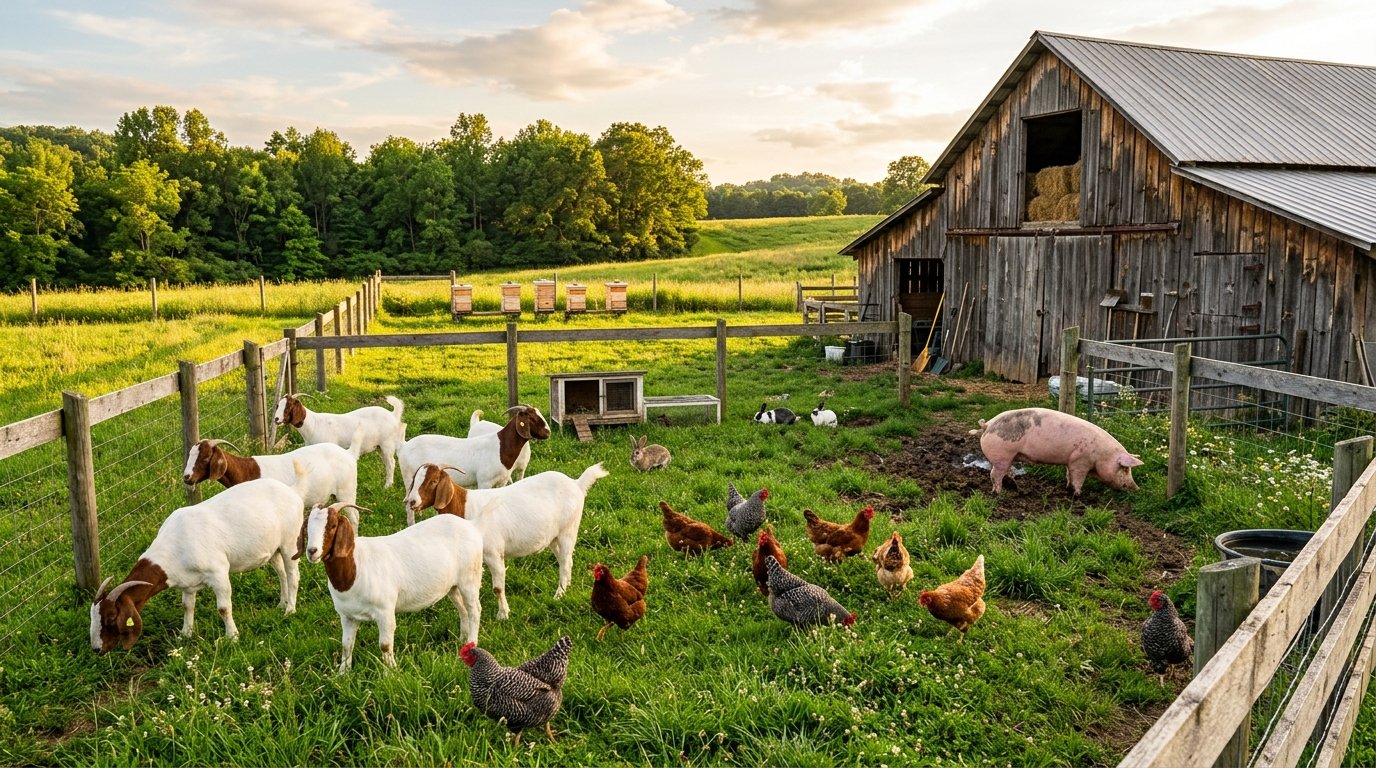

If you want your small farm to pay its way, the animals you choose make a big difference. Some livestock start earning within weeks on very little land. Others need big up-front investment and years before they turn a profit. This guide ranks the most profitable farm animals for small farms and homesteads, explains how each one makes money, and shows you what it really takes to turn a profit, because the animal is only half the equation. How you sell matters just as much.
What Makes a Farm Animal Profitable?
Before comparing animals, understand the factors that decide profit on a small farm:
- Startup cost: buying animals, housing, fencing and equipment
- Feed cost: usually the biggest ongoing expense
- Time to first income: weeks for meat chickens, years for cattle
- Land needed: critical if you only have a few acres
- Reproduction rate: faster breeders multiply your stock cheaply
- Processing rules: selling meat, milk or eggs is regulated, and requirements vary by country, state and province
- Your market: direct sales to customers earn far more than selling at auction
Quick Comparison: Most Profitable Farm Animals
| Animal | Startup cost | Land needed | Time to first income | Main products |
|---|---|---|---|---|
| Meat chickens (broilers) | Low | Very little | ~6–10 weeks | Whole birds, cuts |
| Laying hens | Low | Very little | ~5–6 months | Eggs |
| Quail | Very low | Minimal | ~2 months | Eggs, meat, hatching eggs |
| Rabbits | Low | Minimal | ~3–4 months | Meat, breeding stock, manure |
| Honeybees | Medium | Minimal | Usually year 2 | Honey, wax, pollination, nucs |
| Pigs | Medium | Small | ~6 months | Pork (whole/half hogs) |
| Goats | Medium | Moderate | ~1 year+ | Meat, milk, soap, kids |
| Sheep | Medium | Moderate | ~1 year+ | Lamb, wool |
| Grass-fed beef cattle | High | Large | ~2 years | Beef (shares, cuts) |
1. Meat Chickens (Broilers)
For fast turnaround, meat chickens are hard to beat. Commercial Cornish Cross broilers reach processing weight in roughly 6–8 weeks, while slower-growing “freedom ranger” types take around 9–11 weeks. You can raise several batches per season on a small area, especially with movable pasture pens.
How they make money: pasture-raised whole chickens sold directly to customers command premium prices compared with supermarket chicken.
Watch out for: processing regulations. In the US, federal law has limited exemptions for small producers who slaughter and sell their own poultry, with rules about bird numbers and where you can sell. State rules vary. In the UK, Canada and Australia, check your food safety authority’s rules on selling poultry meat.
2. Laying Hens
Eggs are the classic farm-stand product. Customers come back weekly, which builds a loyal base you can sell other products to. Profit per hen is modest, so the money comes from scale, good layers, controlling feed costs, and selling direct at a premium for pasture-raised eggs.
Best for: beginners, and farms with a roadside stand or local customers. New to hens? Start with our guide to raising chickens for beginners.
3. Quail
Coturnix quail are one of the most overlooked small-farm animals. They need very little space, start laying at around 6–8 weeks old, and each hen can lay close to an egg a day in good conditions. Quail eggs sell to restaurants, specialty food stores and health-conscious buyers, and hatching eggs and chicks sell to other keepers.
Watch out for: the niche market. Line up buyers before you scale up. Also check local rules, since some areas classify quail differently from poultry.
4. Rabbits
Rabbits are extremely efficient. Gestation is only about 31 days, a doe can raise several litters per year, and fryers are ready at roughly 10–12 weeks. They need little space, are quiet, and their manure can go straight onto the garden without composting.
How they make money: meat, breeding stock, pet and show rabbits, and manure or worm-farming sidelines.
Watch out for: market demand for rabbit meat varies a lot by region. Build your customer list first.
5. Honeybees
Bees need almost no land and produce several products: honey, beeswax, nucleus colonies (nucs) for other beekeepers, and paid pollination services. Local raw honey sells at premium prices at farmers’ markets.
Watch out for: the learning curve and colony losses. Expect to harvest little or no honey in the first year, and take a local beekeeping course before starting.
6. Pigs
Raising feeder pigs is a popular seasonal enterprise. Buy weaners in spring, raise them for roughly 5–6 months to around 250–280 lb (110–130 kg), and sell whole or half hogs directly to customers who pay for processing. Pigs also clear and till rough ground.
Watch out for: feed costs, which make or break pig profits, and strong fencing (electric fencing works well). Always follow your country’s rules on what pigs can legally be fed. Many countries, including the UK, ban feeding kitchen scraps to pigs.
7. Goats
Goats offer several income streams: meat (Boer and Kiko breeds), dairy (Nubian, Alpine, Nigerian Dwarf), and value-added products like goat milk soap and lotions, which often earn far more than raw milk. Registered breeding stock can also sell well.
Watch out for: fencing (goats are escape artists), parasite management, and raw milk laws, which vary widely between jurisdictions.
8. Sheep
Sheep are efficient grazers that turn pasture into lamb, and some breeds produce valuable wool. Hair sheep breeds like Katahdin and Dorper don’t need shearing and suit meat-focused small farms.
Watch out for: predators, parasites, and needing enough pasture to avoid buying lots of hay.
9. Grass-Fed Beef Cattle
Cattle can be profitable when you sell grass-fed beef directly by the quarter, half or whole. But they need the most land (often 1.5–2+ acres per cow-calf pair in good pasture, and far more in dry regions), the highest investment, and about 2 years to go from calf to finished beef.
Best for: farms with plenty of good pasture. Not ideal for small acreage.
How to Actually Make a Profit
- Sell direct. Farm stands, farmers’ markets, CSA boxes, social media and local delivery. Direct sales often earn far more than wholesale or auction.
- Add value. Soap from goat milk, cured pork, honey products and hatching eggs earn higher margins than raw products.
- Control feed costs. Buy in bulk, use pasture, and reduce waste with good feeders.
- Stack enterprises. Chickens following cattle or pigs, bees in the orchard. Each system supports the others.
- Know the regulations first. Check licensing, processing and labeling rules before you sell anything.
- Track everything. Many small farms think they’re profitable until they add up feed, bedding, vet bills and their time.
Best Choice by Farm Size
- Under 1 acre: Laying hens, quail, rabbits, bees
- 1–5 acres: Add meat chickens on pasture, a few pigs, or dwarf goats. See our one-acre homestead plan.
- 5–20 acres: Goats, sheep, pastured poultry at scale, pigs
- 20+ acres: Grass-fed beef becomes viable, often alongside sheep or poultry
Bigger livestock usually means bigger equipment. Our small farm tractor guide helps you pick the right size.
FAQ: Most Profitable Farm Animals
What is the most profitable farm animal for a small farm?
For small acreage, meat chickens, laying hens, quail and rabbits usually offer the best return on a small investment because they need little land and produce income quickly. The most profitable choice depends on your local market.
What farm animal makes money fastest?
Meat chickens (about 6–8 weeks for Cornish Cross) and quail (laying from about 6–8 weeks) are among the fastest.
Is raising chickens profitable?
It can be, mainly through direct sales of pastured eggs or meat birds at premium prices. Backyard flocks kept only for family eggs usually don’t make money.
Are goats profitable?
Goats can be profitable, especially through value-added products like goat milk soap or by selling quality breeding stock, but they require good fencing and parasite management.