

Last updated: October 2026
This guide contains affiliate links. As an Amazon Associate, FarmingAround earns from qualifying purchases, at no extra cost to you.
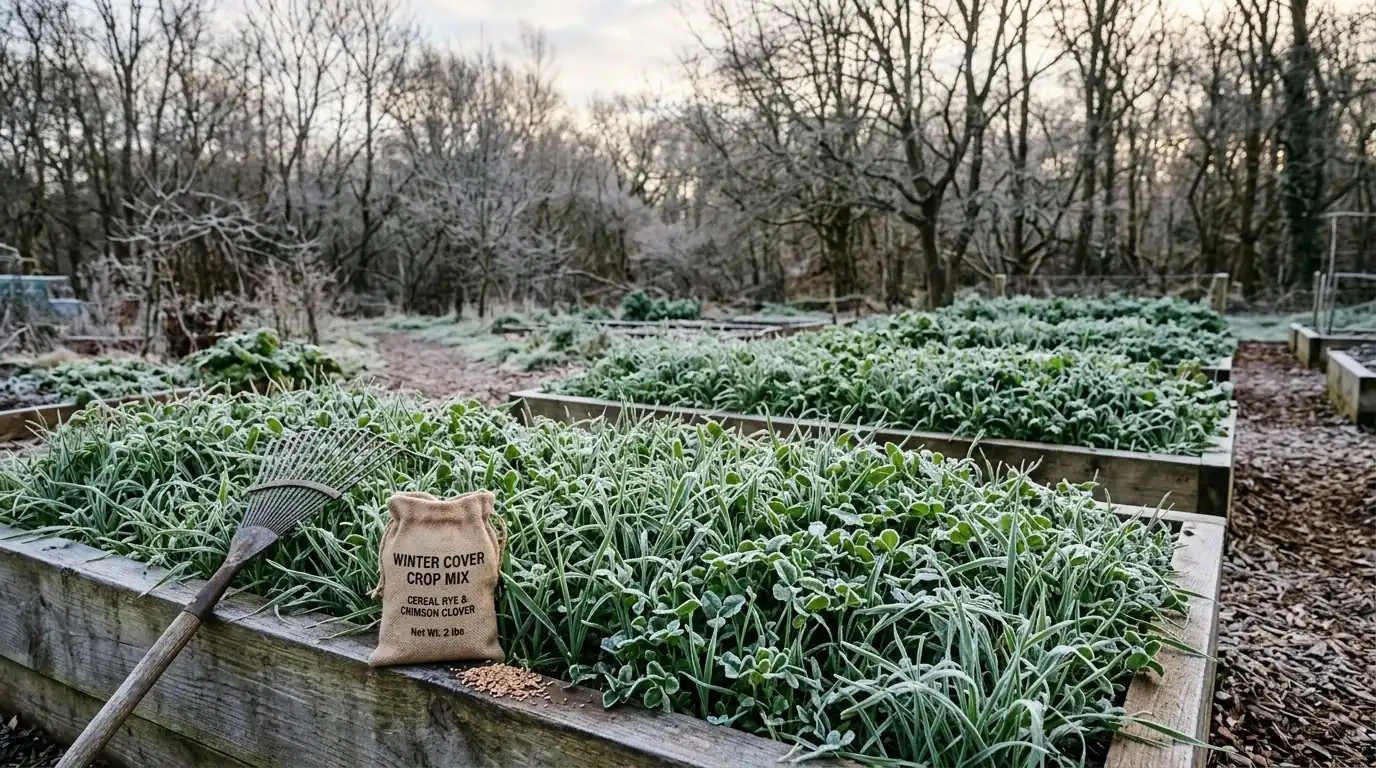
Leaving garden beds bare over winter lets rain wash away topsoil, weeds move in, and nutrients leach out. Winter cover crops fix all three. Sown in autumn, they protect the soil, add organic matter, and some even pull nitrogen from the air to feed next year’s vegetables. This guide covers the best winter cover crops for home gardens, when to plant them, how much seed you need, and how to turn them under in spring.
Key takeaways
- Why: cover crops stop erosion, add organic matter, suppress weeds and, with legumes, add nitrogen.
- Best mix: a grass plus a legume, such as cereal rye with hairy vetch, or oats with field peas.
- When: most should be sown 4–8 weeks before the first frost; cereal rye can go in later.
- Spring: cut at flowering, before seed set, and wait 2–3 weeks before direct-sowing after rye.
In this guide
- Why Plant Winter Cover Crops?
- Best Winter Cover Crops for Gardens
- Winter-Kill vs Overwintering Cover Crops
- How Much Seed Do You Need?
- How to Plant Winter Cover Crops
- How to Terminate Cover Crops in Spring
- Common Mistakes
- Quick Reference: Winter Cover Crops at a Glance
- FAQ: Winter Cover Crops for Gardens
- Sources
Why Plant Winter Cover Crops?
- Prevent erosion: roots hold soil in place through winter rain and snowmelt.
- Add organic matter: when turned in or cut down, they feed soil life and improve structure. They’re especially valuable on heavy clay soils.
- Fix nitrogen: legumes like clover and vetch capture nitrogen from the air.
- Suppress weeds: a dense cover crowds out winter weeds.
- Break up compaction: deep-rooted crops like daikon radish drill through hardpan.
- Catch leftover nutrients before winter rains wash them away.
Best Winter Cover Crops for Gardens
| Cover crop | Type | Winter hardiness | Main benefit | Plant by (approx.) |
|---|---|---|---|---|
| Cereal rye | Grass | Very hardy | Most cold-tolerant; huge biomass, weed suppression | Late autumn, even after first frost |
| Winter wheat | Grass | Hardy | Easier to manage than rye | Mid to late autumn |
| Hairy vetch | Legume | Hardy | High nitrogen fixation | 4–6 weeks before first frost |
| Crimson clover | Legume | Moderately hardy | Nitrogen, pollinator flowers in spring | 6–8 weeks before first frost |
| Oats | Grass | Winter-kills in cold areas | Easy spring management (dies back on its own) | 6–8 weeks before first frost |
| Daikon (tillage) radish | Brassica | Winter-kills in hard freezes | Breaks compaction, scavenges nutrients | 6–8 weeks before first frost |
| Field (Austrian winter) peas | Legume | Moderately hardy | Nitrogen; edible shoots | 6–8 weeks before first frost |

Best combinations: a grass plus a legume, such as cereal rye + hairy vetch or oats + field peas. The grass provides biomass and structure, the legume provides nitrogen, and the grass stems support the vining legume.
Winter-Kill vs Overwintering Cover Crops
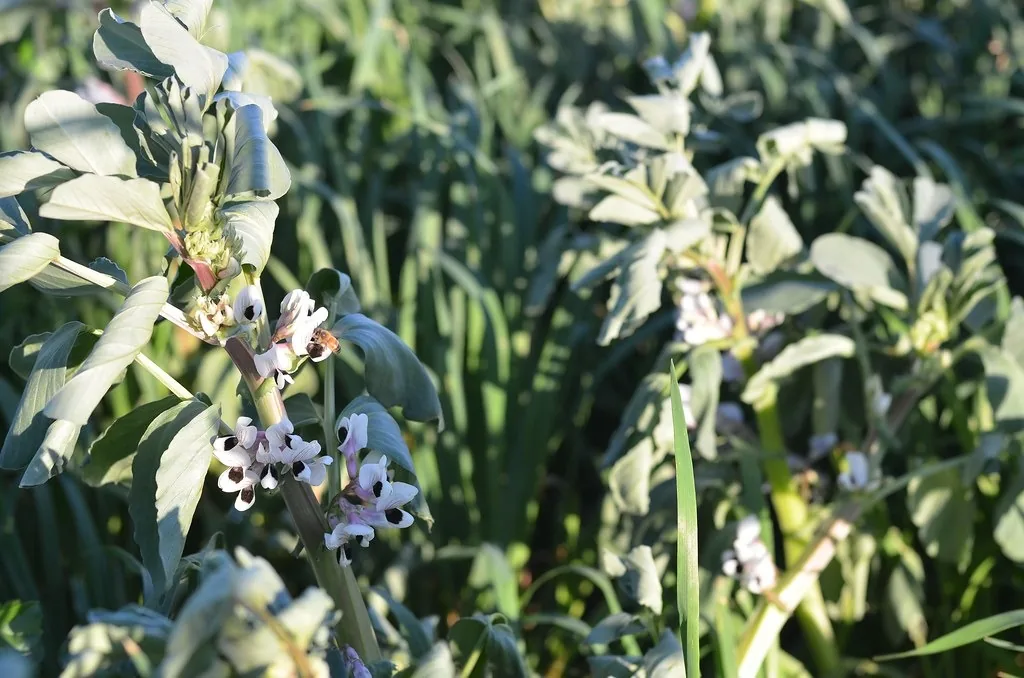
- Winter-kill crops (oats, daikon radish, and often peas in cold areas) die in hard freezes and leave a mulch that’s easy to plant into in spring. They’re great for beds you want to plant early.
- Overwintering crops (cereal rye, winter wheat, hairy vetch, crimson clover) keep growing in spring and produce more biomass and nitrogen, but need to be cut or turned in before planting.
How Much Seed Do You Need?
Typical broadcast seeding rates for small gardens (approximate; check your seed supplier):
| Crop | Per 100 sq ft | Per 1,000 sq ft |
|---|---|---|
| Cereal rye | about 0.3–0.4 lb | about 3–4 lb |
| Oats | about 0.3–0.4 lb | about 3–4 lb |
| Hairy vetch | about 0.1–0.2 lb | about 1–2 lb |
| Crimson clover | about 0.05–0.1 lb | about 0.5–1 lb |
| Daikon radish | about 0.02–0.05 lb | about 0.25–0.5 lb |
When mixing two crops, reduce each rate to roughly half to two-thirds.
How to Plant Winter Cover Crops
- Clear the bed of spent crops and large debris.
- Loosen the surface lightly with a rake.
- Inoculate legume seed (clover, vetch, peas) with the correct rhizobia inoculant to maximize nitrogen fixation.
- Broadcast seed evenly by hand.
- Rake it in to about ¼–½ in (0.5–1 cm) deep, or cover lightly with compost.
- Water if the soil is dry, and keep it moist until the seedlings are up.
- Protect from birds with row cover if they’re eating the seed.
Pro tip: In the Southern Hemisphere, sow winter cover crops in autumn, roughly March–May, and cut them in spring around September–October. In frost-free climates, choose crops that don’t need cold to finish, such as oats and field peas.
Watch: cover crops for winter
GrowVeg’s short video looks at using cover crops to recharge garden soil over winter.
How to Terminate Cover Crops in Spring
Timing matters. Cut cover crops when they begin flowering but before they set seed. That’s when biomass and nitrogen peak and regrowth is least likely.
- Cut and mulch (no-dig): cut plants at soil level with shears, a scythe or a mower, leave them as mulch, and plant transplants through it.
- Cut and incorporate: chop the plants and lightly work them into the top few inches of soil.
- Occultation: cover cut plants with a tarp for 2–4 weeks to break them down.
- Wait before planting: allow about 2–3 weeks after incorporating before direct seeding. Cereal rye in particular can temporarily inhibit small-seeded crops. Transplants are less affected.
Common Mistakes
- Planting too late: legumes and clovers need time to establish before winter. Cereal rye is the best option for late sowings.
- Letting it go to seed: cover crops can become weeds.
- Skipping inoculant on legumes, which reduces nitrogen fixation.
- Direct-sowing too soon after turning in rye.
Don’t let cover crops set seed. Hairy vetch seed can stay viable in soil for years, and rye, wheat and buckwheat that drop seed become weeds. Cut them at flowering.
Cover crops work best alongside compost. See how to build a compost pile, and use our vegetable planting calendar to time spring planting after you cut the cover.
Quick Reference: Winter Cover Crops at a Glance
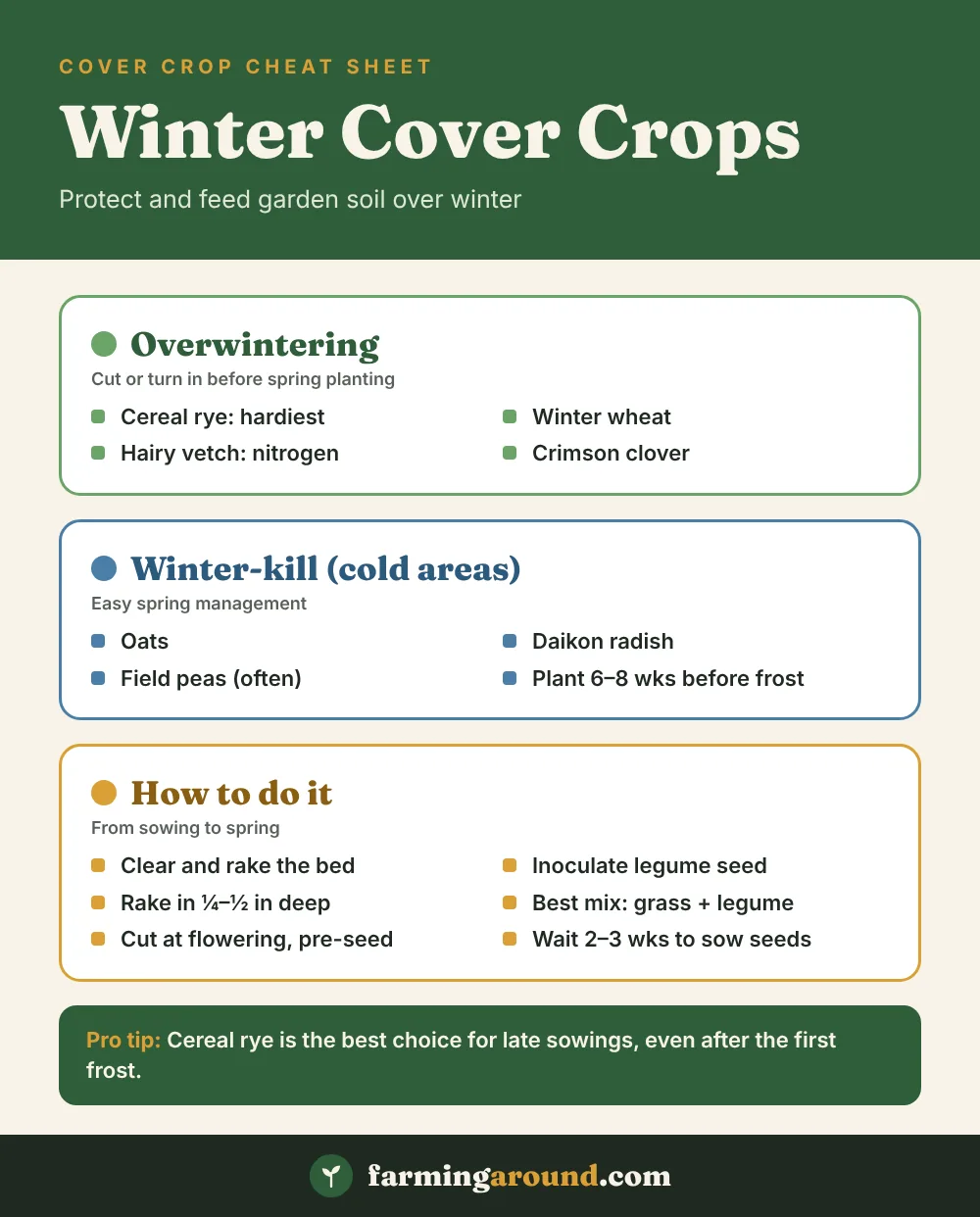
A one-card summary of which cover crops to use and how to grow them.
Helpful gear for this guide
Handy picks that match the advice above.
Links go to Amazon. Prices and availability change, so check reviews and fit for your setup before buying.
FAQ: Winter Cover Crops for Gardens
What is the best winter cover crop for a vegetable garden?
For most gardens, a mix of cereal rye and hairy vetch (or crimson clover) offers the best balance of soil protection and nitrogen. For easy spring management, choose oats and peas, which winter-kill in cold regions.
When should I plant winter cover crops?
Most should be sown 4–8 weeks before your first frost. Cereal rye can be sown later, even after the first frost.
Can I plant cover crops in raised beds?
Yes. Use small-seeded, easy-to-manage crops like crimson clover, oats or buckwheat (summer), and cut them by hand in spring.
Do cover crops replace compost?
They complement it. Cover crops add organic matter and nitrogen in place, and compost adds nutrients and biology. Using both builds soil fastest.
Pair cover crops with a productive autumn planting plan. See fall garden vegetables to plant now.
Sources
- Types of Cover Crops for Use in Home Vegetable Gardens (Iowa State University Extension)
- Simple Steps for Getting Started with Cover Crops (SARE)
Seeding rates and hardiness vary by region and seed lot. Check with your local extension office or seed supplier.


4 Comments