
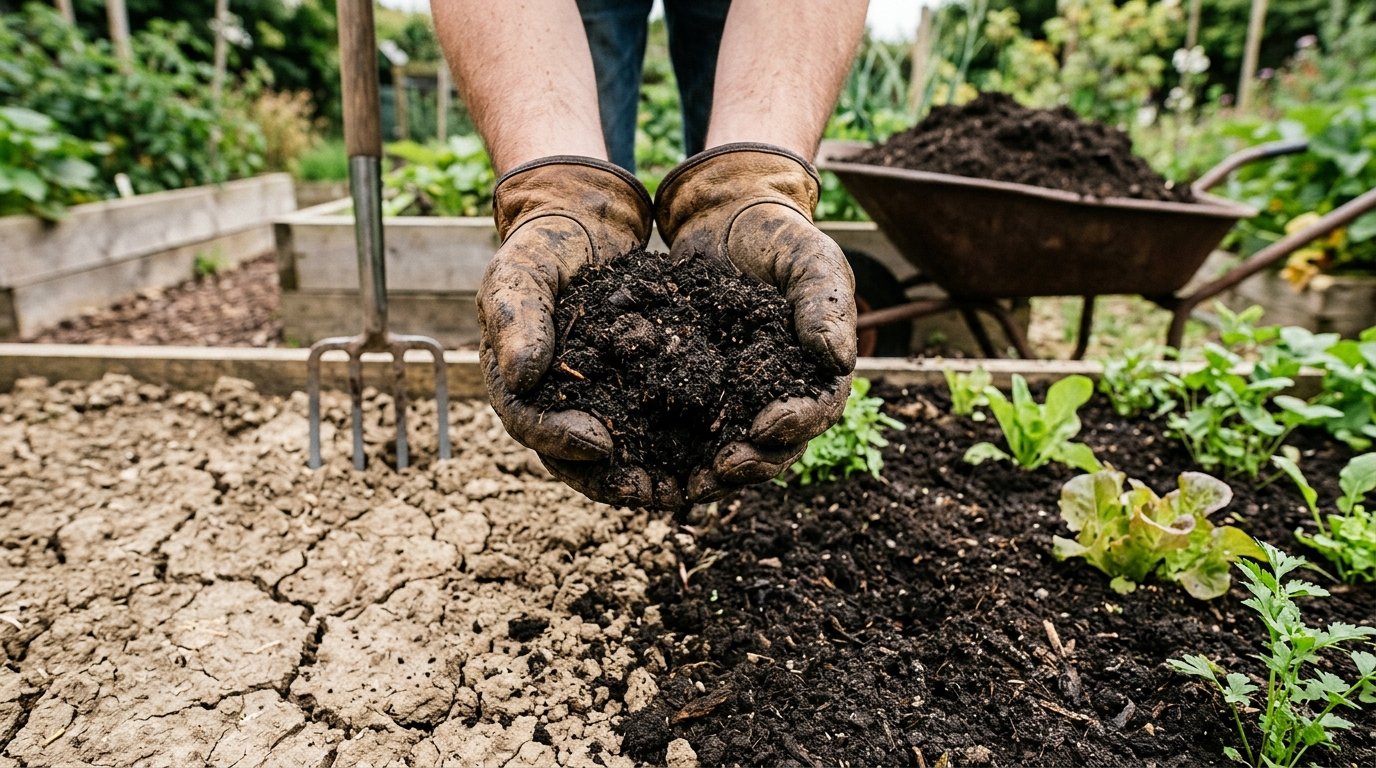

Clay soil has a bad reputation. It’s sticky when wet, rock-hard when dry, slow to warm in spring, and can drown plant roots after heavy rain. But clay is also naturally rich in nutrients and holds water far better than sandy soil. The best way to unlock that potential is compost. This guide explains why compost works on clay soil, which type to use, how much you need, and the step-by-step method to turn heavy ground into dark, crumbly, productive soil.
Why Clay Soil Is So Difficult
Clay particles are tiny, smaller than 0.002 mm, and flat, like microscopic plates. They pack together tightly, leaving very little space for air and water to move. That causes the classic clay problems:
- Poor drainage: water sits on the surface or pools around roots
- Compaction: roots struggle to push through dense soil
- Cracking: clay shrinks and cracks as it dries out
- Cold, late soil: wet clay warms slowly in spring
The upside is that clay’s large surface area holds onto nutrients like calcium, magnesium and potassium. Fix the structure, and clay often becomes more fertile than any other soil type.
How Compost Improves Clay Soil
Compost doesn’t “dilute” clay. It changes how clay particles stick together. As organic matter breaks down, soil microbes, fungi and earthworms produce sticky compounds that bind clay particles into small crumbs called aggregates. The spaces between those crumbs let air and water flow and give roots room to grow.
In short, compost helps clay soil to:
- Drain faster after rain
- Stay workable over a wider range of moisture
- Crack less in dry weather
- Feed a thriving population of worms and soil life
- Release nutrients to plants more easily
Best Types of Compost for Clay Soil
| Type | Why it helps clay | Notes |
|---|---|---|
| Homemade garden compost | Balanced, full of microbes, free | Use well-finished compost that is dark and crumbly and smells earthy |
| Leaf mold | Excellent for structure, fungal-rich | Takes 1–2 years to make; low in nutrients but superb for texture |
| Well-rotted manure | Adds organic matter and nutrients | Must be aged 6+ months; fresh manure can burn plants |
| Municipal / green-waste compost | Affordable in bulk | Check it’s fully finished and screened |
| Composted bark fines | Coarse texture opens up clay | Can tie up nitrogen briefly, so add a nitrogen source |
| Mushroom compost | Good structure, widely available | Often alkaline; avoid around acid-loving plants |
Tip: using a mix of two or three types gives the best long-term results, combining nutrients from manure with structure from leaf mold or bark.
How Much Compost Do You Need for Clay Soil?
For a new bed on heavy clay, aim for a 2–3 inch (5–8 cm) layer of compost, worked into the top 6–8 inches (15–20 cm) of soil. After that, top-dress with 1–2 inches (2.5–5 cm) every year.
Quick math for ordering bulk compost:
- 1 cubic yard covers about 324 sq ft at 1 inch deep, or about 108 sq ft at 3 inches.
- 1 cubic meter covers about 20 m² at 5 cm deep.
| Bed size | 2-inch layer | 3-inch layer |
|---|---|---|
| 4 × 8 ft (32 sq ft) | ~0.2 cu yd (5.3 cu ft) | ~0.3 cu yd (8 cu ft) |
| 10 × 10 ft (100 sq ft) | ~0.6 cu yd | ~0.9 cu yd |
| 20 × 50 ft (1,000 sq ft) | ~6.2 cu yd | ~9.3 cu yd |
Step-by-Step: How to Add Compost to Clay Soil
- Check moisture first. Squeeze a handful of soil. If it forms a sticky ribbon and smears, it’s too wet to work, and digging now will make compaction worse. Wait until it crumbles when pressed.
- Loosen, don’t pulverize. Use a broadfork or garden fork to open up the soil. Avoid repeated rototilling, which breaks down the crumb structure you’re trying to build.
- Spread the compost evenly, 2–3 inches deep.
- Mix it into the top 6–8 inches with a fork. Don’t bury it deeply; most soil life and roots are in the top layer.
- Mulch the surface with straw, shredded leaves or wood chips (on paths and perennial beds) to protect the soil from heavy rain and drying out.
- Stay off the beds. Create permanent paths so you never walk on growing areas.
- Top-dress every year with 1–2 inches of compost. After the first year, you can simply lay it on top and let worms pull it in, a “no-dig” approach.
The Best Time to Add Compost to Clay
- Autumn is ideal. Spread compost and mulch, and let winter rain, frost and worms do the work. By spring, the soil is noticeably easier to plant.
- Spring works too, but wait until the soil has dried enough to pass the squeeze test.
- Avoid working clay in mid-summer drought, when it’s baked hard.
Common Mistakes to Avoid
- Adding sand alone. Mixing small amounts of sand into clay can create a dense, concrete-like material. Organic matter is the proven fix.
- Relying on gypsum. Gypsum mainly helps sodic (high-sodium) soils. On typical garden clay, it does little that compost doesn’t do better. Get a soil test before buying it.
- Working wet soil. One session of digging wet clay can undo months of improvement.
- Using unfinished compost. Half-rotted material can temporarily lock up nitrogen and harbor pests.
- Expecting instant results. Clay improves steadily over 2–3 seasons of consistent compost additions.
Other Ways to Improve Clay Soil Alongside Compost
- Raised beds: Raising the growing area by 8–12 inches improves drainage immediately while you build soil below.
- Cover crops: Deep-rooted crops like daikon (tillage) radish and cereal rye break up compaction and add organic matter when cut down.
- Permanent mulch: Keeps the surface from crusting and feeds worms.
- Grow clay-tolerant plants: Brassicas (cabbage, broccoli, kale), squash, beans, many fruit trees and perennials like daylilies and asters do well in improved clay.
- Get a soil test: Check pH and nutrient levels so you’re adding what your soil actually needs.
Make Your Own Compost for Free
Buying compost adds up fast. A home compost system turns kitchen scraps, garden waste, leaves and animal bedding into free soil improver. Aim for roughly a 3:1 mix of “browns” (dry leaves, straw, cardboard) to “greens” (grass clippings, vegetable scraps, manure), keep it as damp as a wrung-out sponge, and turn it every few weeks. If you keep chickens, their bedding and manure make an excellent compost accelerator. See our guide to raising chickens.
FAQ: Compost for Clay Soil
How long does it take compost to improve clay soil?
You’ll notice better workability after the first season. Significant, lasting improvement usually takes 2–3 years of regular additions.
Can you add too much compost to clay?
It’s rare with typical amounts, but very heavy yearly applications of manure-based compost can build up excess phosphorus. Stick to 1–2 inches a year after the first application, and soil test every few years.
Is manure or compost better for clay soil?
Both help. Well-rotted manure adds more nutrients; plant-based compost and leaf mold usually do more for long-term structure. A mix is ideal.
Should I till compost into clay soil?
Loosen and mix it in once when starting a new bed. After that, top-dressing without tilling protects soil structure and gives better long-term results.
Once your soil is improving, put it to work. Potatoes are a great crop for breaking in new ground; here’s how to grow potatoes step by step.

One Comment