

Last updated: September 2026
This guide contains affiliate links. As an Amazon Associate, FarmingAround earns from qualifying purchases, at no extra cost to you.
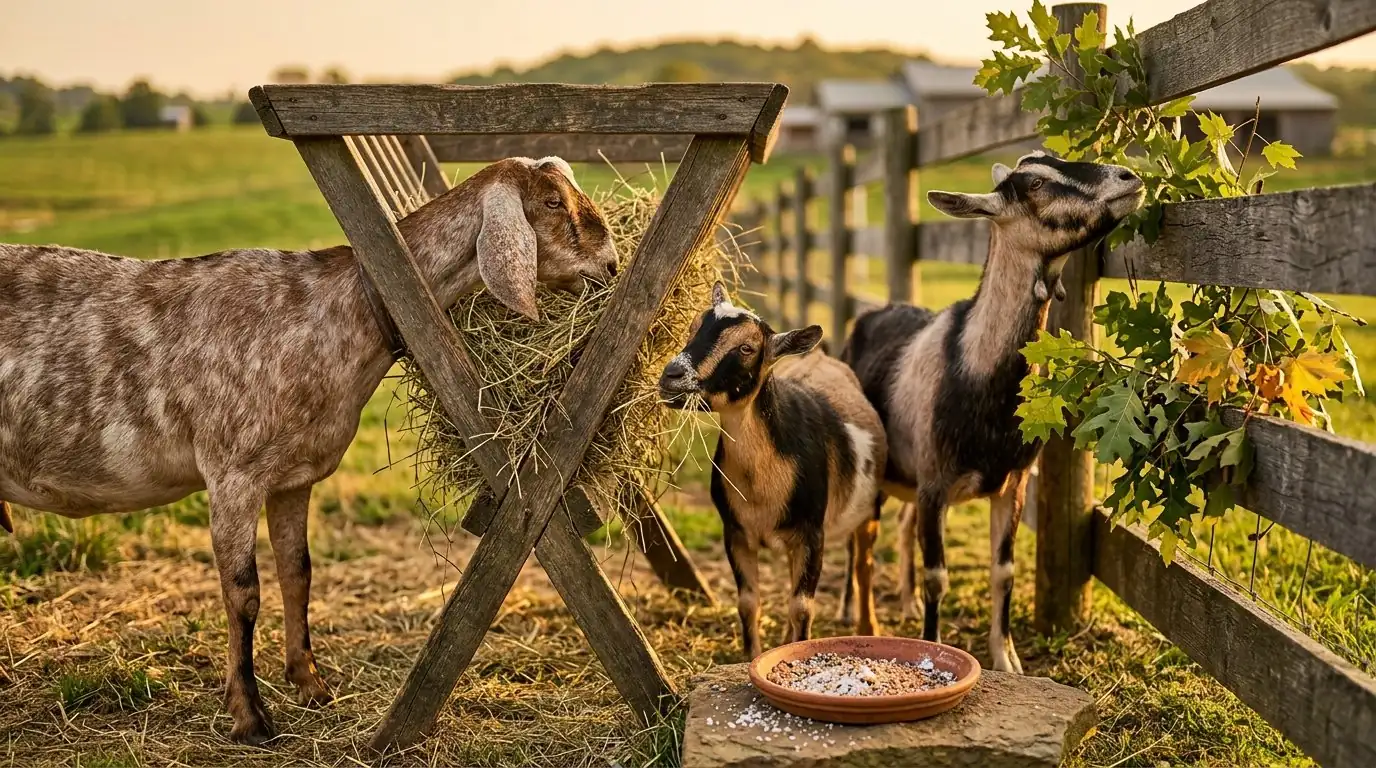
Goats eat mainly forage: hay, pasture, browse (leaves, shrubs, weeds and tree branches) and a goat-specific mineral. Grain and treats like apples, carrots, bananas and pumpkin are safe in small amounts. Despite their reputation, goats don’t “eat anything”. They are picky browsers with sensitive digestive systems, and some common garden plants are deadly to them.
This guide covers what goats should eat every day, the best treats, the plants and foods to avoid, and a quick chart you can save.
Key takeaways
- Forage first: hay, pasture and browse should make up most of a goat’s diet.
- Use a goat-specific loose mineral, because sheep minerals are too low in copper for goats.
- Keep grain and treats small (treats under about 10%) and change feed slowly to avoid bloat.
- Toxic plants kill goats: keep azalea, rhododendron, yew, oleander and wilted cherry leaves out of reach.
In this guide
How a Goat’s Digestion Works
Goats are ruminants. They have a four-part stomach, and the largest part, the rumen, is a fermentation vat full of microbes that break down fibre. Keeping those microbes healthy is the whole point of a good goat diet:
- Fibre keeps the rumen working. Long-stem hay and browse should make up most of what a goat eats.
- Sudden changes cause trouble. A big meal of grain or rich food can cause bloat or grain overload (acidosis), both of which can kill a goat quickly.
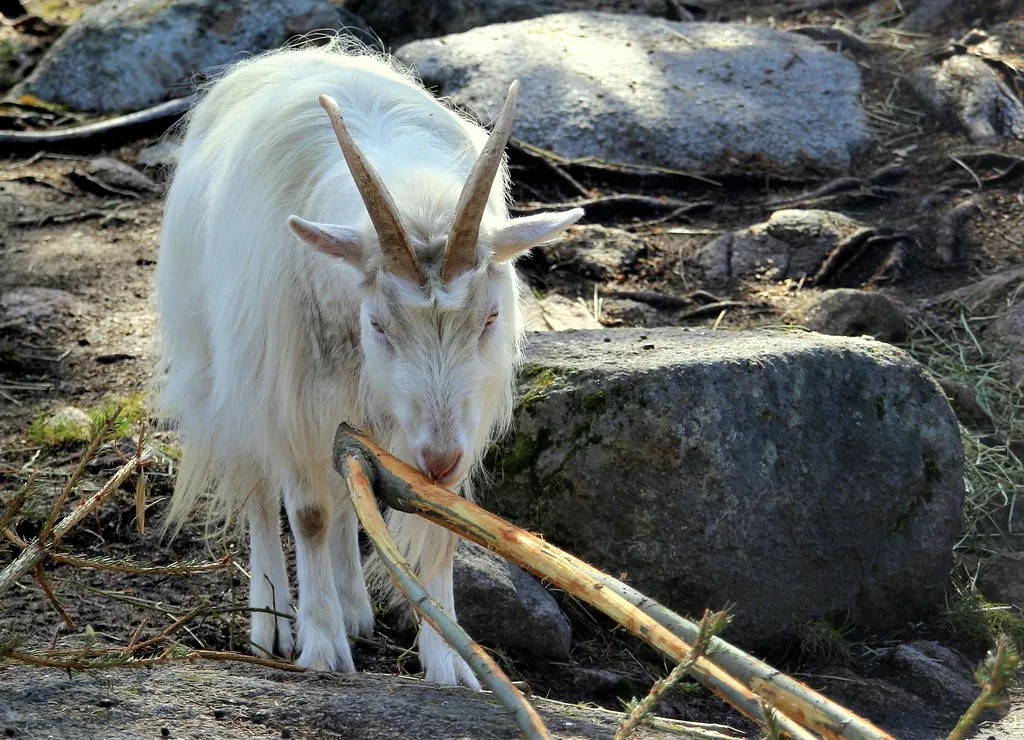
- Goats are browsers, not grazers. Given the choice, they prefer leaves, twigs and weeds at head height over short grass, which also lowers their exposure to parasites near the ground.
What Goats Should Eat Every Day
| Feed | Role | How much / how often |
|---|---|---|
| Grass hay or pasture and browse | The foundation of the diet (fibre and energy) | Free choice. An adult goat eats roughly 2–4% of its body weight in dry matter daily |
| Alfalfa hay or pellets | Extra protein and calcium | Best for pregnant or milking does and growing kids; limit for wethers and bucks |
| Loose goat minerals | Copper, selenium, zinc and other trace minerals | Free choice, always available |
| Clean water | Digestion and milk production | Always; a milking doe can drink several gallons a day |
| Goat grain / concentrate | Extra energy | Only when needed (late pregnancy, milking, kids, hard keepers), introduced slowly |
| Baking soda (optional) | Many keepers offer it free choice to help settle the rumen | In a separate dish, not mixed into feed |
Why Goat-Specific Minerals Matter
Goats need more copper than sheep. Sheep minerals are kept very low in copper because sheep are sensitive to it, so they can leave goats deficient. Copper deficiency shows up as a faded or rough coat, a “fishtail” (hair loss at the tail tip) and poor parasite resistance. Buy a loose mineral labelled for goats; goats often don’t lick hard mineral blocks enough.
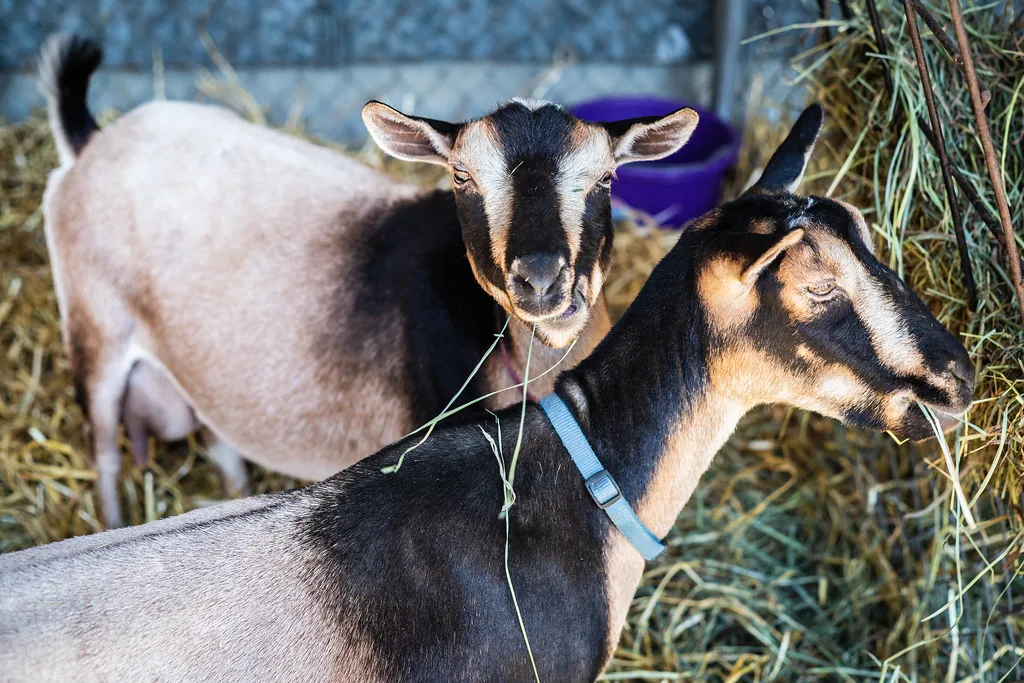
Pro tip: hang hay in a rack or net off the ground. Goats waste less, and they won’t eat hay they’ve stepped on or soiled.
Grain: Less Is More
Many healthy pet goats and wethers never need grain at all. When you do feed it:
- Increase amounts gradually over 1–2 weeks.
- Store grain where goats can’t break in. A goat that gorges on a feed bin is a veterinary emergency.
- For wethers and bucks, keep grain to a minimum and keep the calcium-to-phosphorus ratio around 2:1. Too much grain (high in phosphorus) is a major cause of urinary calculi (bladder stones) in males.
Raising goats for meat? The feeding plan for a meat breed like the Boer goat is a little richer, especially for growing kids.
Watch: How to Feed Goats Properly
Prefer video? This walkthrough covers the basics of feeding goats hay, minerals and protein.
Safe Treats for Goats
Keep treats to no more than about 10% of the daily diet, cut them into pieces a goat can’t choke on, and introduce anything new in small amounts.
| Treat | Safe? | Notes |
|---|---|---|
| Apples | Yes | Sliced; a few slices at a time (too much sugar can upset the rumen) |
| Carrots | Yes | Cut into sticks or coins, not whole, to avoid choking |
| Bananas | Yes | Many goats eat the peel too |
| Pumpkin and winter squash | Yes | Chopped; flesh and seeds are fine. Pumpkin seeds are not a proven dewormer |
| Watermelon | Yes | Chunks and rind |
| Grapes | Yes | In moderation; safe for goats, unlike dogs |
| Strawberries, blueberries | Yes | A handful |
| Lettuce, celery, cucumber | Yes | Small amounts |
| Broccoli, cabbage, kale | In moderation | Brassicas can cause gas and, in large amounts, affect the thyroid |
| Sunflower seeds (black oil) | Yes | A small handful can add shine to coats |
| Oats and whole grains | In moderation | Counts toward the grain limit |
| Weeds and brush: blackberry, poison ivy, kudzu, honeysuckle, multiflora rose | Yes | Goats clear these happily; poison ivy doesn’t affect them |
| Unsprayed Christmas trees and pine | In moderation | A popular winter treat, but keep pine away from pregnant does as a precaution |
| Acorns | Small amounts only | Large amounts of acorns (tannins) can damage the kidneys |
| Bread and crackers | Rarely | A tiny piece is fine; larger amounts risk bloat |
What Goats Should Never Eat
Toxic Plants
Walk your fence line and pasture before turning goats out. These are among the most dangerous plants for goats:
| Plant | Risk |
|---|---|
| Azalea and rhododendron | Very toxic (grayanotoxins); a common cause of poisoning from garden trimmings |
| Mountain laurel | Same toxins as azalea |
| Yew | Extremely toxic; a small amount can be fatal |
| Oleander | Heart toxins; very small amounts can kill |
| Wilted cherry, plum and peach leaves | Release cyanide as they wilt |
| Nightshades (green potatoes, tomato and potato plants) | Solanine |
| Rhubarb leaves | Oxalic acid |
| Milkweed | Heart toxins |
| Water hemlock and poison hemlock | Extremely toxic |
| Lantana | Liver damage and sun sensitivity |
| Bracken fern | Toxic when eaten over time |
This list isn’t complete. Your local extension office can tell you which toxic plants are common in your area.
Garden trimmings are a hidden danger. Never toss hedge or shrub clippings over the fence. Azalea, rhododendron, yew and oleander trimmings are among the most common causes of goat poisoning.
Foods to Avoid
- Avocado (leaves, skin and pit): contains persin, toxic to goats.
- Chocolate and caffeine: toxic.
- Meat, dog food and cat food: goats are herbivores, and feeding mammal-based protein to ruminants is restricted by law in many countries, including the US and UK.
- Chicken feed: not formulated for goats. Layer feed is very high in calcium, and a goat that raids the chicken feeder can bloat. Keep feeders separate.
- Moldy hay or feed: can cause listeriosis and other serious illness.
- Lawn clippings: they ferment fast in a pile and can cause bloat.
- Large amounts of anything new or rich: including grain, fruit and bread.
Feeding Goats Through the Year
- Spring: introduce lush pasture gradually (an hour or two a day at first) to prevent bloat.
- Summer: rotate browse and pasture to reduce parasites, and make sure there’s shade and plenty of water.
- Fall: stock up on good hay before prices rise. Rake up large drops of acorns.
- Winter: give extra hay (digesting fibre keeps goats warm) and use heated buckets or check water twice a day.
- Late pregnancy and milking: add alfalfa and a measured amount of grain, and talk to your vet about selenium and other needs in your area.
Signs of a Diet Problem
Call a vet right away if a goat shows:
- A swollen, tight left side (bloat)
- Grinding teeth, not chewing its cud, or refusing food
- Diarrhea after eating grain or treats
- Straining to urinate or dribbling urine (especially in males)
- Foaming at the mouth, vomiting, staggering or trembling (possible poisoning)
Quick Reference: What Goats Can Eat
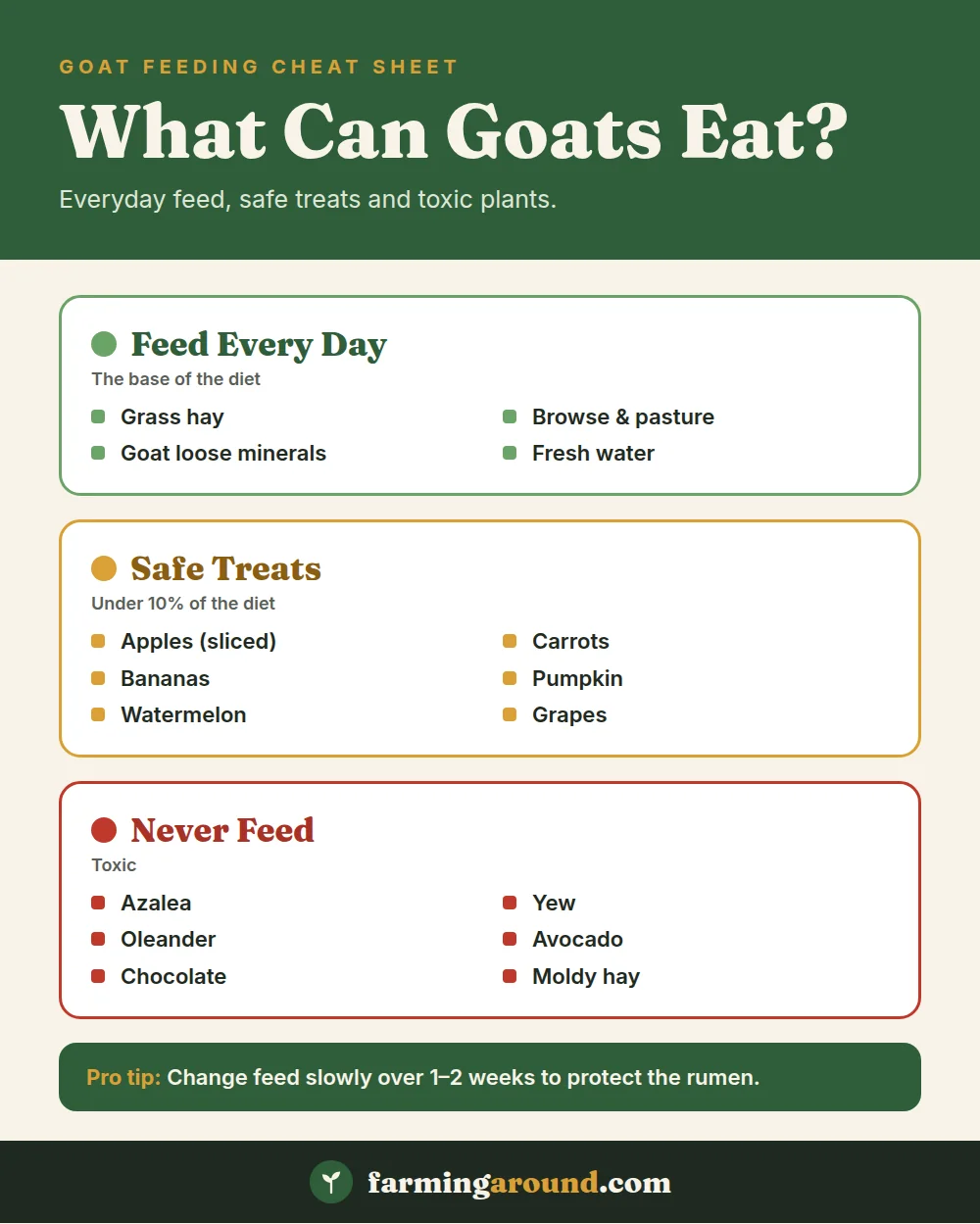
| Feed daily | Treat (≤10%) | Never feed |
|---|---|---|
| Hay, pasture, browse, goat loose minerals, fresh water; alfalfa and grain only when needed | Apples, carrots, bananas, pumpkin, watermelon, grapes, berries, sunflower seeds, weeds and brush | Azalea, rhododendron, yew, oleander, wilted cherry leaves, avocado, chocolate, meat, pet food, moldy feed, lawn clippings |
Planning a small herd? Goats rank among the most profitable farm animals for small acreage, and our guide to homesteading on an acre shows how they fit into a small-farm layout.
Helpful gear for this guide
Handy picks that match the advice above.
Links go to Amazon. Prices and availability change, so check reviews and fit for your setup before buying.
FAQ
Do goats really eat anything?
No. Goats are curious and nibble almost everything, which is where the myth comes from, but they are selective eaters with sensitive stomachs. Many common plants and foods can make them seriously ill.
What is the best food for goats?
Good-quality hay and browse, plus a loose goat mineral and clean water. Everything else, including grain and treats, is a supplement.
Can goats eat grass clippings?
Avoid it. Clippings heat up and ferment quickly, which can cause bloat. Grazing growing grass is fine once goats are used to it.
How much hay does a goat eat per day?
As a rough guide, an adult goat eats 2–4% of its body weight in dry matter a day, so a 100 lb (45 kg) goat eats about 2–4 lb (1–2 kg) of hay if it has no pasture. Actual needs vary with breed, stage of life and hay quality.
Can goats eat bread?
A small piece as an occasional treat won’t hurt, but bread ferments in the rumen and larger amounts can cause bloat.
Is it safe to feed goats kitchen scraps?
Fresh fruit and vegetable scraps are fine in small amounts. Never feed moldy food, meat, dairy leftovers, avocado, chocolate or anything salty or heavily processed.
Sources
- Nutritional Requirements of Goats (Merck Veterinary Manual)
- Vitamins and Minerals for Goats (Cornell University)
- Urinary Calculi in Male Goats and Sheep (University of Maryland Extension)
- Nutrition and Feeding for Sheep and Goats (Oregon State University Extension)
This guide is general information. For a sick goat or a feeding plan for your herd, talk to a vet who treats goats.

5 Comments