

Last updated: October 2026
This guide contains affiliate links. As an Amazon Associate, FarmingAround earns from qualifying purchases, at no extra cost to you.
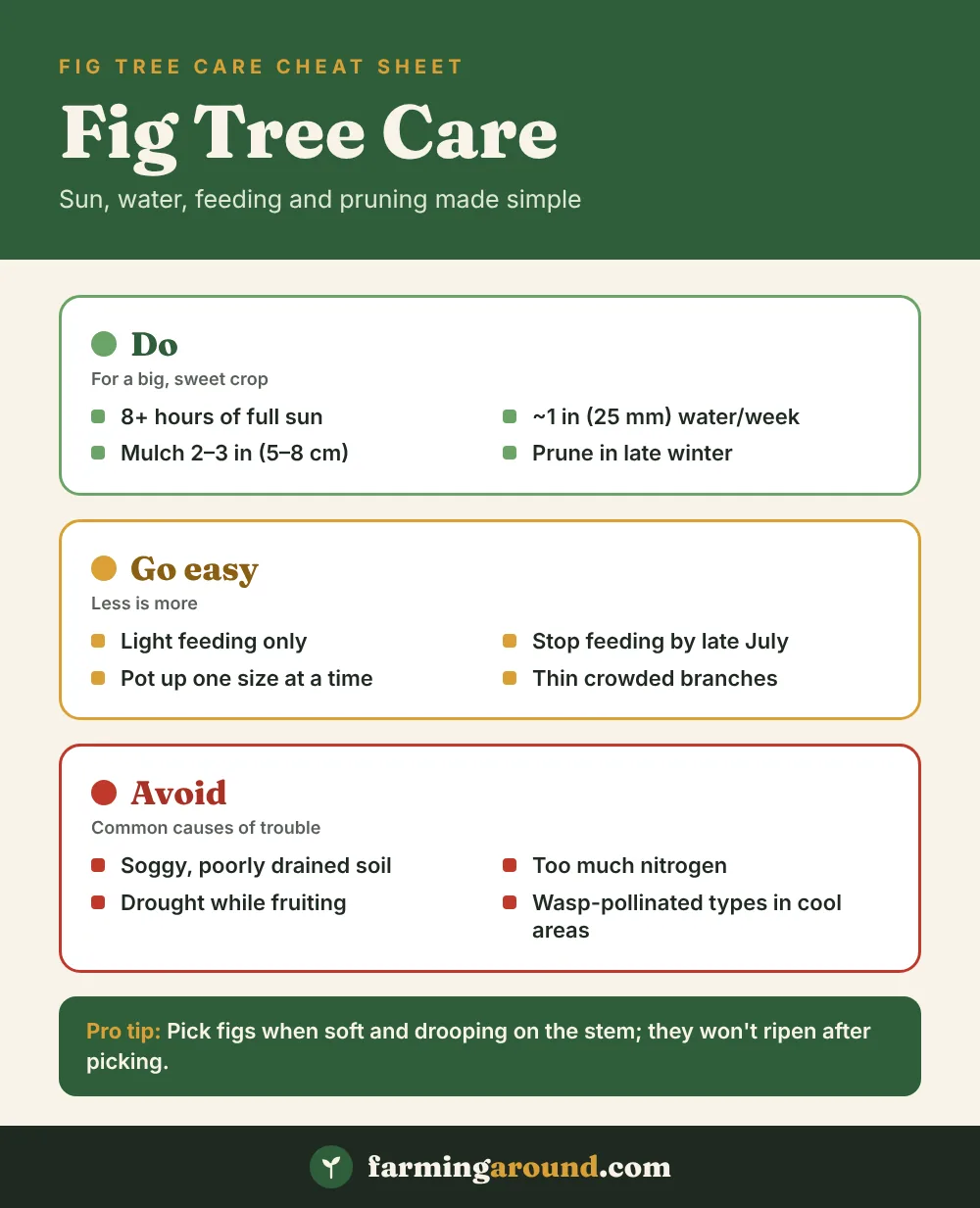
Fig trees are easy to care for once you get four things right: full sun (at least 8 hours), well-drained soil, steady water through summer (about 1 inch / 25 mm a week), and a light hand with fertilizer. Prune in late winter while the tree is dormant, mulch the shallow roots, and protect young trees from hard frost.
This guide walks through fig tree care season by season, covering site and soil, watering, feeding, pruning, growing in pots, harvesting and winter protection, plus a troubleshooting table for the problems gardeners ask about most: fruit dropping, figs not ripening, splitting and yellow leaves.
Key takeaways
- Sun and warmth matter most: give figs 8+ hours of sun and, in cool areas, a south-facing wall.
- Water evenly: drought stress is a top cause of fruit drop. Mulch 2–3 in (5–8 cm) deep.
- Go easy on nitrogen: too much feed means lots of leaves and poor, late fruit.
- Prune when dormant: late winter, after the coldest weather and before new growth.
In this guide
Fig Tree Quick Facts
| Need | What figs want |
|---|---|
| Hardiness | Best in USDA zones 8–10; hardy varieties in zone 7 (and 6 with protection) |
| Sun | Full sun, 8+ hours a day |
| Soil | Well-drained; test pH and nutrients before planting |
| Water | About 1 in (25 mm) a week in the growing season |
| Feeding | Light; often none needed on fertile soil |
| Pruning | Late winter while dormant; summer pinching in cool climates |
| Size | 15–30 ft (4.5–9 m) unpruned; easily kept smaller |
| Years to fruit | Often 3–4 years for a reliable crop |
Sun, Site and Climate
Common figs (Ficus carica) come from warm, dry Mediterranean climates, and they fruit best with lots of sun and heat. Give them at least 8 hours of direct sun in the growing season, shelter from strong wind and a spot that doesn’t sit wet.
In the US, figs grow most easily in zones 8–10. In zone 7, and in zone 6 with winter protection, choose hardy varieties such as ‘Chicago Hardy’, ‘Celeste’, ‘Brown Turkey’ or ‘Olympia’. Even if the top is killed back in a hard winter, these figs can regrow from the roots and still fruit, because the main crop forms on new wood. Young trees are especially vulnerable; Penn State Extension notes they can’t tolerate temperatures below about 20–30°F (around −7 to −1°C).
In the UK and other cool-summer climates, the RHS recommends a sunny, sheltered south- or southwest-facing wall or fence, where reflected heat helps ripen fruit.
Southern Hemisphere note: in Australia, New Zealand and South Africa the seasons are reversed, so plant and prune in winter (June–August), and expect the main harvest in late summer and autumn (February–April).
Soil and Planting
Figs tolerate many soil types as long as drainage is good; soggy ground leads to root rot. Test the soil before planting and adjust based on the results. Avoid sites with a history of root-knot nematodes, which are a major fig pest in sandy southern soils.
- Plant while dormant: in late fall or winter in mild areas, or in spring after hard freezes in colder regions. Container-grown trees can go in later.
- Dig wide, not deep: set the tree at the depth it grew in the pot.
- Restrict roots in cool climates: the RHS suggests a pit about 2 ft (60 cm) deep and wide, lined on the sides with slabs, so the tree puts energy into fruit rather than leafy growth.
- Water in and mulch: spread 2–3 in (5–8 cm) of mulch, keeping it a little away from the trunk.
Watering and Mulching
Figs have shallow roots and dislike drying out, especially while fruit is swelling. Aim for about 1 inch (25 mm) of water a week from rain or irrigation, and more in hot, dry spells or sandy soil. Signs of drought stress include yellowing leaves, leaf drop, and grass under the tree wilting before the rest of the lawn.
Water deeply rather than little and often, and keep a mulch layer topped up to hold moisture and steady soil temperature. Container figs can need water daily in summer heat, but never leave a pot standing in water, especially in winter.
Feeding
Figs are light feeders. On reasonably fertile soil, an established tree mulched each spring with compost or well-rotted manure often needs nothing more. Too much nitrogen pushes leafy growth, delays ripening and makes fruit more likely to drop or split.
- Young trees (years 1–2): Clemson Extension suggests about 1 oz (28 g) of a balanced fertilizer such as 8-8-8 or 10-10-10 monthly from bud break through July.
- Older trees: if growth is weak, split a balanced feed into early spring, early summer and midsummer applications. Stop by late July so new growth can harden before winter.
- Cold areas: feed less or not at all; soft, late growth is the first to be killed by frost.
- Pots and restricted roots: the RHS recommends a high-potassium liquid feed every two weeks in the growing season until fruit starts to ripen.
Pro tip: If your tree grows 3 ft of lush shoots a year but gives few ripe figs, stop feeding for a season. Extra fertilizer is one of the most common reasons figs don’t ripen well.
Pruning
Most fig varieties can bear two crops: a small early-summer breba crop on last year’s wood, and the main crop in mid to late summer on the current year’s growth. Prune with that in mind: heavy winter pruning reduces the breba crop but not the main crop.
- When: late winter, after the coldest weather and before buds break.
- Form: in cold areas, a multi-stemmed bush of 3–8 strong stems recovers better from freeze damage than a single trunk.
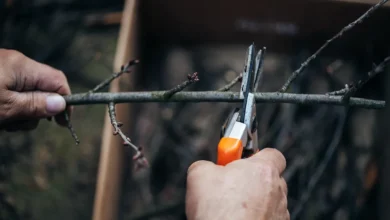
- What to cut: dead and damaged wood, crossing or crowded branches, low branches, and unwanted suckers. Cut back to a bud or branch, leaving no stubs.
- Size control: shorten some of last season’s growth by a third to a half to keep the tree within reach.
- Cool climates: in the UK, pinch out shoot tips in early summer to encourage the pea-sized embryo figs that ripen the following year, and remove larger unripe figs at the end of summer, since they won’t ripen.
Wear gloves and long sleeves: fig sap irritates skin, especially in sunlight. For general techniques and tools, see our guide on how to prune fruit trees.
Watch: How to Prune a Fig Tree
This video from Lazy Dog Farm demonstrates pruning both young and older fig trees.
Figs in Containers
Pots are the best way to grow figs in cold climates, because you can move the tree into an unheated garage or shed for winter. Start in a container about 12 in (30 cm) wide and step up gradually; Penn State recommends ending up with pots at least 18 in (45 cm) across. Overpotting reduces fruiting, so move up only one size at a time. Use a soil-based potting mix, repot or refresh the top layer every couple of years in early spring, and check moisture daily in hot weather. Compact varieties such as ‘Violette de Bordeaux’ and ‘Celeste’ suit containers well.
Harvesting
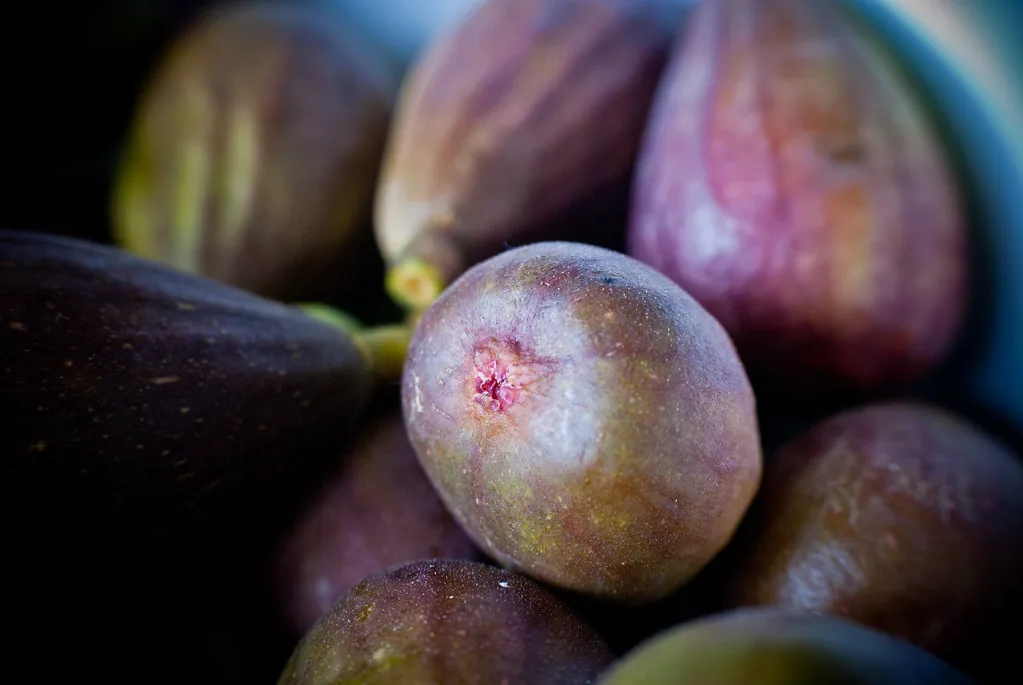
Figs don’t ripen further once picked, so wait until they’re fully ready. A ripe fig:
- has changed to its mature color and feels soft,
- hangs down on a bent neck rather than pointing outward,
- may show a slightly open eye (ostiole) or a drop of nectar.
Fruit typically takes around 90 days from first appearing to ripening. Hold the stalk and gently lift or twist the fig away. Eat fresh within a few days, or dry, freeze or preserve them. Net trees as fruit colors up to keep birds and squirrels off.
Winter Protection
- Mulch the base heavily with straw or leaves to protect the roots and crown.
- Wrap in-ground trees in cold zones: tie branches together, wrap in burlap or frost fleece, and fill with straw. Remove gradually in spring.
- Move pots into an unheated garage, shed or greenhouse after leaf fall until the last frost has passed.
- Stop feeding early so the tree goes into winter with firm, hardened wood.
Buy the right type. Choose self-fruitful “common” figs. Smyrna and some California types need a tiny fig wasp to pollinate them, and the wasp doesn’t live in most of the US, the UK or other cool regions, so the fruit simply drops.
Troubleshooting Common Fig Problems
| Symptom | Likely cause | Fix |
|---|---|---|
| Young fruit falls off | Young tree, drought stress, too much nitrogen, or a variety that needs pollination | Water and mulch steadily, stop feeding, be patient for 3–4 years, grow a common fig |
| Figs stay hard and green | Cool summer, too much shade or nitrogen | More sun, a warm wall, less feed; in the UK, remove late fruit |
| Fruit splits | Heavy rain or watering after a dry spell | Water evenly and keep mulch topped up |
| Sour smell, oozing eye | Fig souring (yeasts spread by insects) | Pick promptly, clear fallen fruit, grow closed-eye varieties |
| Yellow-brown leaves dropping in late summer | Fig rust or drought | Rake up fallen leaves, improve airflow, water in dry spells |
| Stunted tree, knotty swollen roots | Root-knot nematodes | No cure; plant new figs in a fresh, tested site |
| Fruit pecked or missing | Birds, squirrels | Net the tree as fruit begins to color |
For more on diagnosing leaf color problems, see why plant leaves turn yellow. Want more figs? They are among the easiest fruit to root from cuttings, as covered in how to propagate plants, and they feature in our list of fast-growing fruit trees.
Helpful gear for this guide
Handy picks that match the advice above.
Links go to Amazon. Prices and availability change, so check reviews and fit for your setup before buying.
At a Glance: Fig Tree Care
FAQ
How often should I water a fig tree?
Give in-ground trees about 1 inch (25 mm) of water a week in the growing season, more in hot, dry weather. Potted figs may need watering daily in summer.
Why is my fig tree dropping fruit?
The most common causes are a young tree, drought stress, too much nitrogen fertilizer, or a variety that needs a pollinating wasp. Water evenly, cut back on feed and grow a self-fruitful common fig.
When should I prune a fig tree?
Prune in late winter, after the coldest weather and before new growth starts. In cool climates, pinch shoot tips again in early summer.
Can fig trees grow in pots?
Yes, and it’s the best option in cold climates. Use a pot at least 12 in (30 cm) wide to start, move up gradually, and shelter the pot in an unheated building over winter.
How long until a fig tree produces fruit?
Many trees give a few figs early, but expect around 3–4 years before a reliable, good-quality crop.
Do fig trees need fertilizer?
Often not. An annual mulch of compost is enough for established trees on decent soil. Feed lightly only if growth is weak, and never late in the season.

One Comment