
Last updated: November 2026
When people say “white turkeys,” they usually mean the Broad Breasted White, the fast-growing commercial bird behind almost every supermarket Thanksgiving turkey. But there are also heritage white breeds, the White Holland, Beltsville Small White and Midget White, which grow more slowly, mate naturally and suit small farms better. Occasionally you’ll even see an all-white wild turkey, which is a rare color variation rather than a breed.
This profile covers where white turkeys came from, how the main types compare on size, temperament and production, how to care for them, and which white turkey fits your farm or homestead.
Key takeaways
- “White turkey” usually means the Broad Breasted White, the standard commercial meat turkey.
- Heritage whites (White Holland, Beltsville Small White, Midget White) mate naturally and grow more slowly.
- Broad Breasted Whites generally can’t breed naturally, so you buy new poults each year.
- White wild turkeys are smoke-phase or leucistic color variations, not a breed.
In this guide
White Turkeys: Quick Facts
| Type | Adult weight (tom / hen) | Mates naturally? | Best for | Livestock Conservancy status |
|---|---|---|---|---|
| Broad Breasted White | Processed young; Penn State Extension gives about 24–36 lb (11–16 kg) toms at 17 weeks and 18–20 lb (8–9 kg) hens at 14 weeks | Generally no (artificial insemination) | Fast, efficient meat production | Commercial (not listed) |
| White Holland | 36 / 20 lb (16 / 9 kg) | Yes | Heritage meat bird, calm flock | Threatened |
| Beltsville Small White | 21 / 12 lb (9.5 / 5.4 kg) | Yes | Small table bird | Critical (priority list) |
| Midget White | 20 / 10 lb (9 / 4.5 kg) | Yes | Small farms, meat and some eggs | Watch |
Heritage weights are adult weights from The Livestock Conservancy’s turkey chart.
History and Origin
White Holland
The White Holland is one of the oldest white varieties. It was developed in Europe (the name points to the Netherlands) and brought back to North America by Dutch settlers, and the American Poultry Association recognizes it as a heritage variety. For a long time it was the main white turkey in the US.
Beltsville Small White
Between 1934 and 1941, USDA researchers at Beltsville, Maryland, set out to breed a smaller turkey that would fit apartment-size refrigerators and ovens. The Livestock Conservancy notes that a 1936 survey found most home consumers wanted a bird of 8–15 pounds. Using White Holland, White Austrian, Narragansett, Bronze and wild turkey stock, they created the Beltsville Small White, recognized by the APA in 1951. It peaked in the mid-1950s, then nearly disappeared by the 1970s as the industry moved to bigger birds.
Broad Breasted White
The Broad Breasted White was developed by crossing the Broad Breasted Bronze with the White Holland. White feathers won out because pin feathers left after plucking are much less visible on a white bird, giving a cleaner-looking carcass. By the 1960s it dominated commercial production, replacing both the Broad Breasted Bronze and the Beltsville Small White.
Midget White
The Midget White was developed at the University of Massachusetts in the late 1960s as a smaller companion to the Broad Breasted White. The market for it never really took off, but it survived with small breeders and is valued today as a friendly, manageable heritage-type bird.
Appearance
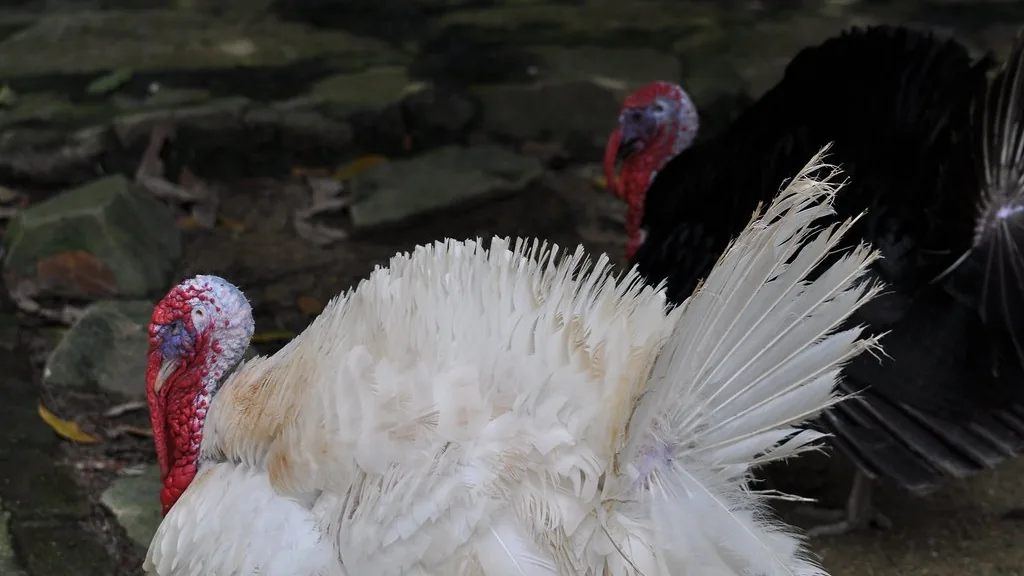
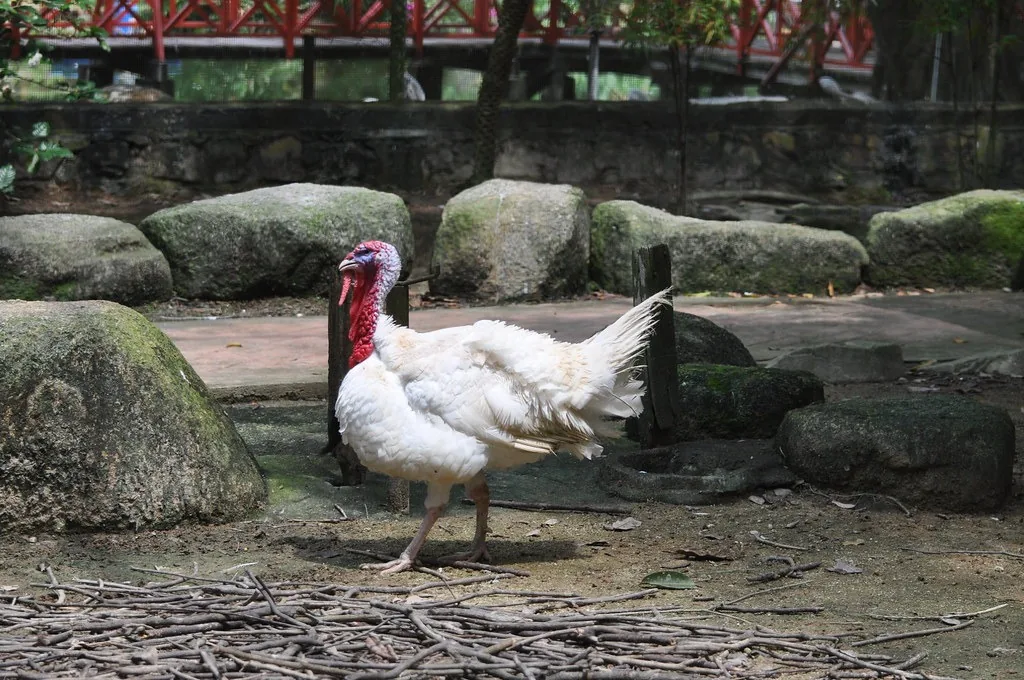
All white turkeys have pure white plumage, with the classic turkey head: bare skin that shifts from red to bluish-white, a fleshy snood over the beak and a wattle under the chin. Toms carry a black beard of hair-like feathers on the chest; some hens have a small one too. Oklahoma State University’s breed profile of the Beltsville describes dark brown eyes, a horn-colored beak and pinkish-white shanks and toes.
The easiest way to tell the types apart is body shape. Broad Breasted Whites are extremely deep-chested and heavy, with short legs relative to their bulk. Heritage whites look more like a classic turkey: longer-legged, more upright and able to fly short distances.
Temperament
Temperament depends heavily on how a line was bred and how the birds are raised, so individuals vary. In general:
- Broad Breasted Whites are usually docile and not very active, partly because their weight makes moving around hard work.
- White Hollands have a reputation as one of the calmest turkey varieties.
- Beltsville Small Whites range from docile to more assertive, but are generally good natured and outgoing.
- Midget Whites are often described by The Livestock Conservancy as very people-oriented birds.
As with any turkeys, toms can become pushy during breeding season, so supervise children around adult males.
Pro tip: If you raise Broad Breasted Whites, offer low perches or none. They’re heavy for their legs, and jumping down from a high roost can injure them.
Meat and Egg Production
Meat: Broad Breasted Whites are bred for rapid growth and a very high share of breast meat; the Cooperative Extension’s poultry resource notes that about 70% of their meat is breast meat. Heritage turkeys grow more slowly, cost more in feed per pound and produce closer to an even split of white and dark meat, which many people find more flavorful.
Eggs: Turkeys aren’t kept for eggs the way chickens are, but heritage white hens do lay seasonally in spring and summer. The Midget White stands out, with hens laying up to about 80 eggs, according to The Livestock Conservancy. Our guide to whether turkeys lay eggs explains when hens start and how many eggs to expect, and our turkey eggs guide covers eating and hatching them.
Breeding: This is the biggest practical difference. Heritage whites mate naturally and can raise their own young. Broad Breasted Whites generally can’t, because of their size and build, so commercial flocks rely on artificial insemination. If you keep Broad Breasted Whites, plan to buy new poults every year.
Watch: raising turkeys on a small pasture farm
Sow the Land shows how they raise and sell turkeys on a small pastured farm.
Care Requirements
Brooding poults
Turkey poults can’t regulate their body temperature for roughly the first 10 days. Penn State Extension recommends a room temperature around 88°F (31°C) with a heat source raising it to about 95°F (35°C) underneath, then lowering by about 5°F (3°C) a week until you reach 70°F (21°C). A brooder heat plate is a lower-fire-risk alternative to a hanging heat lamp. Poults sometimes need help finding feed and water at first; dipping a few beaks into the waterer helps.
Feed
Turkeys need more protein than chickens. Penn State Extension suggests a 28% protein starter for the first 3–4 weeks, stepping down gradually as birds grow, and not dropping below 16% for finishing. Provide grit if they get whole grains or forage. See our full guide to what turkeys eat for feeding by age.
Housing and space
Give growing turkeys secure shelter at night and dry bedding. Penn State Extension suggests about 3–5 square feet (0.3–0.5 m²) of housing per bird from 8 weeks, depending on target weight, and about 250 birds per acre on range. Heritage whites like to roost high; heavy Broad Breasted birds should have low perches or none, since jumping down can injure their legs.
Health
- Blackhead (histomoniasis): Penn State Extension warns it can be a serious problem when turkeys share ground with chickens, or use ground where chickens have been kept within the last 3–5 years. Raise them apart where possible.
- Weight-related problems: Broad Breasted Whites kept well past processing age are prone to leg, heart and joint problems from their size.
- Biosecurity: turkeys are susceptible to avian influenza. Read our guide to bird flu in backyard flocks; the same precautions apply.
Keep turkeys apart from chickens if you can. Penn State Extension warns that blackhead (histomoniasis) can be serious in turkeys raised with chickens or on ground used by chickens within the last 3–5 years.
What About White Wild Turkeys?
Every so often, hunters and birdwatchers spot an all-white or mostly white turkey in the wild. These aren’t a breed. According to the National Wild Turkey Federation, they’re color phases caused by genetics:
- Smoke phase: probably the most common color phase. These birds lack brown pigment, so they look mostly white with gray and black markings on the back, wings and tail.
- Leucistic (all-white): birds that lack pigment almost entirely. They aren’t true albinos unless they have pink eyes.
Wild and domestic turkeys do sometimes interbreed, but the NWTF notes this doesn’t explain all color variations.

Pros and Cons of White Turkeys
| Pros | Cons | |
|---|---|---|
| Broad Breasted White | Fast growth; heavy, meaty carcass; lots of breast meat; clean-looking dressed bird; docile | Can’t breed naturally; buy poults every year; health problems if kept long; poor foragers |
| Heritage whites (White Holland, Beltsville, Midget White) | Mate naturally; better foragers; longer productive lives; calm or friendly lines available; clean-dressing white plumage | Slower growth and higher feed cost per pound; smaller birds (Beltsville, Midget); can be hard to source |
Which White Turkey Is Right for You?
- Want a big holiday turkey in one season? Broad Breasted White. Start poults in spring and process before health problems set in.
- Want a self-sustaining flock? A heritage white such as the White Holland, which can breed and raise its own poults.
- Short on space or want a smaller table bird? Midget White or Beltsville Small White. Buy from a reputable breeder, as The Livestock Conservancy warns Midget Whites are sometimes sold under the Beltsville name.
- Want to help conserve rare breeds? All three heritage whites are on The Livestock Conservancy’s priority list.
Comparing other breeds? Our profile of Narragansett turkeys covers a colorful heritage alternative, and our list of the most profitable farm animals shows where turkeys fit in a small-farm plan.
Helpful gear for this guide
Handy picks that match the advice above.
Quick Reference

FAQ
What breed of turkey is white?
The most common is the Broad Breasted White, the standard commercial turkey. Heritage white breeds include the White Holland, Beltsville Small White and Midget White.
Why are most commercial turkeys white?
White feathers leave less visible pin feathers on the dressed bird, giving a cleaner-looking carcass. That made white birds more appealing to processors and shoppers.
Can Broad Breasted White turkeys breed naturally?
Generally not. Their size and very large breasts make natural mating difficult, so commercial producers use artificial insemination. Heritage white breeds can mate naturally.
How big do white turkeys get?
It depends on the type. Penn State Extension gives Broad Breasted White toms at about 24–36 lb by 17 weeks. Heritage White Holland toms average about 36 lb as adults, while Midget White and Beltsville toms are around 20–21 lb.
Are white wild turkeys albino?
Usually not. Most white wild turkeys are smoke-phase or leucistic birds. A true albino has pink eyes.
How long do white turkeys live?
Broad Breasted Whites are bred to be processed young and rarely live long if kept, because of weight-related health problems. Heritage whites have a longer, productive outdoor lifespan, which is part of the definition of a heritage turkey.
Sources
- Beltsville Small White Turkey (The Livestock Conservancy)
- Heritage Turkey Chart (The Livestock Conservancy)
- Small Flock Turkey Production (Penn State Extension)
- What Causes Color Phase Turkeys? (National Wild Turkey Federation)
For flock health questions, talk to a vet who treats poultry or your local extension office.
This guide contains affiliate links. As an Amazon Associate, FarmingAround earns from qualifying purchases, at no extra cost to you.
Get free farming guides in your inbox
Practical guides, seasonal tips and market updates. No spam, unsubscribe anytime.
Subscribe free