
Last updated: November 2026
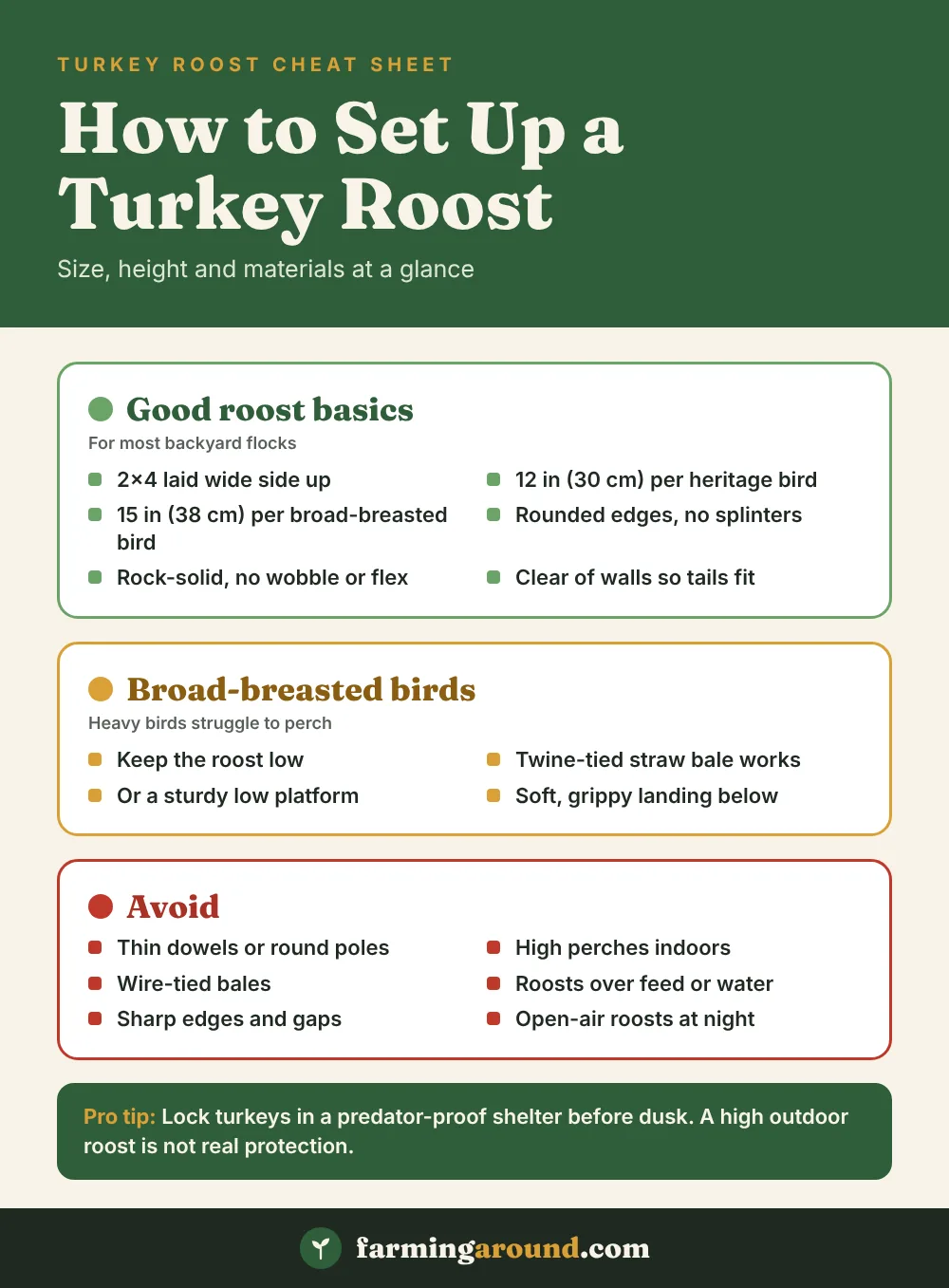
A turkey roost is a sturdy, wide perch or platform where turkeys sleep off the ground at night. For most backyard flocks, a 2×4 board laid wide side up, set low and solid inside a predator-proof shelter, is all you need. Allow about 12 inches (30 cm) of roost per heritage turkey and 15 inches (38 cm) per broad-breasted bird, and give heavy commercial-type birds a low platform or straw bale instead of a bar.
This guide covers the main roost designs, how big and how high to build, which materials work, how to keep costs down, and the mistakes that cause sore feet, leg injuries and lost birds. Whether you keep a few heritage turkeys or are raising broad-breasted birds for the table, you’ll find a setup that fits your space and budget.
Key takeaways
- Use a wide, flat perch: a 2×4 laid wide side up suits most turkeys better than a round pole or dowel.
- Give each bird enough room: about 12 in (30 cm) per heritage turkey and 15 in (38 cm) per broad-breasted turkey.
- Keep it low for heavy birds: broad-breasted turkeys often can’t perch well, so offer a low platform or twine-tied straw bale.
- A roost is not predator protection: lock turkeys in a secure shelter before dusk, however high they sleep.
In this guide
Do Turkeys Need a Roost?
Turkeys naturally sleep off the ground. Wild turkeys fly up into trees at dusk, and domestic heritage breeds keep that instinct strongly. If you don’t give them somewhere to perch, they’ll pick their own spot, often the top of a fence, a gate, a trailer or the roof of your coop.
That said, a roost is a comfort and management tool rather than a strict requirement. University of Maine Extension notes that roosts are optional for turkeys and that birds can be injured jumping down from them. Market birds raised on deep, dry bedding often do fine without one. Heritage turkeys kept for breeding or as long-term flock members are much happier with a proper place to perch, and so are you, because they stop roosting where you don’t want them.
As a rule of thumb:
- Heritage turkeys (Bourbon Red, Narragansett, Royal Palm, Slate and similar): give them a real roost. They want height and will use it.
- Broad-breasted turkeys (Broad Breasted White and Bronze): offer a low, wide platform or bale. Many mature birds are too heavy to perch on a bar.
- Poults: once they’re feathered and moving around confidently, a low practice perch a few inches off the floor helps them learn.
If you’re still deciding which turkeys suit you, our guides to Narragansett turkeys and white turkey breeds explain how size and type differ.

Turkey Roost Designs
There’s no single right design. Choose based on your breed, the size of your shelter and how much building you want to do.
1. Single bar roost
A 2×4 or 2×6 fixed horizontally between two walls or sturdy posts. It’s the simplest design and works well for a small heritage flock in a shed or coop. Lay the board with the wide side facing up so birds can rest their feet flat.
2. Ladder or tiered roost
Two or three bars set at staggered heights, angled against a wall like a leaning ladder. Birds hop up in steps instead of flying straight to the top, which is easier on their legs. Space the bars far enough apart horizontally that birds on higher rungs don’t drop manure on those below.
3. Freestanding A-frame roost
Two A-shaped end frames joined by one or more bars. Because it stands on its own, you can move it for cleaning or use it inside a barn, a hoop house or a covered run. Make the feet wide and brace them well so a group of heavy birds can’t tip it.
4. Low platform or bench
A solid, wide board or low bench raised slightly off the floor. This is the best choice for broad-breasted birds and older or heavy turkeys that struggle on a narrow bar. Add a little bedding or a rubber mat on top for grip.
5. Straw bale roost
Small rectangular straw bales make an easy, soft, low roost for heavy birds. Use only bales tied with twine, not wire, since loose or broken wire can injure feet and legs. Replace bales when the strings loosen or they start to sag.
6. Mobile roost
A roost bolted to a skid or a small trailer frame, often under a roof, for flocks rotated around pasture. It still needs to be inside a secure, predator-proof enclosure at night, such as electric poultry netting with a lockable shelter.
Watch: A simple DIY turkey roosting stand
Here’s a short build of a freestanding turkey roost stand you can adapt for your own flock.
How Big Should a Turkey Roost Be?
Roost length is the number that matters most, because turkeys need room to settle side by side without shoving each other off.
| Turkey type | Roost space per bird | Best roost style |
|---|---|---|
| Heritage turkeys | About 12 in (30 cm) | Wide bar, ladder or A-frame |
| Broad-breasted turkeys | At least 15 in (38 cm) | Low platform, bench or straw bale |
| Young poults | Less, but give extra as they grow | Low practice perch |
So for six heritage turkeys you’d want at least 6 ft (1.8 m) of roost, and for six broad-breasted birds at least 7.5 ft (2.3 m). Build a little extra. Toms in particular like space, and a cramped roost leads to squabbling at bedtime.
Width: turkeys have big feet and sleep with them flat, so a wide surface is more comfortable than a round pole. A standard 2×4 (actual size about 1.5 x 3.5 in, or 3.8 x 8.9 cm) laid flat is a popular choice. A 2×6 gives heavy birds even more support.
Distance from the wall: leave enough room behind the bar for a turkey’s body and tail, noticeably more than you would for chickens. A cramped roost against a wall means bent tail feathers and birds that won’t settle.
Pro tip: Measure your roost by the birds you’ll have when they’re fully grown, not the poults you have today. Turkeys grow fast, and a roost that looks roomy in spring can be crowded by fall.
How High Should a Turkey Roost Be?
Higher isn’t better inside a shelter. Turkeys are heavy, and every morning they jump down. A hard landing from a tall perch is a common cause of leg and foot injuries, including bumblefoot.
- Broad-breasted turkeys: keep the roost very low. A platform or bale just off the floor is plenty. Many will simply sleep on deep bedding, and that’s fine.
- Heritage turkeys: they prefer a higher perch, but indoors a moderate height they can reach in one easy hop or by a ladder is safer than a tall bar.
- Ladder roosts: let birds climb up and down in steps, which is the gentlest option if you want height.
Whatever the height, make the landing zone soft and grippy. A thick layer of dry bedding such as straw or wood shavings under and in front of the roost cushions their landing. Avoid bare concrete.
Heritage turkeys are surprisingly good fliers. If you want to know how high they can really go, see our guide on whether turkeys can fly.

Best Materials for a Turkey Roost
A good roost material is strong, comfortable underfoot and easy to clean.
| Material | Pros | Cons |
|---|---|---|
| Untreated 2×4 or 2×6 lumber | Cheap, flat, easy to cut and fix | Needs sanding; wood can harbor mites in cracks |
| Natural branches or poles | Free, natural grip | Often too round and narrow for big birds; check for strength |
| Twine-tied straw bales | Soft, low, great for heavy birds | Break down and need replacing |
| Solid boards or plywood platform | Very stable for broad-breasted birds | Needs bedding or a mat for grip |
| Metal pipe | Durable, easy to wash | Slippery, cold in winter, too narrow for most turkeys |
For lumber, many keepers prefer untreated wood for anything birds stand on and peck at. Round over the edges with a sander or a sanding block so there are no splinters or sharp corners. Use exterior-grade screws and brackets, and check that the whole roost doesn’t flex or wobble when you lean your weight on it. A turkey roost has to hold several heavy birds landing at once.
How to Build a Simple Turkey Roost
This is a basic freestanding A-frame roost for a small heritage flock. Adjust the length to your bird count using the table above.
- Plan the length. Multiply your number of birds by 12 in (30 cm) for heritage turkeys or 15 in (38 cm) for broad-breasted birds, then add a little extra.
- Cut the parts. You’ll need four legs for two A-shaped end frames, a cross brace for each frame, and one or two 2×4 roost bars cut to your planned length.
- Sand everything. Round the top edges of the roost bars and remove splinters from all surfaces birds will touch.
- Build the end frames. Join each pair of legs at the top in an A shape, and screw a cross brace near the bottom to stop them spreading.
- Attach the roost bars. Fix the bars wide side up across the frames. If you add a second, lower bar, offset it so birds on top don’t foul those below.
- Brace for stability. Add diagonal braces or a base rail joining the feet so the frame can’t rack or tip when several birds land at once.
- Test it. Press down hard and rock it side to side. It should feel completely solid.
- Place and bed it. Set it inside your secure shelter, away from feeders and waterers, with deep dry bedding underneath.
For heavy birds, skip the A-frame and build a low, wide bench from 2×6 boards on short legs, or simply set out two or three twine-tied straw bales side by side.
Turkey Roost Costs: Build vs Buy
A turkey roost is one of the cheapest pieces of poultry equipment you can make. Prices for lumber and hardware vary a lot by region and season, so here’s how the options compare in relative terms rather than exact figures.
| Option | Relative cost | Best for |
|---|---|---|
| Bar fixed between existing walls or posts | Lowest: a board and a few screws | Small heritage flocks in a shed or coop |
| Straw bales | Low, but recurring as bales wear out | Broad-breasted birds, short-term setups |
| DIY freestanding or ladder roost | Low to moderate: lumber, screws, brackets | Most backyard flocks |
| Mobile roost on skids or a trailer | Moderate to high | Pasture rotation |
| Ready-made perches | Varies widely | Small flocks; check they’re sized for turkeys |
Most ready-made perches are designed for chickens and are too narrow or flimsy for turkeys, so check the bar width and load before buying. Reusing sound scrap lumber is the easiest way to keep the cost close to zero.
Where to Put a Turkey Roost
Location matters as much as design:
- Inside a predator-proof shelter. Raccoons, foxes, coyotes, owls and dogs all take turkeys. Close birds in before dusk and let them out after it’s light. Gaps as small as a coin can let some predators in, and rats can bite sleeping birds.
- Away from feed and water. Turkeys drop a lot of manure overnight. Keep the roost well clear of feeders and drinkers.
- Out of drafts but well ventilated. Damp, ammonia-heavy air causes respiratory problems. High vents that move air without blowing directly on roosting birds are ideal. The same principles apply as in our guide to chicken coop ventilation.
- Somewhere easy to clean. Put the roost where you can reach underneath with a fork or shovel.
A tree is not a safe roost. Heritage turkeys will happily roost high in trees or on open rails, but a high outdoor perch does not reliably protect them from owls, raccoons and other climbing or flying predators. Unless the whole area is fully predator-proof, train your flock to go into a secure shelter every evening.
Common Turkey Roost Mistakes
- Using chicken-sized perches. Thin dowels and round poles are too narrow for turkey feet and can’t take the weight.
- Building too high indoors. High perches mean hard landings and more leg and foot injuries.
- Not enough space. Crowded birds fight, fall off and end up sleeping on the floor anyway.
- Wobbly frames. If a roost moves when birds land, they won’t trust it.
- Wire-tied bales or sharp edges. Loose wire, protruding screws and splinters cause injuries.
- Roosting over feed or water. This contaminates both and spreads disease.
- Forgetting to clean. Manure builds up fast under a turkey roost. Remove it regularly and keep bedding dry.
- Relying on height for safety. Only a locked, predator-proof shelter keeps turkeys safe at night.
Good roosting goes hand in hand with good feeding. See what turkeys eat for the right feeds at each stage.
Helpful gear for this guide
Handy picks that match the advice above.
Links go to Amazon. Prices and availability change, so check reviews and fit for your setup before buying.
Turkey Roost at a Glance
FAQ
How much roost space does a turkey need?
Allow about 12 inches (30 cm) per heritage turkey and at least 15 inches (38 cm) per broad-breasted turkey. Add a little extra so birds can settle without fighting.
What is the best wood for a turkey roost?
A 2×4 or 2×6 laid wide side up is the most common choice. Sand the edges smooth and make sure the frame is rock solid.
Can broad-breasted turkeys roost?
Young broad-breasted birds may perch, but many mature birds are too heavy to use a bar comfortably. Give them a low platform, bench or twine-tied straw bale, or let them sleep on deep, dry bedding.
Can turkeys and chickens share a roost?
They can share a building, but turkeys need wider, stronger perches with more space, so give them their own roost. Many keepers house them separately for disease reasons too; talk to your vet or extension office about blackhead disease risk in mixed flocks.
Why are my turkeys roosting on the fence?
They’re looking for height. Give heritage birds a proper roost in their shelter, herd them in at dusk for a few nights until they learn the routine, and lock the door.
How often should I clean under the roost?
Remove manure and wet bedding regularly, at least weekly in most setups and more often in wet weather or with larger flocks, and keep the bedding dry.
Sources
- How much roost space do I need for turkeys? (Meyer Hatchery)
- Turkey Brooding and Management, Bulletin #2187 (University of Maine Cooperative Extension)
- Building a Good Home for Turkeys (The Open Sanctuary Project)
For lameness, foot sores or other health problems in your turkeys, contact a poultry vet or your local extension office.
This guide contains affiliate links. As an Amazon Associate, FarmingAround earns from qualifying purchases, at no extra cost to you.