
Raising meat chickens is one of the fastest ways to put home-grown protein in your freezer. In as little as 6–8 weeks, a batch of chicks can grow into table-ready birds, and pasture-raised chicken tastes noticeably better than most store-bought meat. This guide covers everything you need to raise meat chickens successfully: choosing the right breed, brooding, feeding, housing on pasture, realistic costs and your processing options.
Meat Chickens at a Glance
| Most common breed | Cornish Cross (Cornish × Rock hybrid) |
| Time to harvest | About 6–8 weeks (Cornish Cross); 9–12+ weeks (slower-growing breeds) |
| Typical dressed weight | About 4–6 lb (1.8–2.7 kg) for Cornish Cross |
| Feed | High-protein broiler feed, about 20–22% protein |
| Feed per bird | Roughly 12–15 lb (5.5–7 kg) for Cornish Cross to 8 weeks |
| Space | Brooder first, then a coop or movable pasture pen |
Best Meat Chicken Breeds
| Breed | Weeks to harvest | Pros | Cons |
|---|---|---|---|
| Cornish Cross | 6–8 | Fastest growth, most meat, best feed efficiency | Prone to leg and heart problems, less active, not suited to long lives or breeding |
| Freedom Ranger / Red Ranger | 9–12 | Active foragers, hardier, richer flavor | Longer to raise, a bit less breast meat |
| Dual-purpose heritage (e.g., Plymouth Rock, Orpington) | 16–20+ | Can breed your own, excellent flavor | Slow, smaller carcasses, more feed per pound |
For beginners: Cornish Cross gives the fastest, most predictable results. If you want birds that forage more and handle heat better, try Rangers.
Step 1: Set Up the Brooder
Meat chicks need warmth for their first 2–3 weeks, and they grow very fast.
- Heat: about 90–95°F (32–35°C) under the heat source in week one, lowering it about 5°F (3°C) per week. Radiant heat plates are safer than heat lamps.
- Space: start at about ½ sq ft per chick, increasing to at least 1 sq ft by week 3.
- Bedding: deep pine shavings, refreshed often. Meat birds produce a lot of manure.
- Water: plenty of clean water at all times, with multiple waterers for bigger batches.
The brooder setup is the same as for laying hens, which we cover in detail in raising chickens for beginners.
Step 2: Feed Correctly
- Use a broiler starter/grower feed with about 20–22% protein from day one. Some producers switch to a lower-protein finisher for the final weeks.
- Don’t use layer feed: it has too little protein and too much calcium for growing meat birds.
- Cornish Cross feeding schedule: after the first 2 weeks, many growers remove feed overnight (about 12 hours on, 12 hours off). This slows the extreme growth rate slightly and reduces leg problems and heart failure, while water stays available at all times.
- Offer grit if birds are on pasture or getting any food besides feed.
Step 3: Move Them to Pasture (or a Coop)
From about 3 weeks old, or once fully feathered and the weather is mild, meat chickens can move outdoors.
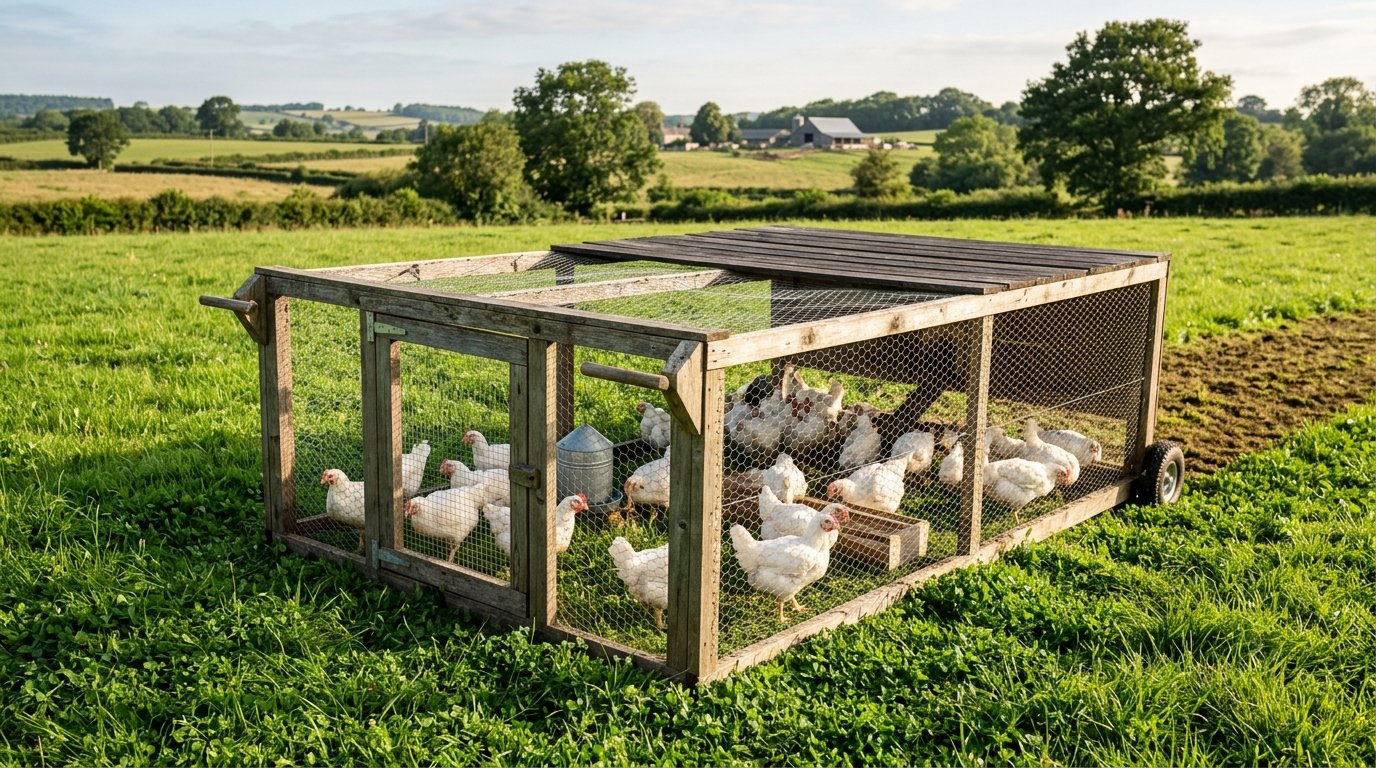
Movable Pasture Pens (“Chicken Tractors”)
A floorless pen, often about 10 × 12 ft (3 × 3.6 m) and 2–3 ft tall, is moved to fresh grass daily. Benefits:
- Birds get fresh forage, insects and sunlight
- Manure is spread evenly, fertilizing your pasture
- Cleaner birds and less smell than a fixed coop
Allow roughly 1.5–2 sq ft (0.14–0.19 m²) per bird by finishing age. Provide shade (half-cover the pen), protection from rain, and strong predator-proof sides.
Fixed Coop With a Run
This works well too. Plan about 2 sq ft per bird inside, keep bedding dry, and clean out often.
Step 4: Manage Health and Welfare
- Heat stress: Cornish Cross struggle in heat. Provide shade, airflow, cool water, and move pens during cooler parts of the day.
- Leg problems: overnight feed restriction, space to move, and not overfeeding all help.
- Sudden death/heart issues: more common in fast-growing birds. Controlled feeding reduces the risk.
- Predators: hawks, foxes, raccoons and dogs. Use hardware cloth and secure pens.
- Biosecurity: wash hands, use dedicated boots, and keep wild birds away from feed.
How Much Does It Cost to Raise Meat Chickens?
Costs vary by region and feed prices, but here’s a realistic per-bird breakdown for Cornish Cross (USD, approximate):
| Cost item | Per bird (approx.) |
|---|---|
| Chick | $2–$4 |
| Feed (12–15 lb) | $6–$10 |
| Bedding, electricity, grit | $0.50–$1.50 |
| Processing (if outsourced) | $4–$8 |
| Estimated total | About $12–$22 per bird |
Plus one-time equipment costs: brooder, feeders, waterers, and a pasture pen. The price per pound often lands near or below premium pasture-raised chicken, with full control over how your birds are raised. Selling meat birds can also be a small-farm income stream; see our list of the most profitable farm animals.
Step 5: Processing Options
Use a Processor
The easiest option: book a local poultry processor well in advance (they fill up in peak season). You drop off live birds and collect packaged chickens.
Process at Home
Many homesteaders process their own birds with basic equipment: a killing cone, sharp knife, scalder (water around 145–150°F / 63–66°C), plucker or hand plucking, and a clean workspace with plenty of cold water. Key food safety rules:
- Withhold feed (not water) for several hours before processing to empty the crop.
- Chill carcasses quickly in ice water to below 40°F (4°C).
- Rest birds in the refrigerator for 1–2 days before freezing or cooking so the meat relaxes and becomes tender.
Selling meat? Rules for processing and selling poultry vary widely. In the US, small producers may qualify for federal exemptions with strict limits, and state rules differ. In the UK, Canada, Australia and elsewhere, check your national and local food safety requirements before selling anything.
Raising Meat Chickens: Week-by-Week Timeline (Cornish Cross)
| Age | What happens |
|---|---|
| Day 1 | Chicks into a warm brooder; dip beaks in water; starter feed |
| Weeks 1–2 | Lower heat weekly; add space; watch for pasty vents |
| Weeks 2–3 | Start 12-hour overnight feed removal; feathering begins |
| Weeks 3–4 | Move to a pasture pen or coop if the weather allows |
| Weeks 4–7 | Rapid growth; move the pen daily; manage heat |
| Weeks 6–8 | Weigh a few birds; process at target weight |
FAQ: Raising Meat Chickens
How long does it take to raise meat chickens?
Cornish Cross are typically ready in 6–8 weeks. Slower-growing breeds take 9–12 weeks or more.
Can I raise meat chickens with laying hens?
It’s best not to. They need different feeds and grow at very different rates, and Cornish Cross can be bullied by layers.
How many meat chickens should a beginner raise?
A first batch of 10–25 birds is manageable and teaches you the process before scaling up.
Is raising meat chickens worth it?
For many homesteaders, yes. You get high-quality meat, know exactly how it was raised, and it’s often cheaper than premium pasture-raised chicken.