Last updated: November 2026
An automatic chicken coop door opens at dawn and closes at dusk on its own, so your hens are locked in safely every night even when you are late, away or asleep. For most backyard flocks, choose a vertical sliding door with a light sensor plus a timer backup, a door that locks when closed, and a power source you can rely on in winter. Below are the main options and what to check before you buy.
Key takeaways
- An automatic door closes the coop at dusk and opens it at dawn, even when you are late or away.
- Must-have: a door that locks when closed, so a raccoon can’t slide it up from below.
- Choose a light sensor plus timer backup, and an anti-pinch or obstacle stop.
- Plan power for winter: cold drains batteries and short days limit solar panels.
In this guide
Why an automatic door is worth it
Most flock losses happen at night or at first light, when raccoons, foxes, coyotes and owls hunt. Chickens go to roost on their own at dusk, but someone still has to shut the door. Miss that once and you can lose the whole flock. An automatic door removes that daily risk, and lets your hens out at sunrise even if you sleep in.
A door is only as good as the coop around it. Pair it with predator-proof walls and windows: see our chicken coop plans and raising chickens for beginners guides.
Quick picks
- Best self-locking door panel (add to an opener): ChickenGuard Self-Locking Predator-Proof Coop Door
- Best complete door for wooden coops: Omlet Automatic Chicken Coop Door Opener
- Best battery-powered door: Run-Chicken T50 Automatic Coop Door
- Best with app control: Omlet Smart Automatic Coop Door Opener (WiFi)
- Best aluminum door with anti-pinch: JVR Automatic Chicken Coop Door
- Best for large breeds: INNOLAND Large Automatic Chicken Coop Door
- Solar option: Solar Automatic Chicken Coop Door with LCD Timer
Comparison at a glance
| Product | Type | Best for | Key feature |
|---|---|---|---|
| ChickenGuard | Self-locking door panel (no motor) | Adding to an opener | Locks shut when closed |
| Run-Chicken T50 | Battery-powered aluminum door | Coops with no outlet nearby | App and timer control, anti-pinch |
| Omlet Automatic Door Opener | Complete door for wooden coops | Wooden coops, no wiring | Light sensor or timer |
| Omlet Smart Opener | WiFi opener | Checking the door from your phone | App control |
| JVR Automatic Door | Aluminum door and frame | Simple timer setup | Anti-pinch |
| INNOLAND Large Door | Large aluminum door | Big breeds | Wider opening |
| Solar door with LCD timer | Solar-powered door | Coops far from power | Solar panel with timer |
How automatic coop doors work
Most models have three parts: a door panel (usually sliding up and down), a motor unit that lifts and lowers it, and a control that decides when. The control is either a light sensor (opens at sunrise, closes at dusk, adjusts with the seasons) or a timer (opens and closes at set times). Many doors offer both, which is ideal: use the light sensor day to day, and the timer as a backup or for winter when you want hens in a little earlier.

The main options
1. Self-locking door panels
A self-locking door holds itself shut when closed, so a raccoon cannot slide it open from below. That is the single most important safety feature. The ChickenGuard self-locking door is designed around this idea and is a good choice if predators are a real problem where you live. Note that it is sold as a door only, without a motor, so you pair it with an opener.
Pros: strongest protection against raccoons lifting the door.
Cons: you still need a solid frame and predator-proof coop around it.
2. Complete battery doors for wooden coops
Omlet’s door comes as a complete unit, with its own door and motor, and fits wooden coops without wiring. The Omlet Automatic Door Opener runs on batteries (4 AA, which Omlet rates at around six months) and works with a light sensor or timer, and the Omlet Smart version adds WiFi and app control so you can check or close the door from your phone.
Pros: no wiring, quick to fit on a wooden coop.
Cons: batteries need changing; make sure it fits your coop wall.
3. All-in-one aluminum doors
These come as a complete door and frame that you mount over an opening. Look for anti-pinch so the door stops if a hen is underneath. The JVR automatic door has a timer, anti-pinch and an aluminum panel. For big breeds like Brahmas or Jersey Giants, a wider opening such as the INNOLAND large door is easier for them to use.
The Run-Chicken T50 is a popular battery-powered option: an aluminum door with app and timer control and an anti-pinch safety sensor, with no cables or solar panel to run.
4. Solar-powered doors
Solar doors make sense when the coop is far from an outlet. Check that the panel gets direct sun in winter, when days are short. The solar door with LCD timer is one example. In very cloudy climates, keep spare batteries on hand.
Pros: no cables, works far from the house.
Cons: short winter days and cloudy weeks can drain the battery.

Torn between the big brands? Read our ChickenGuard vs Omlet vs Run-Chicken comparison.
Watch: a Run-Chicken automatic door in use
The Homestead Engineer installs and tests the Run-Chicken automatic coop door.
How we chose
We focused on doors and openers made for chicken coops, with a light sensor or timer, a design that keeps the door closed against predators, and power options that work for a typical backyard setup. We favoured models that offer anti-pinch or self-locking features and left out designs that rely on a door simply dropping shut with nothing to hold it closed.
What to look for before you buy
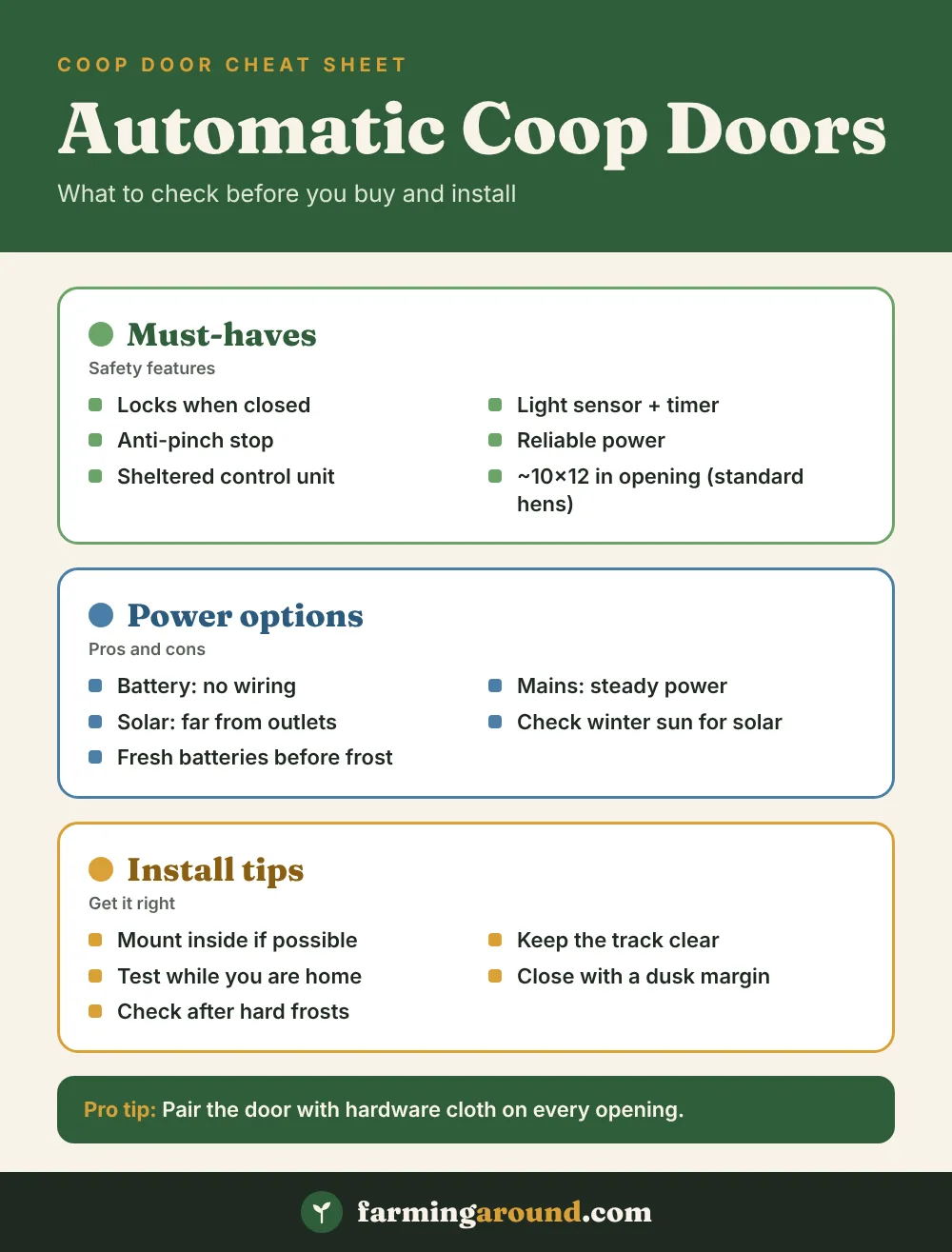
- Locking when closed. The door should not slide up if pushed from below.
- Light sensor and timer. Both together give you flexibility and a backup.
- Anti-pinch or obstacle stop. Protects a hen that lingers in the doorway.
- Power. Batteries, mains or solar. Cold weather drains batteries faster, so check them before winter.
- Opening size. Standard hens need about 10 x 12 inches; large breeds need more.
- Weather resistance. The control unit should be sheltered from rain and snow.
Pro tip: Run the door for a few days while you are home and watch each evening. Set the closing time with a margin, because some hens go in late, especially in summer.
A door that can be lifted from below is not predator-proof. Raccoons are strong and persistent. Pair a locking door with 1/2-inch hardware cloth on windows and vents; University of New Hampshire Extension notes predators can reach through larger mesh openings.
Installation tips
- Mount the door on the inside of the coop when possible, where the motor stays dry.
- Keep the track clear of bedding, snow and ice so the door can close fully.
- Test it for a few days while you are home, and check that every hen goes in before it closes.
- Set the dusk closing time with a margin: some hens go in late, especially in summer.
- Check after hard frosts that the door is not frozen in its track. Our winterizing guide covers this and other cold-weather jobs.
While you are working on the coop, check the airflow too: our chicken coop ventilation guide shows where vents should go so the coop stays dry with the door shut. Our best chicken feeders roundup covers the other big chore-saver.
Quick Reference
FAQ
Are automatic chicken coop doors safe?
Yes, when they lock when closed and have an obstacle stop. A door that can be lifted from below is not predator-proof.
Light sensor or timer: which is better?
A light sensor follows the seasons on its own, while a timer is predictable. A door with both is the best choice.
Do automatic doors work in winter?
Most do, but cold drains batteries and ice can block the track. Keep the track clear and use fresh batteries before the first freeze.
Will my chickens learn to use it?
Chickens go to roost on their own at dusk, so they adapt within a few days. Watch the first evenings in case a hen gets left outside.
Bottom line
An automatic door is one of the best upgrades for a backyard flock. Choose a model that locks shut, has a light sensor with a timer backup, and suits your power setup. If winter is coming, pair it with a heated chicken waterer so your morning chores almost disappear.
Sources
- What Are the Best Ways to Protect My Chickens from Predators? (UNH Extension)
- Identifying and Preventing Poultry Predators (University of Maryland Extension)
For predator problems in your area, your local extension office can offer region-specific advice.
This guide contains affiliate links. As an Amazon Associate, FarmingAround earns from qualifying purchases, at no extra cost to you.
Get free farming guides in your inbox
Practical guides, seasonal tips and market updates. No spam, unsubscribe anytime.
Subscribe free