

Last updated: October 2026
This guide contains affiliate links. As an Amazon Associate, FarmingAround earns from qualifying purchases, at no extra cost to you.
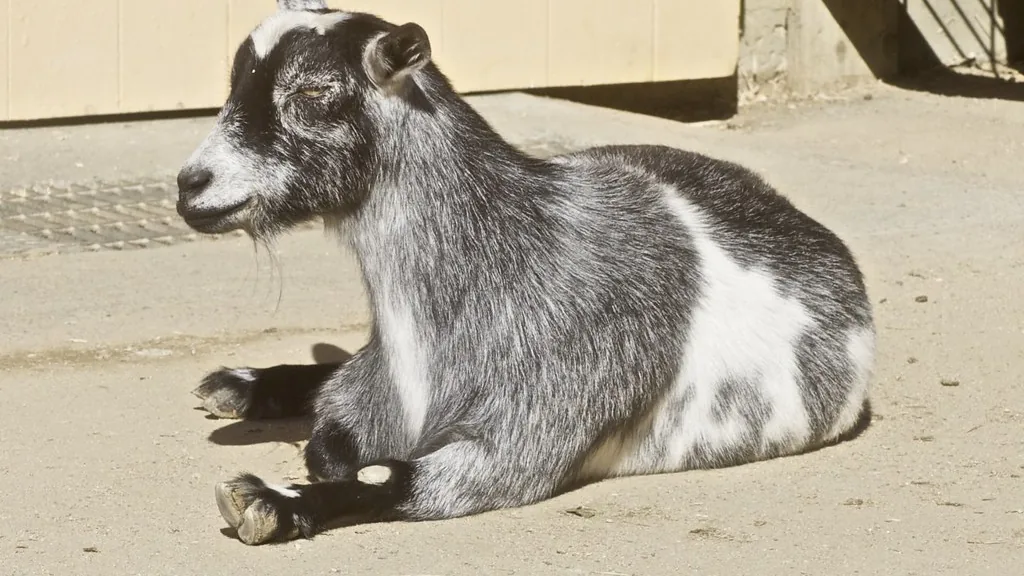
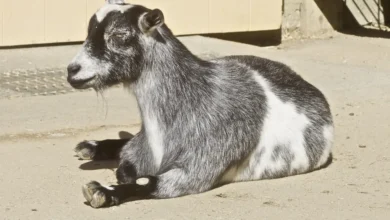
Nigerian Dwarf goats are a miniature dairy breed: does stand no more than 22.5 inches (57 cm) at the shoulder, average about 75 lb (34 kg), and give rich milk that is often 6–10% butterfat. They’re friendly, easy to handle, breed year-round and fit on far less land than a full-size dairy goat, which is why they’ve become one of the most popular homestead goats in North America.
This breed profile covers where Nigerian Dwarfs came from, how big they get, what they’re like to live with, how much milk to expect and what they need day to day, so you can decide whether a small herd is right for your farm or backyard.
Key takeaways
- Small dairy breed: does max out at 22.5 in (57 cm) and bucks at 23.5 in (60 cm) at the withers.
- Rich milk: roughly 1½–2 quarts (1.4–1.8 L) a day from a good doe, with butterfat often 6–10%.
- Gentle and social: great with families, but they must live with at least one other goat.
- Not a Pygmy: Nigerian Dwarfs are built like slim dairy goats; Pygmies are stocky and cobby.
In this guide
Nigerian Dwarf Goat Quick Facts
| Trait | Nigerian Dwarf |
|---|---|
| Type | Miniature dairy goat |
| Height (does) | 17–22.5 in (43–57 cm) at the withers (ADGA) |
| Height (bucks) | Up to 23.5 in (60 cm) |
| Average weight | About 75 lb (34 kg); no official weight limit |
| Colors | Any color or pattern; blue or brown eyes |
| Milk | About 3–4 lb (1.4–1.8 kg) a day from a good doe |
| Butterfat | Often 6–10% |
| Breeding season | Year-round |
| Typical litter | Twins to quadruplets; three or four is common |
| Temperament | Gentle, friendly, easy to handle |
| Registries | ADGA, AGS and IDGR in the US; also registered by the Dairy Goat Society of Australia |
History and Origin
Nigerian Dwarfs descend from the West African Dwarf group of goats, small, hardy animals kept for milk and meat across tropical West Africa. Between roughly the 1930s and 1960s, small goats of this type were brought to the United States, mostly for display in zoos.
For years these little goats were lumped together as “pygmies.” Breeders gradually noticed two distinct types: a heavy-boned, cobby goat (which became the Pygmy) and a finer, longer-legged goat with dairy conformation (which became the Nigerian Dwarf). The International Dairy Goat Registry recorded its first Nigerian Dwarf in 1981, the American Goat Society opened a herdbook in 1984, and the American Dairy Goat Association (ADGA) began registering the breed in the early 2000s. It is still the only miniature dairy breed ADGA registers.
The breed was once listed as rare by The Livestock Conservancy, but numbers grew so quickly that it was removed from the conservation list in 2013. Today there are tens of thousands registered in the US, with growing populations in Canada and Australia.
Size and Appearance
Think of a Nigerian Dwarf as a scaled-down Swiss dairy goat rather than a tiny barrel. The body is balanced and fairly long for its height, the legs are straight, the face is straight or slightly dished, and the ears stand up. The coat is short to medium and fine.
- Height: ADGA calls for does of 17–22.5 in (43–57 cm) and bucks of 17–23.5 in (60 cm max). Animals over the limit can’t be shown.
- Weight: about 75 lb (34 kg) on average. Bucks are thicker through the neck and chest.
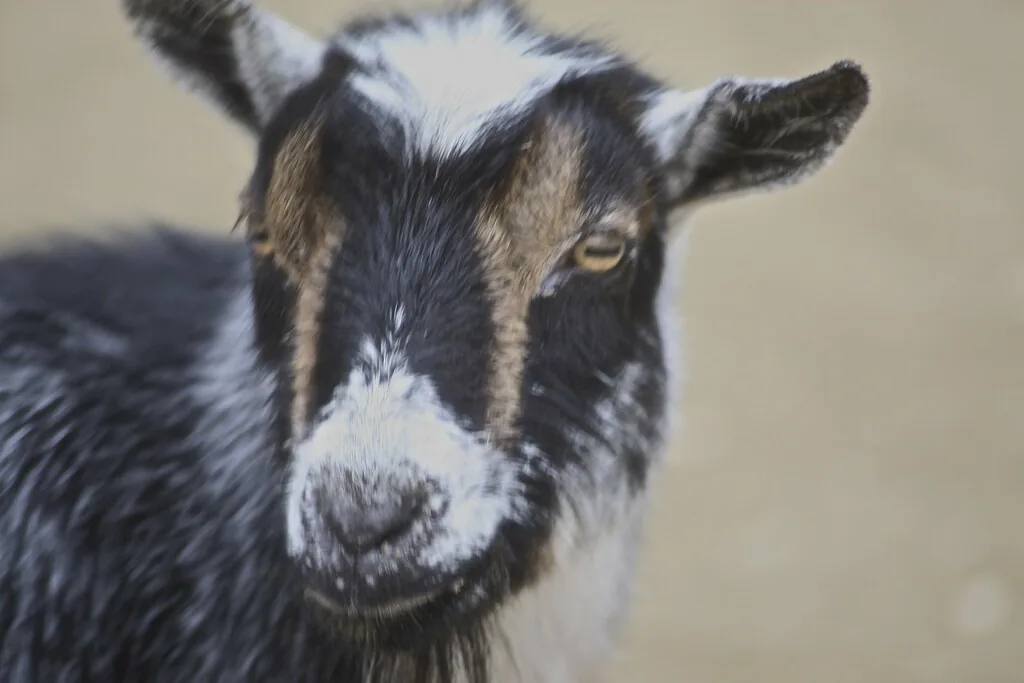
- Color: anything goes, including black, chocolate, gold, buckskin, chamoisee and lots of white spotting. Kids sometimes change color as they grow.
- Eyes: brown or blue, with no preference in the standard.
- Horns: most kids are born with horn buds. Goats shown in ADGA dairy shows must be hornless, so many breeders disbud kids in their first weeks.
Temperament
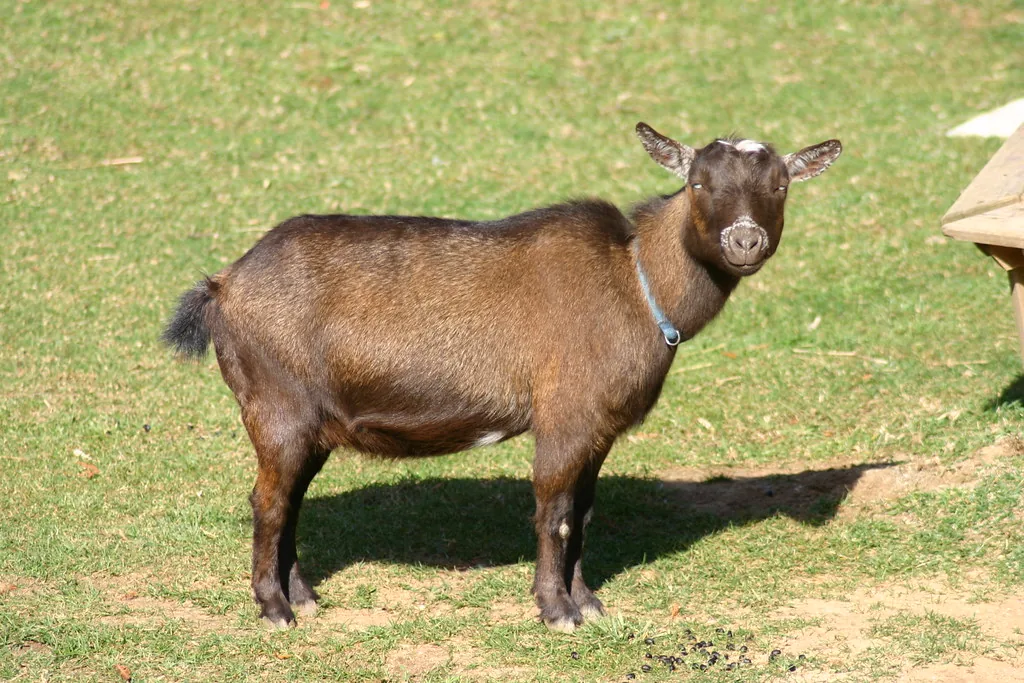
Gentle and affectionate is the usual description, and it fits. Nigerian Dwarfs are curious, people-oriented and small enough that children can help with them safely. Even breeding bucks are generally easy to handle, though every buck gets pushy and smelly during rut.
They are, however, very much herd animals. A single goat kept alone will call constantly, pace and fret. Plan on at least two: two does, a doe and a wether, or two wethers if you just want pets and brush clearing. They’re also agile and clever, so expect them to test gates, climb anything climbable and find the weak spot in a fence.
Milk Production and Breeding
How much milk does a Nigerian Dwarf give?
A good doe gives about 3–4 lb of milk a day, roughly 1½–2 quarts (1.4–1.8 L), at peak. ADGA’s 2010 lactation averages for the breed were 729 lb (331 kg) of milk with 6.1% butterfat and 4.4% protein, and top does produce far more. Lactations usually run about ten months.
The milk is the breed’s big selling point: sweet, creamy and high in solids, which makes it excellent for cheese, butter, yogurt and soap. Because does are small, the teats are small too, so check udder and teat size if you plan to hand-milk.
Breeding and kidding
- Season: unlike most dairy breeds, Nigerian Dwarfs breed year-round, so you can stagger kidding for a steadier milk supply. Many breeders still give does a rest of six months or more between pregnancies.
- Age: does can be bred at 7–8 months if well grown, though many breeders wait until about a year. Buck kids can be fertile as young as 3 months, so separate them from does early.
- Litters: three or four kids is common and five happens. Newborns weigh about 2 lb (0.9 kg).
- Mothering: does are generally attentive mothers that can raise their kids unassisted.
Pro tip: If you want milk, buy from a herd that milk-tests or shows. Ask to see the dam’s udder and milk records, not just the cute kid in front of you.
Watch: Why Homesteaders Love Nigerian Dwarf Goats
This video from Sweet Briar Farm introduces the breed and why it suits small homesteads.
Care Needs
Space, shelter and fencing
Nigerian Dwarfs need far less room than full-size dairy goats, but they still need a dry, draft-free shelter and a secure outdoor area for exercise and browsing. Fencing is the biggest challenge: use woven wire or livestock panels at least 4 ft (1.2 m) tall, and avoid anything a small head can push through. Add something to climb, such as a stump or cable spool.
Feeding
Good-quality hay or pasture and browse should make up most of the diet, with free-choice loose goat mineral and clean water at all times. Milking does and late-pregnant does need extra energy and protein, usually a measured amount of grain or dairy ration fed on the stand. For a full list of safe foods and treats, see our guide on what goats can eat.
Watch the grain with wethers and bucks. Grain-heavy diets are a major cause of urinary stones (urinary calculi) in male goats, which can block the urethra and is an emergency. Keep wethers mostly on hay and browse, and call a vet straight away if a male goat strains to urinate.
Health routine
- Testing: buy from herds that test for CAE, CL and Johne’s disease, and quarantine new arrivals before mixing them in.
- Vaccines: a CD&T vaccine (clostridial diseases and tetanus) is standard; ask your vet about a schedule.
- Parasites: check eyelid color (FAMACHA) and run fecal egg counts so you deworm the goats that need it rather than the whole herd on a calendar.
- Hooves: trim every 4–8 weeks, more often on soft ground.
Pros and Cons
| Pros | Cons |
|---|---|
| Small, easy for kids and adults to handle | Small teats can be fiddly to hand-milk |
| Very rich, high-butterfat milk | Less total milk than full-size dairy breeds |
| Breeds year-round | Large litters can mean more kidding help |
| Needs less space and feed than big goats | Escape artists that test every fence |
| Friendly and sociable | Must be kept in pairs or groups |
Who Should Keep Nigerian Dwarfs?
Nigerian Dwarfs are an excellent choice if you want family milk without a full-size dairy goat, have a large backyard or small acreage, or want a gentle first goat for children and 4-H projects. Two or three does can comfortably supply a household with milk for drinking and cheese-making. They’re also a good fit for homesteading on an acre or less.
They’re a weaker fit if you want meat (look at Boer goats instead), large volumes of milk for sale, or a goat that will live alone. If you’re still comparing breeds, our overview of types of goats sets the Nigerian Dwarf alongside other dairy, meat and fiber breeds, and you can read about another small American breed in why fainting goats faint.
Helpful gear for this guide
Handy picks that match the advice above.
Links go to Amazon. Prices and availability change, so check reviews and fit for your setup before buying.
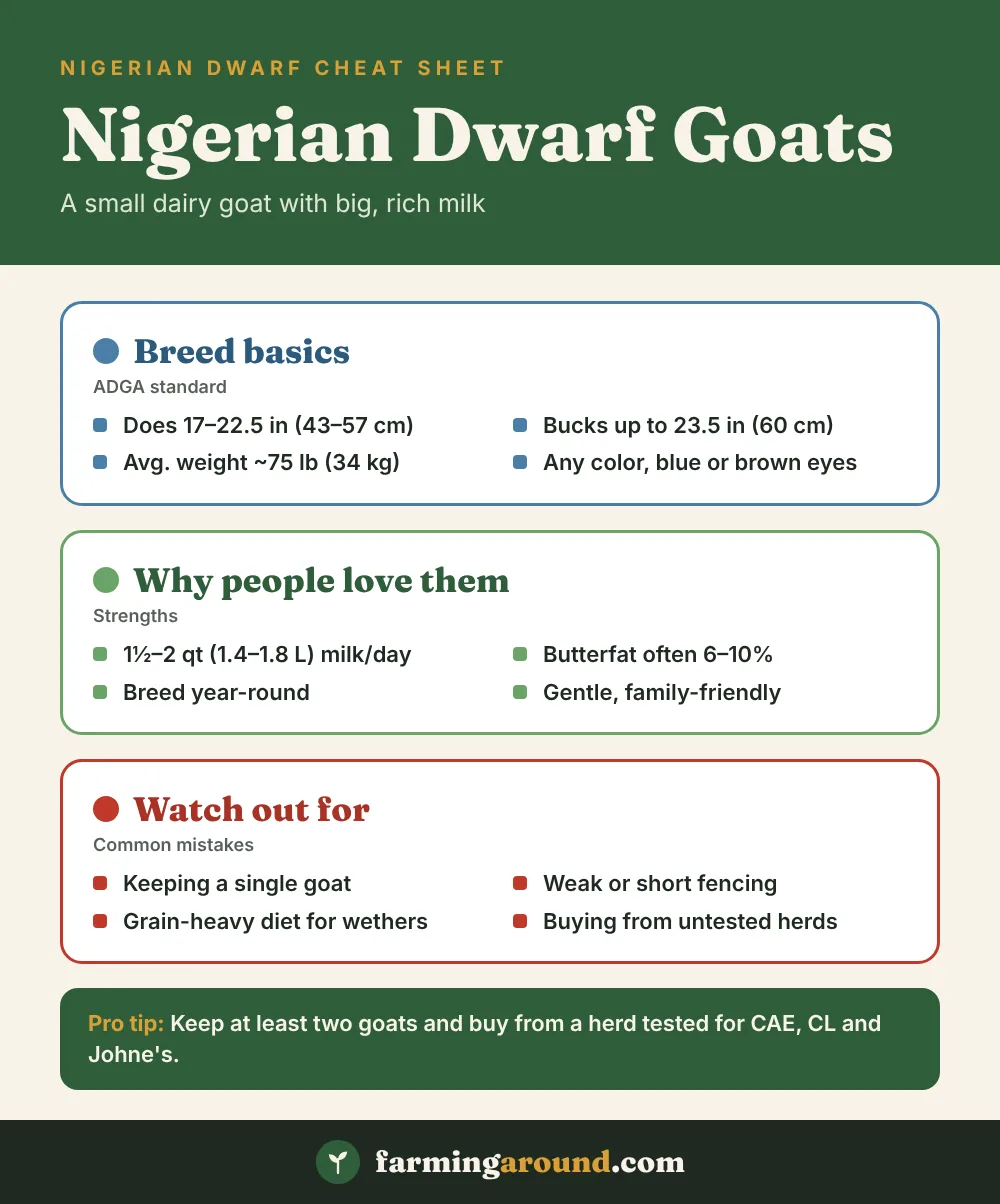
At a Glance: Nigerian Dwarf Goats
FAQ
How big do Nigerian Dwarf goats get?
Does stand 17–22.5 in (43–57 cm) at the withers and bucks up to 23.5 in (60 cm). Adults average around 75 lb (34 kg).
Are Nigerian Dwarf goats good pets?
Yes. They’re gentle, social and small enough for children to handle. Wethers (castrated males) make the easiest pets. Always keep at least two goats together.
How much milk does a Nigerian Dwarf goat produce?
Expect around 1½–2 quarts (1.4–1.8 L) a day from a good doe at peak, with butterfat often 6–10%. Production varies a lot between bloodlines.
What is the difference between a Nigerian Dwarf and a Pygmy goat?
Both trace back to West African Dwarf goats, but Nigerian Dwarfs were bred as dairy goats with a slimmer, more angular build, while Pygmies are stocky, short-legged and kept mostly as pets or for meat. Our Pygmy goat buying guide compares the two side by side.
Can Nigerian Dwarf goats live alone?
No. Goats are herd animals and a lone goat becomes stressed and noisy. Keep a pair at minimum.
When can Nigerian Dwarf does be bred?
Well-grown does can be bred at 7–8 months, though many breeders wait until about a year. Because the breed cycles year-round, you can choose when kids arrive.
Sources
- American Nigerian Dwarf Dairy Association: Breed Information
- Purdue University: Nigerian Dwarf Dairy Goat Fact Sheet
- Oklahoma State University: Breeds of Livestock, Nigerian Dwarf Goats
This guide is general information. For feeding, vaccination and health decisions, talk to a livestock vet or your local extension office.

2 Comments