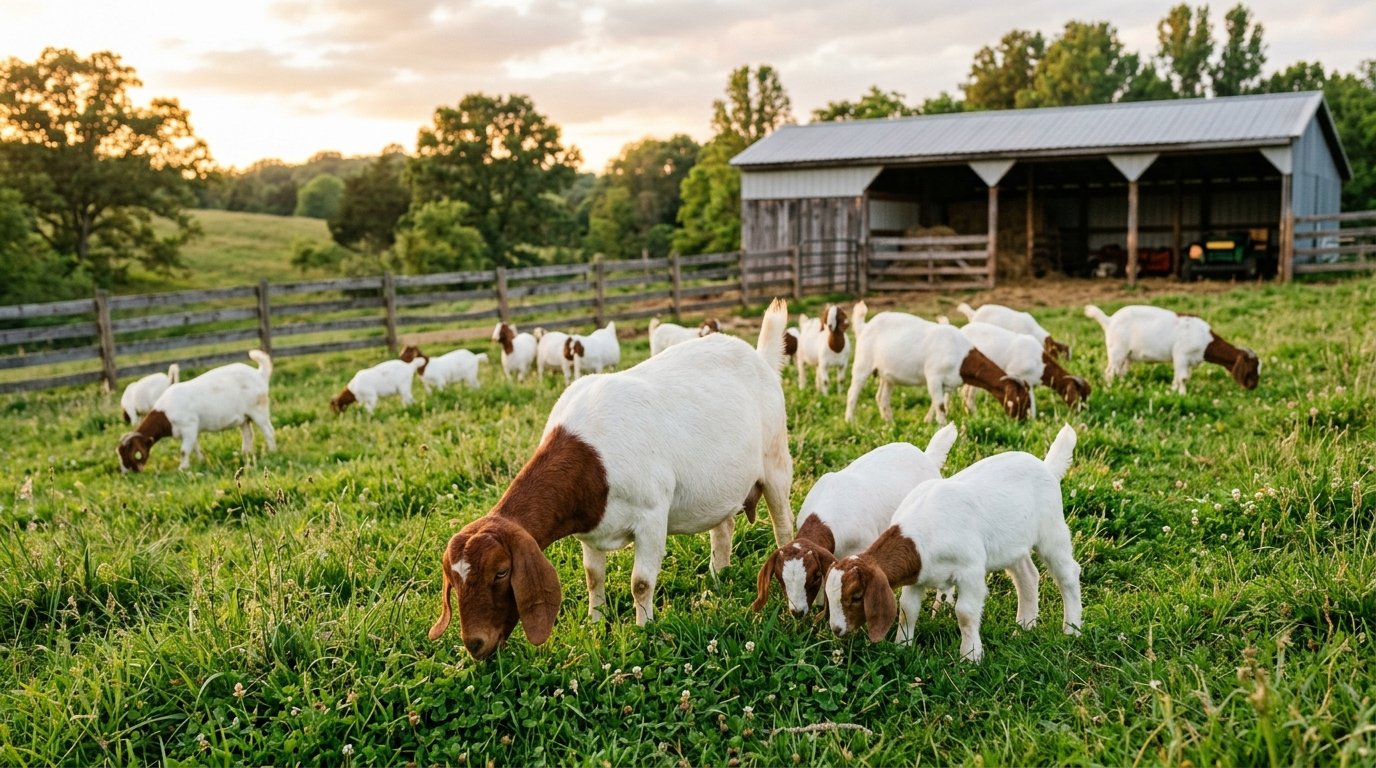

Boer goats are the world’s most popular meat goat breed, and for good reason. They grow fast, carry heavy muscling, are excellent mothers, and adapt to a wide range of climates. With their white bodies, rich red-brown heads and long droopy ears, they’re also one of the most recognizable goats on any farm. Whether you’re considering a small meat herd, show goats or just a few for brush clearing, this guide covers everything you need to know about Boer goats: history, size, temperament, care, feeding, breeding and the health issues to watch for.
Boer Goat Breed Profile
| Origin | South Africa (developed in the early 1900s) |
| Primary use | Meat; also shows, breeding stock and brush control |
| Mature doe weight | About 190–230 lb (85–105 kg) |
| Mature buck weight | About 240–340 lb (110–155 kg) |
| Appearance | White body, red-brown head, Roman nose, long pendulous ears, stocky frame |
| Temperament | Calm, docile, easy to handle |
| Gestation | About 150 days |
| Typical litter | Twins are common; singles and triplets also occur |
| Lifespan | Often 8–12 years |
History of the Boer Goat
The name “Boer” comes from the Dutch word for farmer. South African farmers developed the breed in the early 20th century by selecting local goats for size, fast growth and meat quality. The breed became well established in South Africa, then spread internationally, reaching Australia and New Zealand and later arriving in the United States in the 1990s. Today, Boer goats and Boer crosses dominate meat goat production in many countries.
Why Raise Boer Goats?
- Fast growth: well-fed kids gain weight quickly, reaching market weights sooner than most other breeds.
- Excellent meat yield: a deep, muscular body and a high meat-to-bone ratio.
- Strong mothering: does are attentive and usually produce plenty of milk for their kids.
- Docile nature: calmer and easier to handle than many dairy breeds.
- Adaptable: they do well in hot, dry climates and handle cold with proper shelter.
- Market demand: goat meat is widely eaten around the world, and demand is strong in many communities.
- Brush control: goats are browsers and happily clear weeds, brambles and scrub.
Goats can also be a good small-farm income source. See how they compare in our guide to the most profitable farm animals.
Fullblood, Purebred and Percentage Boer Goats
- Fullblood: 100% Boer genetics, traceable back to original imported stock.
- Purebred: bred up from crosses over several generations until the animal is almost entirely Boer.
- Percentage: crossbred goats with a known share of Boer genetics (for example 50% or 75%).
- Commercial: unregistered goats raised for meat, often Boer crosses.
For a meat herd, commercial and percentage goats are usually the most economical. Registered animals cost more and suit breeders and show homes. Registries include the American Boer Goat Association (ABGA) in the US, the British Boer Goat Society in the UK, and national breed societies in South Africa, Australia and elsewhere.
Housing and Fencing
Shelter
- A dry, draft-free, three-sided shed is enough in most climates. Goats hate rain and wet bedding.
- Allow roughly 15–20 sq ft (1.4–1.9 m²) of indoor space per adult goat.
- Provide deep, dry bedding (straw or wood shavings) and good ventilation.
- Kidding pens (about 4 × 5 ft / 1.2 × 1.5 m) are useful for does giving birth.
Fencing
Goats are famous escape artists. Boer goats are calmer than many breeds, but you still need solid fencing:
- Woven wire (field fence) at least 4 ft (1.2 m) tall, ideally with 4 × 4 in openings so horned goats don’t get their heads stuck.
- A strand of electric wire inside the fence stops goats from leaning and climbing.
- Strong gates with goat-proof latches.
Feeding Boer Goats
Goats are browsers, not grazers. They prefer leaves, shrubs, weeds and brush over short grass.
- Forage first: pasture, browse and good-quality hay should make up most of the diet.
- Hay: when forage is limited, adult goats typically eat around 2–4% of their body weight in dry matter daily.
- Grain/concentrate: useful for late-pregnant and nursing does and growing kids. Increase gradually to avoid digestive upsets.
- Loose goat minerals: always available. Goats need more copper than sheep, so never rely on sheep minerals.
- Clean water: fresh at all times. An adult goat can drink a gallon (about 4 liters) or more a day, more in hot weather or when nursing.
- Bucks and wethers: keep the diet’s calcium-to-phosphorus ratio balanced (about 2:1) and limit grain to help prevent urinary calculi (urinary stones).
Breeding and Kidding
- Does are often bred once they reach about 60–70% of adult weight, commonly around 8–10 months old, depending on growth.
- Boer goats can breed for much of the year, making it possible to plan kidding seasons.
- Gestation is about 150 days (roughly 5 months).
- One mature buck can typically cover 25–50 does in a season, depending on age and conditions.
- Prepare a clean kidding pen, iodine for navels, towels, and a vet’s phone number before kidding season.
- Make sure every kid drinks colostrum within the first few hours of birth.
Health Care Essentials
| Issue | What to know |
|---|---|
| Internal parasites | The biggest health threat to goats, especially barber pole worm. Use FAMACHA eye scoring, rotate pastures, and deworm selectively based on fecal tests and vet advice. |
| Vaccinations | CD&T (clostridium and tetanus) is the standard core vaccine in many countries. Ask your vet for a local schedule. |
| Hoof trimming | Trim every 6–10 weeks or as needed to prevent lameness and foot rot. |
| Urinary calculi | A serious risk in bucks and wethers. Balance minerals, provide plenty of water, and limit grain. |
| Bloat and enterotoxemia | Linked to sudden feed changes and too much grain. Change feed gradually. |
| Copper deficiency | Can cause a rough coat, a faded color and poor growth. Use goat-specific minerals. |
Build a relationship with a local vet who treats goats before you need one. Quarantine new animals for about 30 days, and test for common diseases such as CAE, CL and Johne’s when buying breeding stock.
How Many Boer Goats Per Acre?
It depends heavily on your climate, rainfall and forage quality. Good pasture might support several goats per acre, while dry or poor land supports far fewer. Rotational grazing, meaning moving goats between paddocks every few days, improves forage and breaks parasite cycles. Always plan to supplement with hay during winter or drought. Never keep a single goat: they’re herd animals and need at least one companion.
Boer Goats vs Other Meat Breeds
| Breed | Strengths | Considerations |
|---|---|---|
| Boer | Fast growth, heavy muscling, docile | More parasite-prone; higher feed needs |
| Kiko | Hardy, parasite-resistant, low maintenance | Less muscling than Boer |
| Spanish | Very hardy, good foragers | Slower growth |
| Savanna | Heat tolerant, good mothers | Less common, pricier breeding stock |
| Boer × Kiko cross | Combines growth with hardiness | Popular choice for commercial herds |
FAQ: Boer Goats
How big do Boer goats get?
Mature does typically weigh about 190–230 lb (85–105 kg), and bucks about 240–340 lb (110–155 kg).
Are Boer goats good for beginners?
Yes. Their calm temperament makes them easy to handle, but beginners must learn parasite management and fencing basics.
Can you milk Boer goats?
You can, but they produce less milk than dairy breeds and are bred mainly for meat.
How long do Boer goats live?
Often 8–12 years with good care; some live longer.
Do Boer goats need a barn?
They need a dry, draft-free shelter, such as a simple three-sided shed. A full barn isn’t required.
Planning a small livestock setup? Our guide to homesteading on an acre shows how goats fit alongside chickens and gardens, and our small farm tractor guide helps with handling hay and bedding.