
Last updated: October 2026
This guide contains affiliate links. As an Amazon Associate, FarmingAround earns from qualifying purchases, at no extra cost to you.
Mushroom compost is the spent growing material left over after a commercial mushroom crop, and it makes a good, inexpensive soil conditioner and mulch for most vegetable beds and borders. Use well-weathered (aged) mushroom compost, spread it as a mulch at least 2 inches (5 cm) deep or work it into the top layer of soil, and keep it away from acid-loving plants like blueberries, azaleas and rhododendrons. It’s high in organic matter, but it can be salty and is often limy, so it isn’t a fertilizer substitute or a potting mix.
Below you’ll learn what’s in mushroom compost, where it helps and where it hurts, how much to apply and when, organic options, and the mistakes that most often harm plants.
Key takeaways
- Use weathered material: Penn State recommends mushroom compost aged at least 6 months for gardens, because fresh material is high in salts.
- Best for: vegetable beds, brassicas, new lawns and acidic soils low in organic matter.
- Avoid for: blueberries, azaleas, rhododendrons, camellias, heathers, chalky or alkaline soils, seed-starting and potting mixes.
- Apply as a mulch at least 2 in (5 cm) thick or dig a thinner layer into the soil, and test soil pH every year or two.
In this guide
What Is Mushroom Compost?
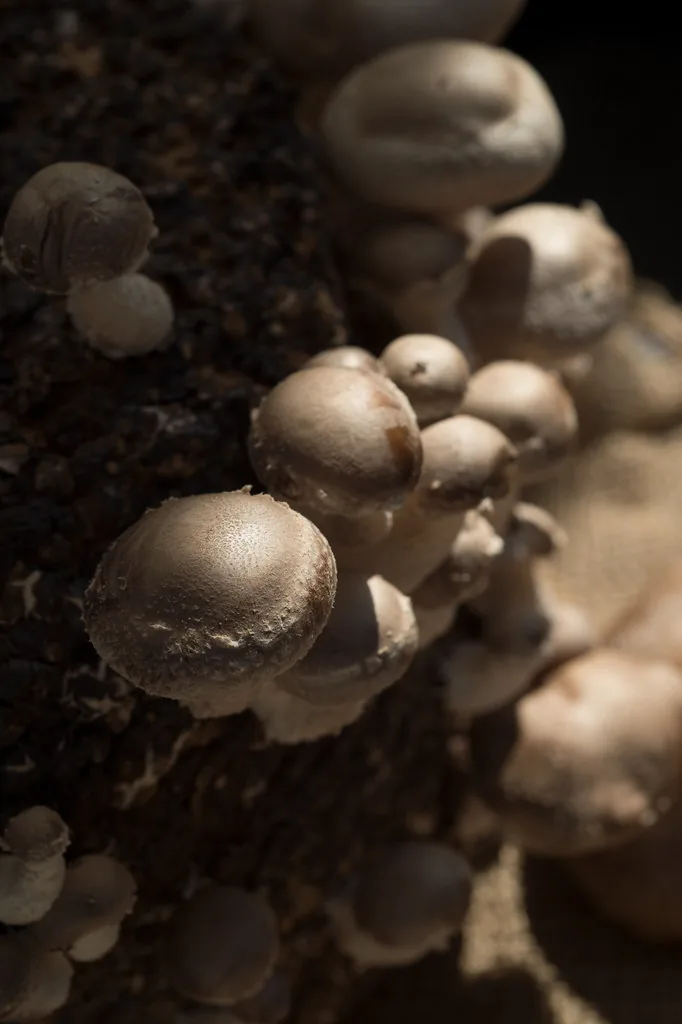
Commercial mushroom farms grow button mushrooms on a specially made compost. Penn State Extension lists typical starting ingredients such as wheat straw and horse manure, hay, corn cobs, cottonseed hulls, poultry manure, brewer’s grain and gypsum. A “casing” layer of peat moss and ground limestone goes on top.
After the mushrooms are harvested, the farm steam-pasteurizes the spent material, which kills weed seeds, insects and disease organisms. What’s left is sold as spent mushroom compost or spent mushroom substrate (SMS). In the UK, the Royal Horticultural Society notes it’s now usually based on composted straw and often contains chalk from the casing layer.
Benefits and Drawbacks
| Benefits | Drawbacks |
|---|---|
| High in organic matter, so it improves soil structure and water holding | Fresh material is high in soluble salts |
| Pasteurized, so weed seeds and pests are killed | Often limy, which raises soil pH over time |
| Often inexpensive in bulk near mushroom farms | Modest nutrient content, so it’s not a complete fertilizer |
| Dark, crumbly and easy to spread as a mulch | Often contains some peat, which the RHS no longer recommends |
Nutrients, pH and Salts
Penn State Extension’s analysis gives a useful picture, though every batch is different:
| Measure | Fresh SMS | Weathered 16 months |
|---|---|---|
| pH | 5.8–7.7 | 7.1 |
| Total nitrogen (% dry weight) | 1.42–2.05 | 2.72 |
| Phosphorus (% dry weight) | 0.45–0.69 | 0.84 |
| Potassium (% dry weight) | 1.93–2.58 | 0.43 |
| Sodium (% dry weight) | 0.21–0.33 | 0.06 |
Two things stand out. First, weathering washes out much of the sodium and potassium, which is why aged material is safer for plants. Second, much of the nitrogen is tied up in organic matter and releases slowly, so treat mushroom compost as a soil improver and still feed hungry crops as needed.
The RHS adds that spent mushroom compost in the UK can be up to 30% chalk, making it distinctly alkaline. Products vary by region and supplier, so ask for an analysis or test it yourself with a soil pH test kit.
Watch for lime-induced yellowing. Too much chalk ties up iron and other nutrients, causing yellow leaves with green veins, stunting and poor flowering. If you see it, stop adding mushroom compost and switch to garden compost or leaf mold.
Yellow leaves have several possible causes, so check our guide to why plant leaves turn yellow before you change anything else.
Where to Use Mushroom Compost (and Where Not To)
Good uses
- Vegetable beds, as a mulch or dug in before planting.
- Brassicas such as cabbage, broccoli, cauliflower, kale and Brussels sprouts. The RHS notes clubroot is less likely in alkaline soil.
- Acidic soils low in organic matter, where its liming effect helps.
- Newly seeded lawns: Penn State notes a light covering shields seed from birds and holds moisture during germination.
- Ornamental borders with plants that tolerate neutral to alkaline soil.
Avoid it for
- Acid-loving (ericaceous) plants: blueberries, rhododendrons, azaleas, camellias and heathers. Mulch these with leaf mold or pine needles instead.
- Soils that are already neutral, alkaline or chalky.
- Fruit crops that prefer neutral to acid soil, according to the RHS.
- Seed-starting and potting mixes, because of the soluble salts.
- Salt-sensitive plants, especially with fresh, unweathered material.
How Much to Apply and When
- Test your soil first. If your pH is already above about 7, choose a different compost.
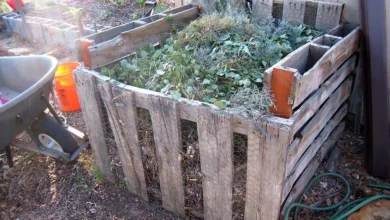
- Use weathered compost. Penn State recommends material weathered at least 6 months for gardens. If you buy fresh compost in fall or winter, pile it and let it weather until spring.
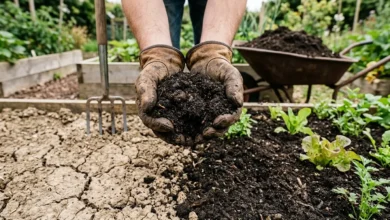
- As a mulch: spread a layer at least 2 inches (5 cm) deep on moist soil, keeping it a few inches away from stems and trunks.
- As a soil improver: work a 1–2 inch (2.5–5 cm) layer into the top 6–8 inches (15–20 cm) of soil a few weeks before planting. That’s a common rate for compost in general; go lighter on heavier soils or if your pH is near neutral.
- Don’t pile it on year after year. The RHS warns that frequent, heavy use builds up chalk and alkalinity. Alternate with well-rotted manure or homemade compost.
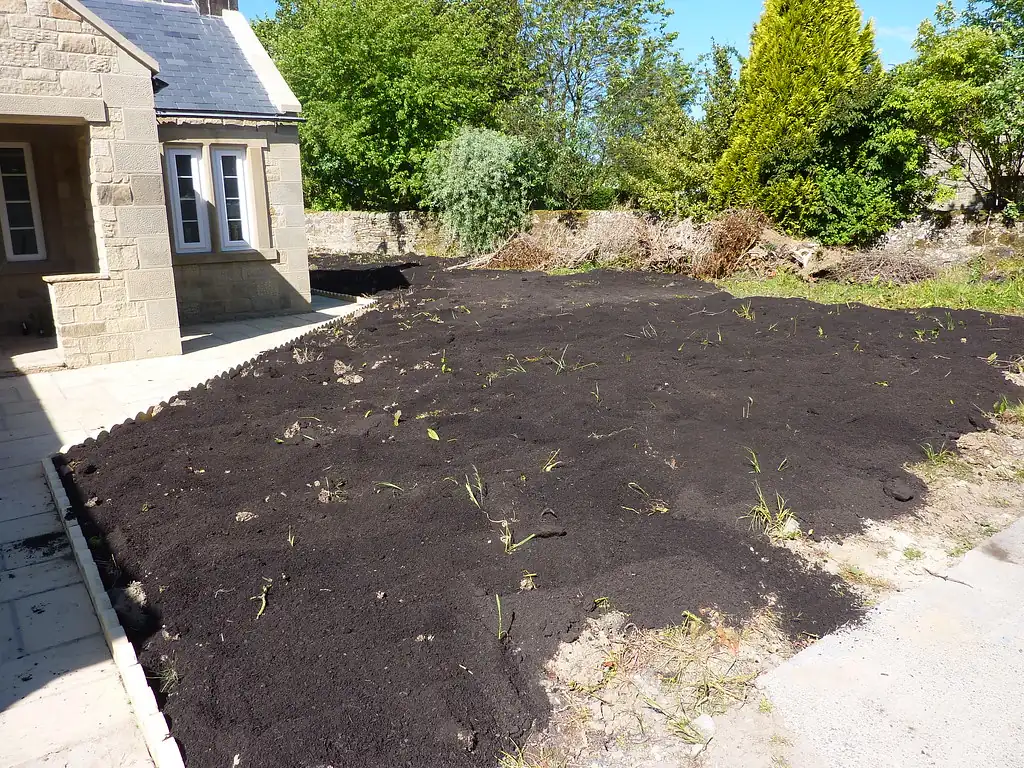
Timing: the RHS suggests mulching from late autumn to late winter (November to February in the Northern Hemisphere, or May to August in the Southern Hemisphere), when soil is moist. Penn State finds spring and summer work well for weathered mushroom compost as a mulch. In practice, any time the soil is moist and not frozen works. In cold climates (USDA zones 3–6), many gardeners spread it in fall after harvest or in spring a few weeks before the last frost date. In mild zones 8–10, early fall and late winter are both good windows.
Pro tip: Rake out any large white lumps of chalk you see in a load of mushroom compost before spreading it. It’s an easy way to limit how much you raise the pH.
Watch: Is mushroom compost good for your garden?
This video from a homesteading channel weighs up the pros and cons of using mushroom compost in a vegetable garden.
Is Mushroom Compost Organic?
Not automatically. Penn State notes pesticide residues in spent mushroom compost are generally low, but conventional mushroom farms can use pesticides during production. If you garden organically, look for compost from a certified organic mushroom farm, ask your supplier, or check with your local extension office for local sources.
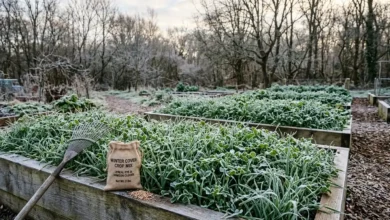
If you’d rather make your own soil improver, our guide on how to build a compost pile walks through it step by step, and winter cover crops add organic matter without changing pH.
Common Mistakes to Avoid
- Using it fresh around seedlings and salt-sensitive plants.
- Using it as potting mix or for seed starting.
- Mulching blueberries, azaleas or other acid-lovers with it.
- Treating it as fertilizer and skipping feeding for hungry crops.
- Adding it every year without testing soil pH.
- Using it on chalky or alkaline soils, where it makes things worse.
If you garden on heavy ground, our guide to compost for clay soil compares mushroom compost with other options.
Helpful gear for this guide
Handy picks that match the advice above.
Links go to Amazon. Prices and availability change, so check reviews and fit for your setup before buying.
Quick Reference
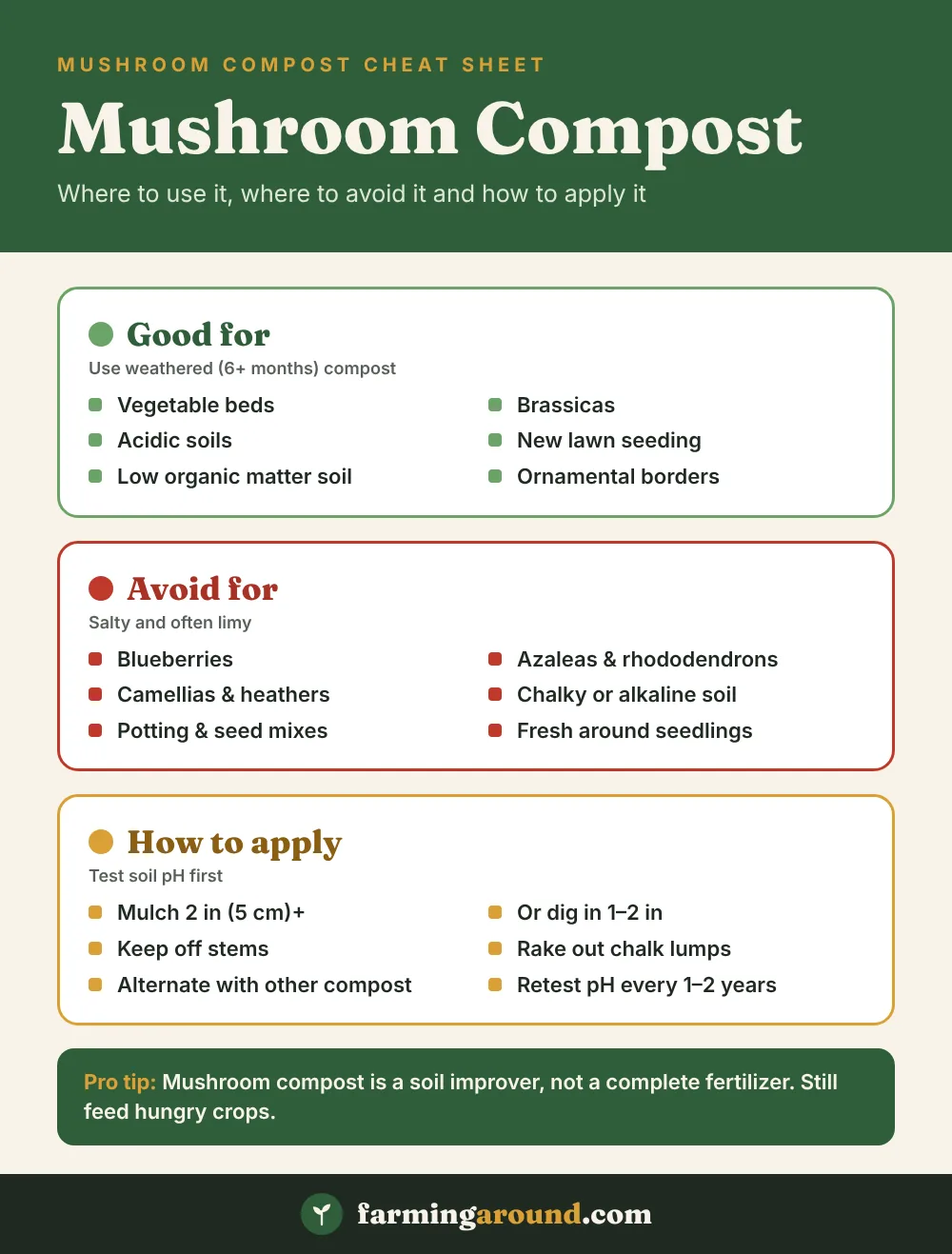
Save this chart for your next compost delivery:
FAQ
Is mushroom compost good for vegetable gardens?
Yes, for most vegetables, as long as you use weathered material and your soil isn’t already alkaline. It’s especially useful for brassicas and for acidic soils low in organic matter.
What plants should not use mushroom compost?
Acid-loving plants such as blueberries, rhododendrons, azaleas, camellias and heathers, plus seedlings and other salt-sensitive plants.
Can you plant directly into mushroom compost?
Not into pure mushroom compost. Its salts and pH can harm roots. Mix it into garden soil or use it as a mulch around established plants.
Does mushroom compost smell?
Fresh material can smell strongly of ammonia or manure. Weathered compost has a much milder, earthy smell.
Is mushroom compost the same as manure?
No. It often starts with straw and horse or poultry manure, but it’s then composted, used to grow mushrooms and pasteurized, so it’s lower in nutrients than fresh manure and has a different pH and salt profile.
Will mushroom compost grow mushrooms in my garden?
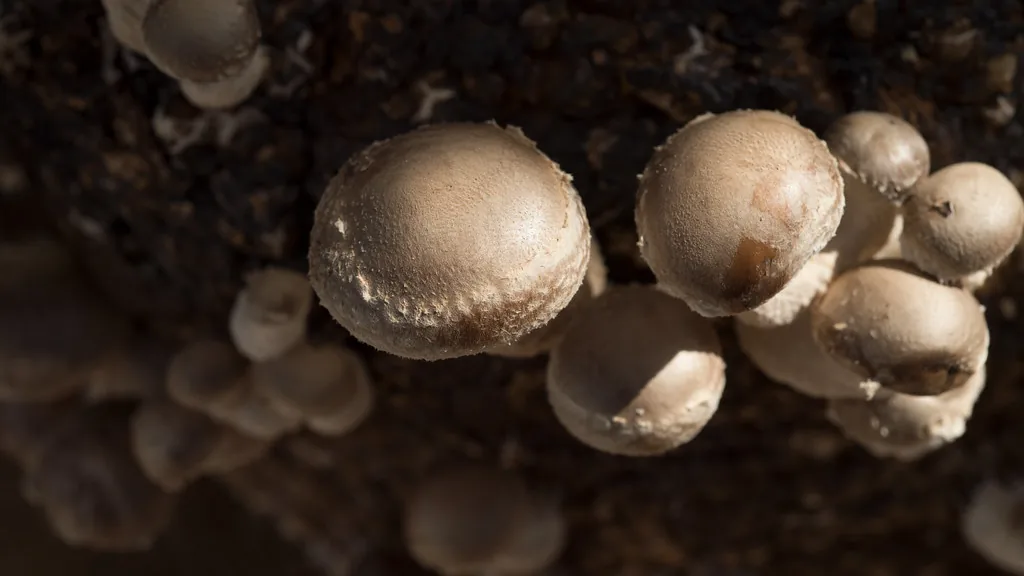
Rarely. The spent material is pasteurized after harvest. Wild mushrooms can appear in any mulch with lots of organic matter, but they usually disappear as the mulch dries.
Sources
Soil conditions vary widely. For advice on your soil, get a soil test through your local extension office.