

Last updated: November 2026
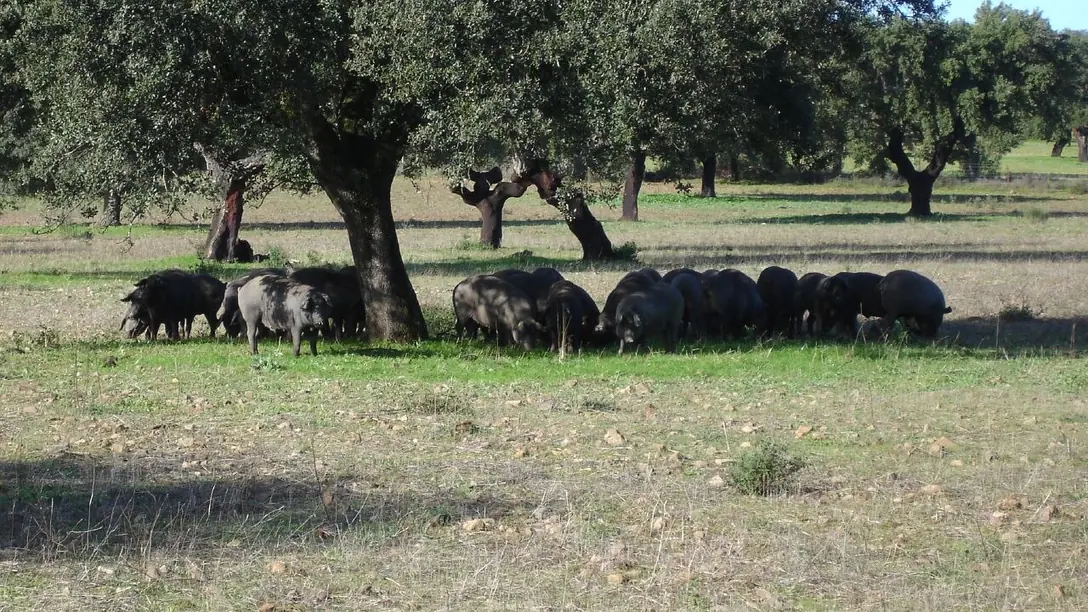
“Spanish pigs” usually means the Iberian pig, a dark, slender, slow-growing breed from southwest Spain and Portugal that’s famous for heavily marbled meat and acorn-fed jamón ibérico. It’s a hardy outdoor forager, but its small litters, slow growth and rarity outside Iberia make it a specialist choice.
This breed profile covers the Iberian pig’s history, appearance and varieties, temperament, meat and production traits, care needs and pros and cons. We also look at the Ossabaw Island hog, an American heritage pig with Spanish roots that’s easier to find in the U.S.
Key takeaways
- The Iberian pig is native to Spain and Portugal and is the breed behind jamón ibérico.
- Adults average about 310 lb (140 kg) for boars and 282 lb (128 kg) for sows, with about 7.5 piglets per litter.
- Acorn finishing (montanera) takes pigs to about 342–364 lb (155–165 kg) at 14–18 months.
- Purebred stock is rare outside Iberia. The Ossabaw Island hog is a Spanish-descended alternative in the U.S.
In this guide
- Spanish Pig Quick Facts
- What Are “Spanish Pigs”?
- History of the Iberian Pig
- Appearance and Varieties
- Temperament and Behavior
- Meat, Fat and Production
- Care and Management
- The Ossabaw Island Hog: America’s Spanish-Descended Pig
- Pros and Cons of Spanish Pig Breeds
- Is a Spanish Pig Breed Right for You?
- At a Glance
- FAQ
- Sources
Spanish Pig Quick Facts
| Trait | Iberian pig (Cerdo Ibérico) |
|---|---|
| Origin | Southwest Spain and Portugal (called Porco Alentejano in Portugal) |
| Main use | Cured ham, shoulder and loin; increasingly fresh pork |
| Color | Black, slate gray, blond or reddish; dark hooves |
| Adult weight | About 310 lb (140 kg) for boars and 282 lb (128 kg) for sows |
| Height at withers | About 30–31 in (77–80 cm) |
| Litter size | About 7.5 piglets on average (range about 6–8) |
| Finishing weight | About 342–364 lb (155–165 kg) after acorn finishing |
| Age at slaughter | About 14–18 months in the traditional system |
| Best known for | Heavy marbling and the acorn-fed jamón ibérico de bellota |
Breed figures above come from 3tres3’s Iberian breed profile, which draws on Spanish research data.
What Are “Spanish Pigs”?
When most people search for Spanish pigs, they mean the Iberian pig, the native breed of the Iberian Peninsula. It’s often called the pata negra (“black hoof”) pig, after its dark hooves. Most purebred Iberians today live in western Andalusia, Extremadura and Salamanca in Spain, and in Portugal’s Alentejo region.
A second group also traces back to Spain: pigs brought to the Americas by early explorers. The best known of these in the U.S. is the Ossabaw Island hog from Georgia. Its ancestry is traditionally credited to Spanish explorers’ pigs, though DNA work by The Livestock Conservancy points to roots in the Canary Islands, a regular stop on Spanish voyages west. We cover it near the end of this guide.
History of the Iberian Pig
The Iberian pig descends from ancient domestic pigs of the Iberian Peninsula and was Spain’s main pig breed until the mid-20th century. According to 3tres3, breeding sows may have numbered more than 500,000 in the early 1900s. Numbers then collapsed as faster-growing white breeds took over, and by the 1960s the breed faced a serious risk of extinction.
Recovery began in the late 1980s, driven largely by demand for premium cured ham. Today the breed supports four protected designations of origin (Guijuelo, Dehesa de Extremadura, Jabugo and Los Pedroches), and acorn-fed Iberian ham is exported to Europe, Japan and the U.S.
That said, only a small share of Iberian pork comes from purebred pigs. Spanish rules allow a pig to be sold as Iberian if it’s at least 50% Iberian, with a purebred Iberian mother. The usual crossing partner is the Duroc, which grows faster and produces a leaner carcass.
Appearance and Varieties
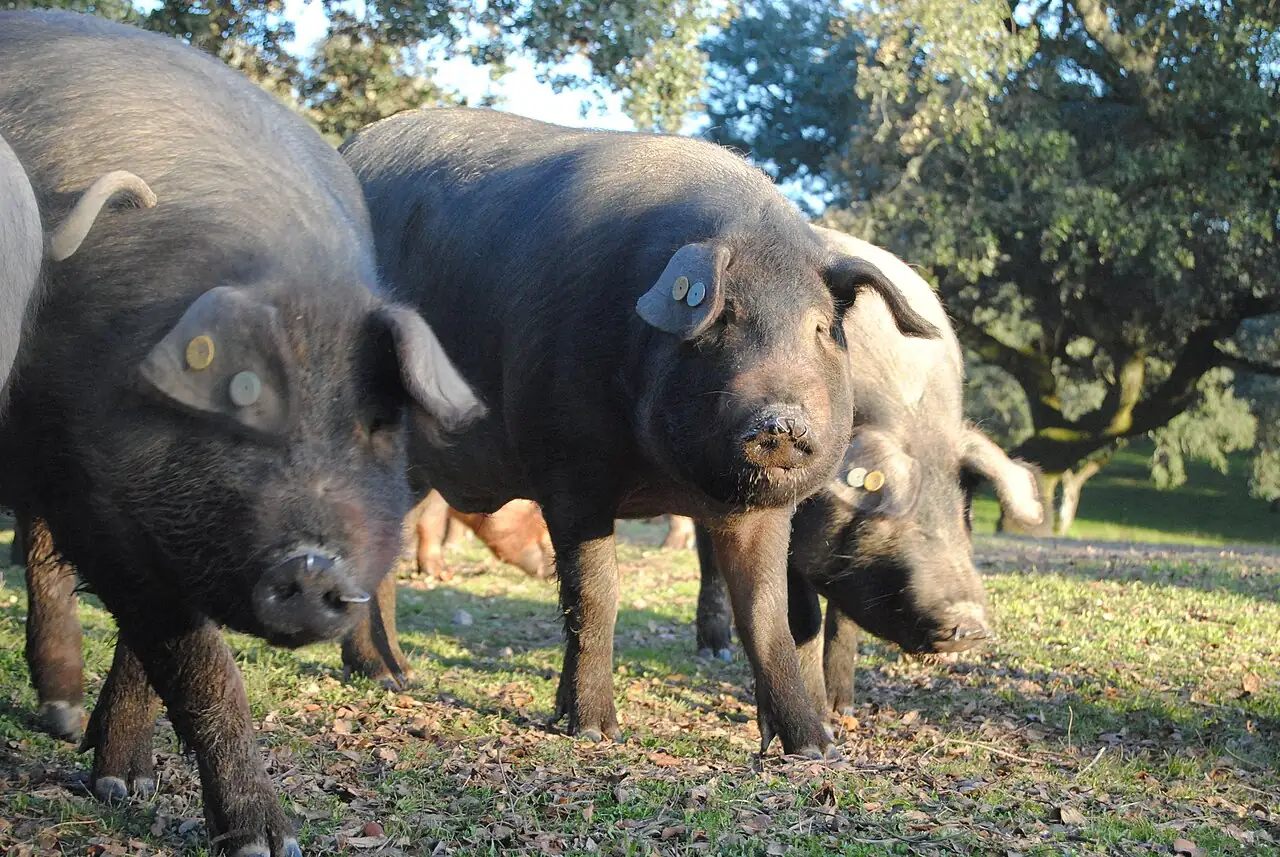
Iberian pigs are medium-sized, with long, slender bodies compared with white commercial breeds. They have long snouts, thin but strong legs and dark, uniform hooves. Skin is always pigmented, but color ranges from black and slate gray to blond and reddish.
Several local varieties exist, and some have been lost or merged over time. The main ones you’ll hear about are:
- Retinto: Reddish to brown, and the most common variety today.
- Entrepelado: Dark with sparse hair.
- Lampiño: Black and almost hairless.
- Torbiscal: A composite line that may show lighter or striped legs.
- Manchado de Jabugo: A rare spotted variety from the Jabugo area.

Temperament and Behavior
Iberian pigs are a rustic, outdoor breed. In the traditional system they roam the dehesa, Spain’s open oak woodland pasture, walking long distances each day to graze grass and gather acorns. That activity is part of what makes the meat so marbled.
Like most heritage pigs, they’re curious, strong and active, and they do best with plenty of room to forage. Pigs handled calmly from a young age are far easier to move, check and load than pigs that rarely see people. If you’re new to keeping pigs, our guide to raising pigs covers handling, housing and daily care.
Meat, Fat and Production
Iberian pigs grow slowly and lay down far more fat than modern commercial breeds. 3tres3 reports back fat of about 1.4–3.5 in (35–90 mm) at the withers and intramuscular fat averaging about 6.9%, with a range of about 3–20%. Much of that fat is monounsaturated, and the meat is redder and darker than standard pork.
The montanera
The traditional finishing period is the montanera, which runs through the acorn season in autumn and winter. Pigs are raised outdoors to about 209–231 lb (95–105 kg), then turned out in the dehesa to fatten on acorns and grass until they reach about 342–364 lb (155–165 kg), usually at 14–18 months old. Only a minority of Iberian pigs are finished this way. Most are raised more intensively and finished on feed.
Reproduction
Iberian sows have small litters by modern standards. 3tres3 reports an average of about 7.5 piglets per litter, about 2.2 litters per year, and first farrowing at about 10–16.5 months. Piglets weigh about 2.4–3.1 lb (1.1–1.4 kg) at birth.
What the ham labels mean
Spain’s Iberian quality standard uses colored labels on hams and shoulders:
| Label color | What it means |
|---|---|
| Black | 100% Iberian, acorn-finished (bellota) |
| Red | Iberian cross (at least 50%), acorn-finished |
| Green | Iberian or cross, raised outdoors on pasture and feed (cebo de campo) |
| White | Iberian or cross, raised on feed in farm systems (cebo) |
Watch: The Iberian Pig
This short video from Livestock Genetics from Spain introduces the Iberian pig breed.
Care and Management
Raising Iberian or other heritage Spanish-type pigs isn’t very different from raising other outdoor pigs, but a few points matter more than usual.
- Space to roam: These pigs are built for foraging. Rotate them through paddocks or woodland so they don’t strip the ground bare.
- Strong fencing: Woven wire or hog panels backed by a line of electric fence at snout height keep pigs from rooting under or pushing through.
- Shade, shelter and a wallow: Pigs can’t sweat to cool themselves. Provide shade, a dry, draft-free shelter and a mud wallow in hot weather.
- Clean water at all times: A growing pig drinks a lot. A nipple drinker on a barrel or water line stays cleaner than an open trough.
- Controlled feeding: Breeds that fatten easily can become obese, especially breeding stock. Feed a balanced pig ration and adjust by body condition.
- Acorns and mast: Pigs handle acorns far better than cattle or horses, and woodland grazing has a long history in Europe. Still, introduce any big change in diet gradually.
- Health care: Work with a vet on parasite control, vaccinations and any movement or testing rules for pigs in your area.
Check the rules before feeding scraps. Feeding pigs kitchen scraps or food waste that has been in contact with meat is illegal in the UK and EU and restricted in many U.S. states, because it can spread diseases such as African swine fever. Check your local rules.
Finding Iberian pigs outside Spain
Purebred Iberian breeding stock is rare outside Spain and Portugal, and moving live pigs between countries involves strict animal health rules. If you find a seller, ask for registration papers, health records and details of the pigs’ bloodlines. Many small farms outside Iberia get a similar outdoor, high-fat pork from local heritage breeds instead.
Pro tip: Can’t find Iberian stock? Choose a local outdoor heritage breed known for marbling and lard, and finish it slowly on pasture or woodland for a similar style of pork.
The Ossabaw Island Hog: America’s Spanish-Descended Pig
The Ossabaw Island hog descends from pigs left on Ossabaw Island, off the Georgia coast, by early explorers. Centuries of isolation and a harsh island environment shaped a hardy, thrifty pig. The Livestock Conservancy lists the breed as Critical, and live pigs can no longer be taken off the island because of disease concerns, so today’s breeding herds come from pigs moved to the mainland starting in the 1980s.
| Trait | Ossabaw Island hog |
|---|---|
| Adult weight | About 250–300 lb (113–136 kg) for boars, 150–250 lb (68–113 kg) for sows |
| Color | Mostly black, black with white spots, or light with black spots |
| Temperament | Active; docile if handled when young |
| Litters | Can produce two litters of about 8–12 piglets a year |
| Experience level | Intermediate |
Ossabaws store body fat very efficiently, a survival trait from lean seasons on the island, so breeders need to manage feed carefully to prevent obesity. Their pork and lard are prized by chefs for charcuterie and sausage.
Pros and Cons of Spanish Pig Breeds
| Pros | Cons |
|---|---|
| Exceptionally marbled, flavorful meat | Slow growth means higher feed and time costs per pig |
| Hardy and well suited to outdoor, forage-based systems | Small litters compared with commercial breeds |
| Excellent for cured meats and lard | Fatty carcasses aren’t what most standard butchers expect |
| Helps conserve rare genetics | Purebred stock is hard to find outside Iberia |
Is a Spanish Pig Breed Right for You?
An Iberian or Ossabaw pig suits you if you have woodland or rotational pasture, want premium pork for curing or direct sales, and are happy to wait longer for a finished pig. They’re less suited to anyone who needs fast-growing, lean pigs or plans to sell to a standard commercial market. For youth projects and fairs, a breed covered in our show pigs guide is usually a better fit.
If you’re weighing pigs against other livestock for income, our list of the most profitable farm animals is a good place to compare.
Helpful gear for this guide
Handy picks that match the advice above.
Links go to Amazon. Prices and availability change, so check reviews and fit for your setup before buying.
At a Glance
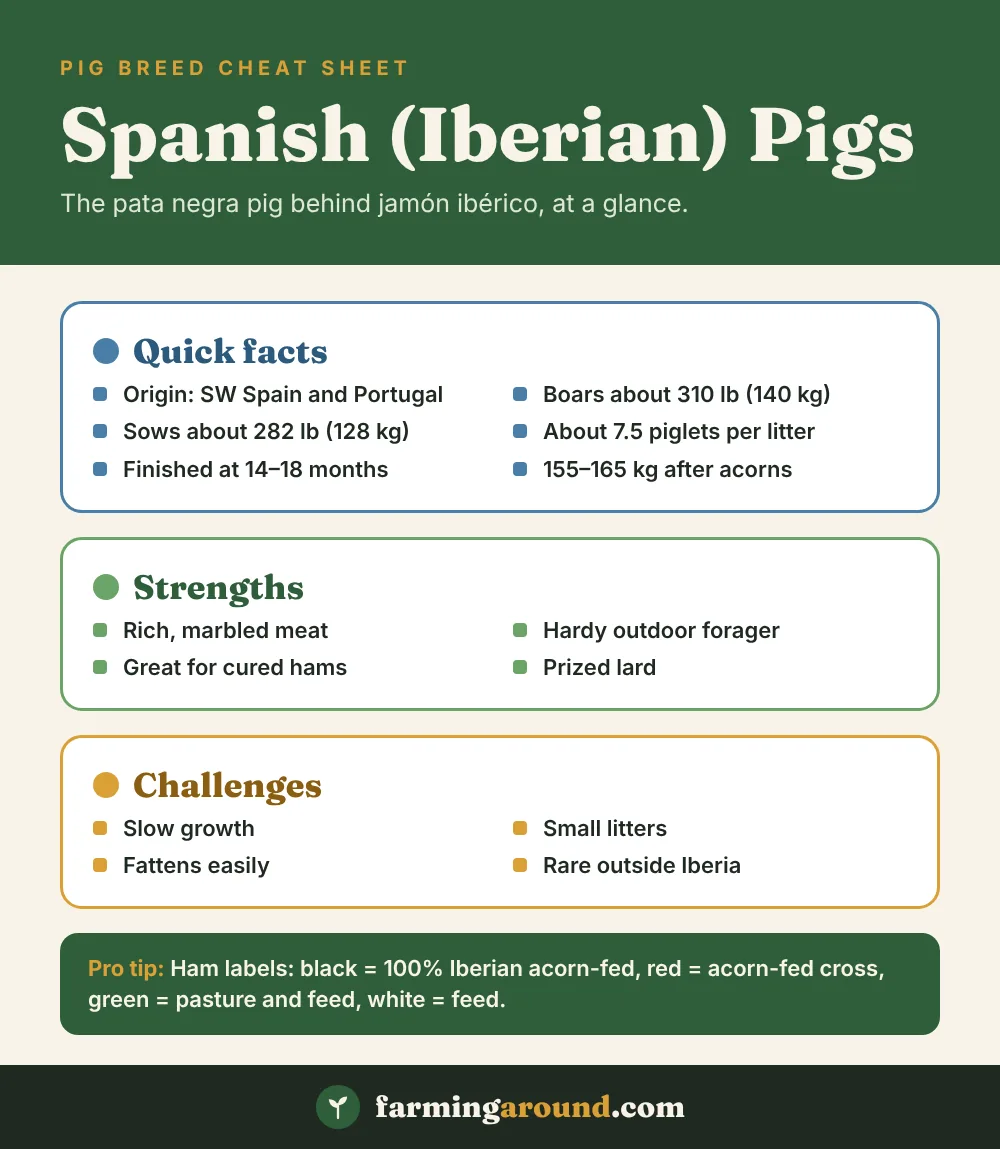
Here are the key Iberian pig facts in one chart:
FAQ
What breed is the Spanish pig?
The best-known Spanish pig is the Iberian pig (Cerdo Ibérico), the native breed of Spain and Portugal. It’s the pig behind jamón ibérico.
Why are Iberian pigs called pata negra?
Pata negra means “black hoof.” Iberian pigs typically have dark hooves, and the name became shorthand for Iberian ham.
How big do Iberian pigs get?
Adult boars average about 310 lb (140 kg) and sows about 282 lb (128 kg). Pigs finished on acorns usually reach about 342–364 lb (155–165 kg) at 14–18 months.
What do Iberian pigs eat?
They’re raised on feed and pasture, and the top-grade pigs are finished on acorns and grass in the dehesa during the montanera season in autumn and winter.
Can you raise Iberian pigs in the U.S. or UK?
It’s possible, but purebred Iberian stock is rare outside Spain and Portugal, and importing live pigs involves strict health rules. Heritage breeds like the Ossabaw Island hog offer a similar outdoor, fat-rich pork.
Are Ossabaw Island hogs Spanish?
They’re traditionally thought to descend from Spanish explorers’ pigs. DNA research points to ancestors from the Canary Islands, which Spanish ships used as a stopping point on the way to the Americas.
Sources
- 3tres3: Breed cards, Ibérico (Iberian) pig
- The Livestock Conservancy: Ossabaw Island hog
- Enrique Tomás: Characteristics and origin of the Iberian pig
Check local rules on buying, moving and slaughtering pigs, and work with a vet or your local extension office on herd health.
This guide contains affiliate links. As an Amazon Associate, FarmingAround earns from qualifying purchases, at no extra cost to you.
Get free farming guides in your inbox
Practical guides, seasonal tips and market updates. No spam, unsubscribe anytime.
Subscribe free

One Comment