


Last updated: September 2026
Choosing the best tractor for a small farm is one of the biggest purchases you’ll make, and one of the easiest to get wrong. Buy too small and you’ll struggle with every job. Buy too big and you’ll pay for horsepower you never use, compact your soil, and find it can’t fit through your gates.
This buying guide explains how to match a tractor to your acreage and your jobs, which features actually matter, the brands worth shortlisting, and how to buy used with confidence.
Key takeaways
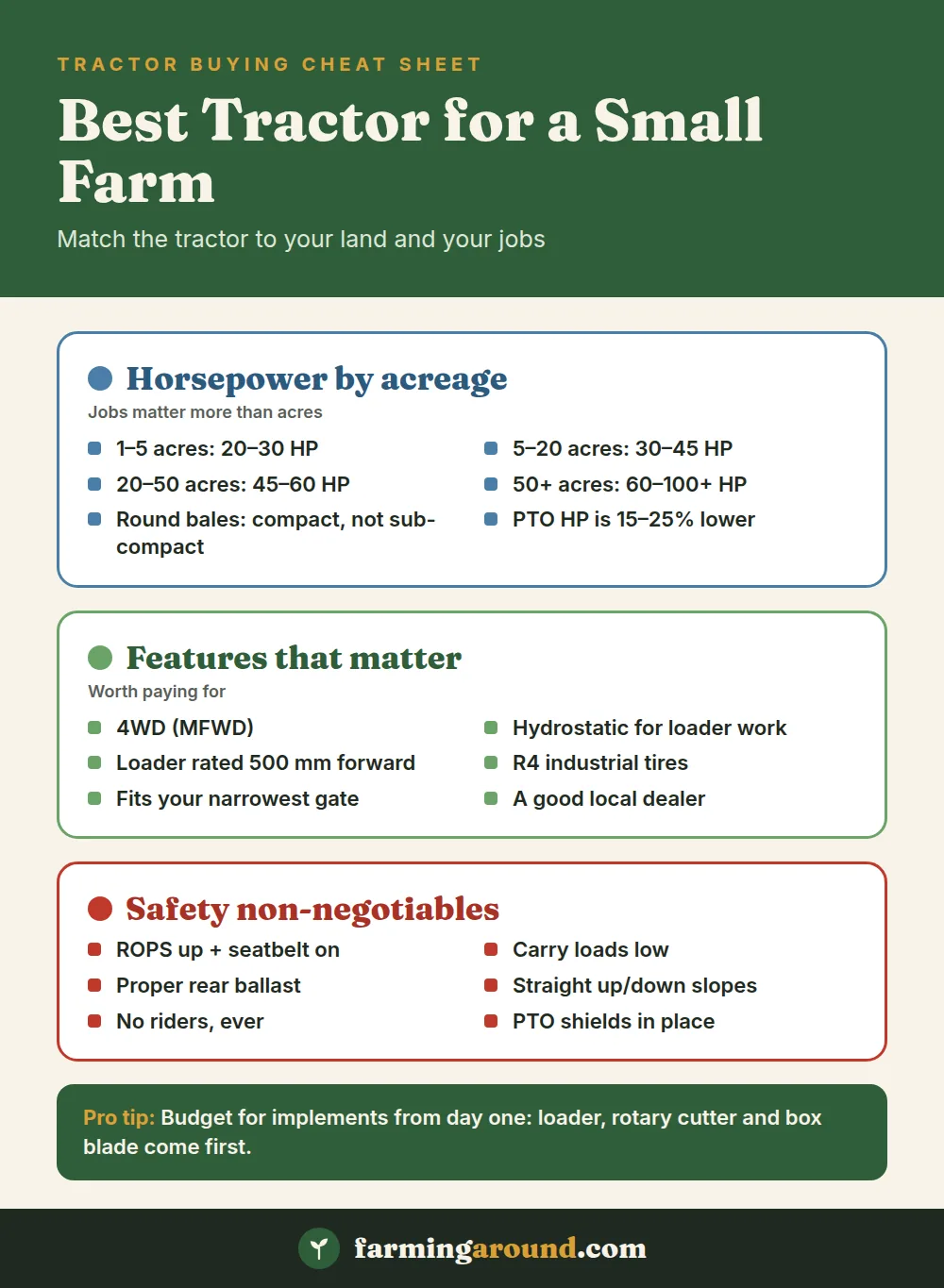
- Most small farms need a sub-compact or compact tractor, roughly 20–60 HP depending on acreage and jobs.
- 4WD, a front loader and hydrostatic drive are the features that matter most for everyday small-farm work.
- Budget for implements: loader, rotary cutter and box blade come first.
- Never compromise on safety: ROPS up, seatbelt on, loads low, no riders.
In this guide
- Step 1: Understand the Tractor Classes
- Step 2: Match Horsepower to Your Acreage and Jobs
- Step 3: Know the Specs That Actually Matter
- Step 4: Plan Your Implements (the Real Cost)
- Brands Worth Shortlisting
- New vs Used: How to Buy a Used Tractor
- Safety: Non-Negotiables
- So What’s the Best Tractor for a Small Farm?
- Quick Reference: Choosing a Small-Farm Tractor
- FAQ: Best Tractor for Small Farm
Step 1: Understand the Tractor Classes
Small-farm tractors fall into three main categories:
| Class | Engine HP (approx.) | Best for | Typical 3-point hitch |
|---|---|---|---|
| Sub-compact (SCUT) | Under 25 HP | 1–5 acres, mowing, light loader work, gardens | Category 1 (limited lift) |
| Compact utility (CUT) | 25–60 HP | 5–50 acres, hay for small herds, brush cutting, heavier loader work | Category 1 / Category 2 |
| Utility | 45–100+ HP | Larger hay operations, big implements, livestock farms | Category 2 |
For most small farms and homesteads, the right answer is a sub-compact or compact utility tractor.

Step 2: Match Horsepower to Your Acreage and Jobs
Acreage is a starting point, but the jobs you’ll do matter more. Here’s a practical guide:
| Land size | Suggested HP | Typical jobs |
|---|---|---|
| 1–5 acres | 20–30 HP | Mowing, moving mulch and compost, garden tilling, snow clearing |
| 5–20 acres | 30–45 HP | Brush hogging pasture, moving round bales, post-hole digging, grading driveways |
| 20–50 acres | 45–60 HP | Small-scale haying, larger rotary cutters, heavy loader work |
| 50+ acres | 60–100+ HP | Full hay operations, large tillage, big livestock operations |
Pro tip: Rule of thumb: if you’ll regularly move round bales (often 800–1,200 lb / 360–550 kg), you need a compact tractor with enough loader capacity and enough weight to lift them safely, not a sub-compact.

Watch: How to Pick the Right Tractor Size
Tractor Mike walks through choosing the right tractor size for your property in this video.
Step 3: Know the Specs That Actually Matter
PTO Horsepower vs Engine Horsepower
Engine HP is what’s advertised. PTO horsepower, the power delivered to implements like mowers and tillers, is lower, often 15–25% less. Implement makers list minimum PTO HP, so check this number when matching equipment.
Transmission: Hydrostatic vs Gear
- Hydrostatic (HST): Pedal-controlled, no clutching, and very easy for loader work, mowing around obstacles, and beginners. Most sub-compact and compact buyers choose this.
- Gear / shuttle shift: More efficient power transfer, good for long steady pulling like tilling big areas or haying. Requires more operator skill.
4WD Is Almost Essential
Four-wheel drive (4WD/MFWD) makes a huge difference with a front loader, on slopes, in mud and in snow. On a small farm, it’s worth the extra cost.
Loader Lift Capacity
Check loader lift capacity at the pivot pin and 500 mm forward. The second number is what you actually get with a load in the bucket or on forks. Also check the tractor’s rear ballast requirements; a box blade or ballast box on the back is needed for safe loader work.
Weight and Size
Heavier tractors pull and lift better but compact soil more and may not fit through gates, barn doors or trailers. Measure your narrowest gate before buying.
Tires
- Ag (R1): Best traction in mud and fields, but tear up lawns
- Industrial (R4): The best all-rounder for mixed farm and loader work
- Turf (R3): Gentle on lawns, poor traction in mud
Step 4: Plan Your Implements (the Real Cost)
A tractor is only as useful as what you attach to it. Budget for implements from the start. They can add a significant amount to your total spend.
| Implement | What it does | Priority |
|---|---|---|
| Front-end loader | Moves soil, compost, mulch, bales, manure | Essential |
| Rotary cutter (brush hog) | Mows pasture, rough grass and brush | Essential for pasture |
| Box blade | Grades driveways, levels ground, acts as ballast | High |
| Pallet forks / bale spear | Moves feed, pallets, round bales | High (livestock farms) |
| Rotary tiller | Prepares garden and crop beds | Medium |
| Post-hole digger | Makes fencing jobs far faster | Medium |
| Grapple | Handles logs, brush, debris | Medium to high |
| Backhoe | Digging trenches, drainage, stumps | Situational |
Brands Worth Shortlisting
Several brands build reliable sub-compact and compact tractors. Rather than chasing one “best” model, compare what’s available through dealers near you:
- John Deere: 1 Series (sub-compact), 2–4 Series (compact). Huge dealer network and strong resale value.
- Kubota: BX (sub-compact), B and L Series (compact). Known for reliability and widely available across the US, UK, Canada and Australia.
- Mahindra: Strong value on heavier compact and utility tractors.
- Kioti: Good feature-for-money value, well-regarded warranties.
- LS Tractor: Competitive pricing with generous standard features.
- New Holland and Massey Ferguson: Full lines from compact to utility, with established farm dealer networks.
The dealer matters as much as the brand. A good local dealer for servicing, parts and warranty work is worth more than a small price saving from a dealer three hours away.
New vs Used: How to Buy a Used Tractor
A well-maintained used tractor can save a lot of money. Check these points before buying:
- Hours: Compact tractor engines often last several thousand hours with good maintenance. Condition and service history matter more than hours alone.
- Cold start: Ask the seller not to warm it up before you arrive. Watch for hard starting and excessive smoke.
- Leaks: Look for oil or hydraulic fluid around the engine, hydraulic lines, loader cylinders and axles.
- Loader test: Raise a loaded bucket and hold it. It shouldn’t drift down noticeably.
- Steering and play: Check front-end play and that 4WD engages properly.
- PTO: Engage it under load if possible.
- Loader frame and welds: Cracks or fresh welds suggest abuse.
- Paperwork: Serial number, service records and proof of ownership.
Safety: Non-Negotiables
Rollovers kill. Tractor rollovers are a leading cause of farm deaths. Penn State Extension notes that a ROPS used with a fastened seatbelt is highly effective at preventing death or serious injury in an overturn.
Always:
- Buy a tractor with a ROPS (rollover protective structure) and wear the seatbelt when the ROPS is up
- Carry loads low, especially on slopes, and add proper rear ballast
- Drive straight up and down steep slopes rather than across them
- Never allow riders
- Keep PTO shields in place and disengage the PTO before dismounting
So What’s the Best Tractor for a Small Farm?
- Homestead of 1–5 acres: A 20–25 HP sub-compact with hydrostatic transmission, 4WD and a loader.
- Small livestock farm of 5–20 acres: A 30–45 HP compact with 4WD, a loader rated for your bales, and a rotary cutter.
- Mixed farm of 20–50 acres: A 45–60 HP compact or light utility tractor that can run haying equipment.
Buy for the jobs you’ll do most often, go slightly bigger than you think you need (most owners wish they had), and prioritize a dependable local dealer.
Still deciding what livestock the tractor will support? Our guides to sheep breeds and types of goats can help you plan pasture and hay needs.
Helpful gear for this guide
Handy picks that match the advice above.
Links go to Amazon. Prices and availability change, so check reviews and fit for your setup before buying.
Quick Reference: Choosing a Small-Farm Tractor
FAQ: Best Tractor for Small Farm
What size tractor do I need for 10 acres?
For 10 acres of pasture or mixed use, a 30–45 HP compact tractor with 4WD and a loader handles mowing, bale moving and general work comfortably.
Is a sub-compact tractor enough for a small farm?
For 1–5 acres with gardening, mowing and light material handling, yes. For round bales, heavy brush cutting or larger acreage, step up to a compact.
Hydrostatic or gear transmission?
Hydrostatic is easier and faster for loader and mowing work, which is most small-farm use. Gear drives suit long, steady field work.
Do I need 4WD on a small farm?
Strongly recommended, especially with a loader, on slopes, or in wet climates.
Planning the rest of your land? Read our guide to homesteading on one acre, or see which livestock can help pay for your equipment in our list of the most profitable farm animals.
Sources
- Finding the Tractor That Fits Your Farm (Cornell Small Farms Program)
- Rollover Protection for Farm Tractor Operators (Penn State Extension)
- Match Implement Size to Tractor (Farm Energy, Cooperative Extension)
More Guides in This Series
- Kubota BX Series
- TYM Tractor Review: Features, Pros & Cons
- New Holland Tractor Review: Features, Pros & Cons
This guide contains affiliate links. As an Amazon Associate, FarmingAround earns from qualifying purchases, at no extra cost to you.
Get free farming guides in your inbox
Practical guides, seasonal tips and market updates. No spam, unsubscribe anytime.
Subscribe free

5 Comments